Flat Bar vs Drop Bar Bike: 5 Differences and Which to Pick
Choose a flat bar if your rides are short, in traffic or on rough paths and you want an upright view and simple controls. Choose a drop bar if rides run long enough that changing hand position matters, or you want a lower position for open roads. The choice also decides your brakes and shifters: Park Tool measures about 6 mm of cable pull from a drop-bar lever against about 15 mm from a flat-bar V-brake lever, so the two are not interchangeable and a later swap costs more than the bar.
Flat bar vs drop bar bike: 5 differences
| Difference | Flat bar | Drop bar |
|---|---|---|
| 1. Hand positions | One main grip position, wide apart | Three common positions: tops, hoods and drops |
| 2. Riding posture | Upright, with a view of traffic | Can be lower, with the torso leaning toward the bar, if the bike is sized for it |
| 3. Steering at low speed | Wide bar gives more leverage for slow turns and tight spots | Narrower bar, so less leverage for slow-speed turns |
| 4. Brake and shift levers | Separate brake lever and shifter, with brake-lever pull set by the brake type | Combined shift/brake levers on the hoods, with a short cable pull |
| 5. Cost to switch later | Changing bars means new levers, shifters, housing and grips or tape | Same list in reverse, plus a check that the stem and fit still work |
Differences 1 to 3 are about how the bike feels. Differences 4 and 5 are about what is fixed once you buy it, which is why the next two sections matter more than the style label.
Which handlebar suits your riding?
Answer five questions about your usual rides. The result is a starting point for a test ride, not a verdict.
Flat bar: where it fits
- City riding and commuting, where you stop often and want to watch traffic. The best bike for commuting to work guide shows what to look for beyond the bar.
- Mixed pavement and rough paths, where the wide bar helps you steer over bumps.
- Riders coming from a mountain bike, since the grip position carries over.
Drop bar: where it fits
- Rides long enough that one hand position gets tiring. Tops, hoods and drops let you move your hands without stopping.
- Open roads and fast group rides, where a lower position is useful.
- Gravel riding. Many gravel bikes come with drops, and gravel bike vs hybrid bike compares a drop-bar gravel bike with a flat-bar hybrid spec by spec.
Either bar only feels right if the bike fits. If your hands, neck or lower back complain, check common bike fit problems before you blame the handlebar, and see how to raise bike handlebars if you want a more upright position without changing bars.
Can you swap a flat bar for a drop bar?
You can, but it is a cockpit rebuild rather than a bar swap. The problem is cable pull. Park Tool gives these figures for how much cable a lever draws through the housing when it moves about 20 degrees:
| Lever type | Cable pull at about 20 degrees | Brake it is built for |
|---|---|---|
| Modern drop-bar shift/brake lever | About 6 mm | Dual-pivot rim calipers |
| Older flat-bar lever | About 7 mm | Cantilever brakes |
| Modern linear-pull (V-brake) lever | About 15 mm | Linear-pull calipers |
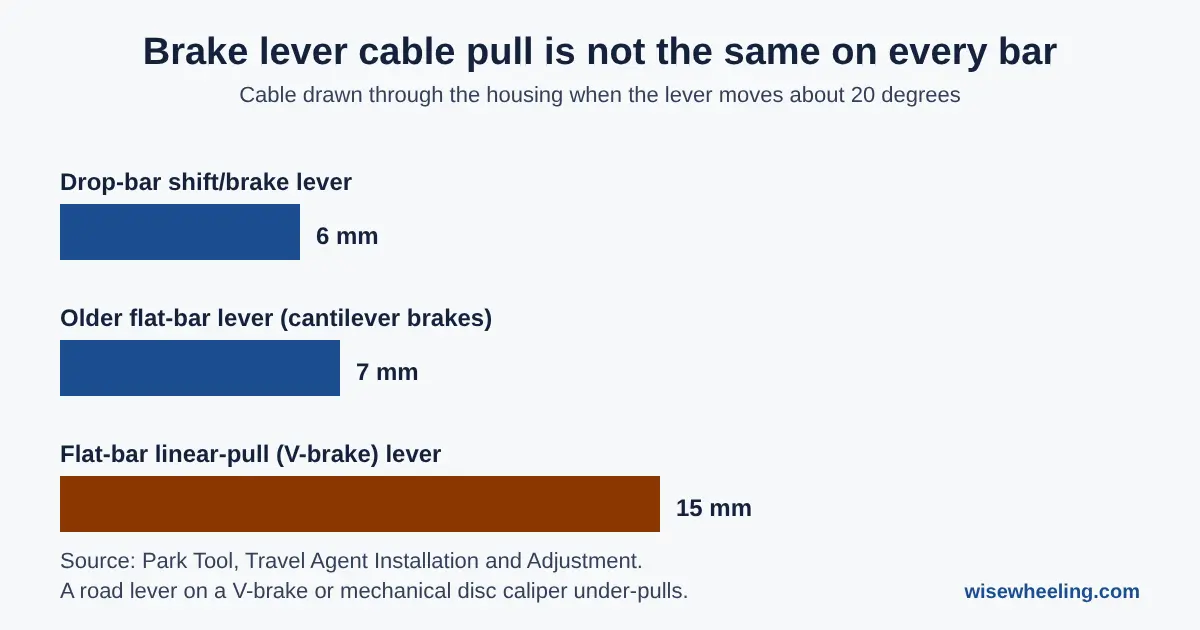
Park says a common road lever should never be paired with linear-pull calipers or mechanical disc brakes, because those brakes need a longer pull than a road lever gives. In practice, a flat-bar bike with V-brakes or mechanical discs cannot simply take drop-bar levers. You would change the brakes as well, or add a cable-pull adapter such as the Travel Agent that Park describes.
Cable routing changes too. Park’s housing guide allows about 90 degrees of handlebar rotation for road bars and up to 180 degrees for mountain-style bars with uninterrupted housing, so housing cut for one bar will be the wrong length for the other. Shifters and derailleurs also have to match each other, so check the maker’s compatibility information for your drivetrain before you buy parts. For most riders it is cheaper to buy the bike that already has the bar they want.
Handlebar width
Width matters on both types, and the two are measured differently. Our guide on how to measure handlebar width shows how to measure what you have and what to check before you order a new bar.

Suryashankar Dasgupta founded Wise Wheeling. He has been cycling for more than 20 years, on geared and single-speed bikes, across many kinds of terrain. His guides cover bike repair, fit and gear, and each one is checked against manufacturer manuals, Park Tool and other primary sources before it’s published. Read how guides are made: https://wisewheeling.com/editorial-policy/