How to Tighten a Loose Rear Hub on a Mountain Bike
This post contains Amazon affiliate links. As an Amazon Associate I earn from qualifying purchases, at no extra cost to you.
To tighten a loose rear hub on a mountain bike, adjust the cone on the left side of the hub and lock it with its locknut. That works only on a cup-and-cone hub. Cartridge-bearing hubs cannot be adjusted, and a wheel that merely sits badly in the dropouts feels the same at the rim. Sort out which one you have first, because the fix is different for each.
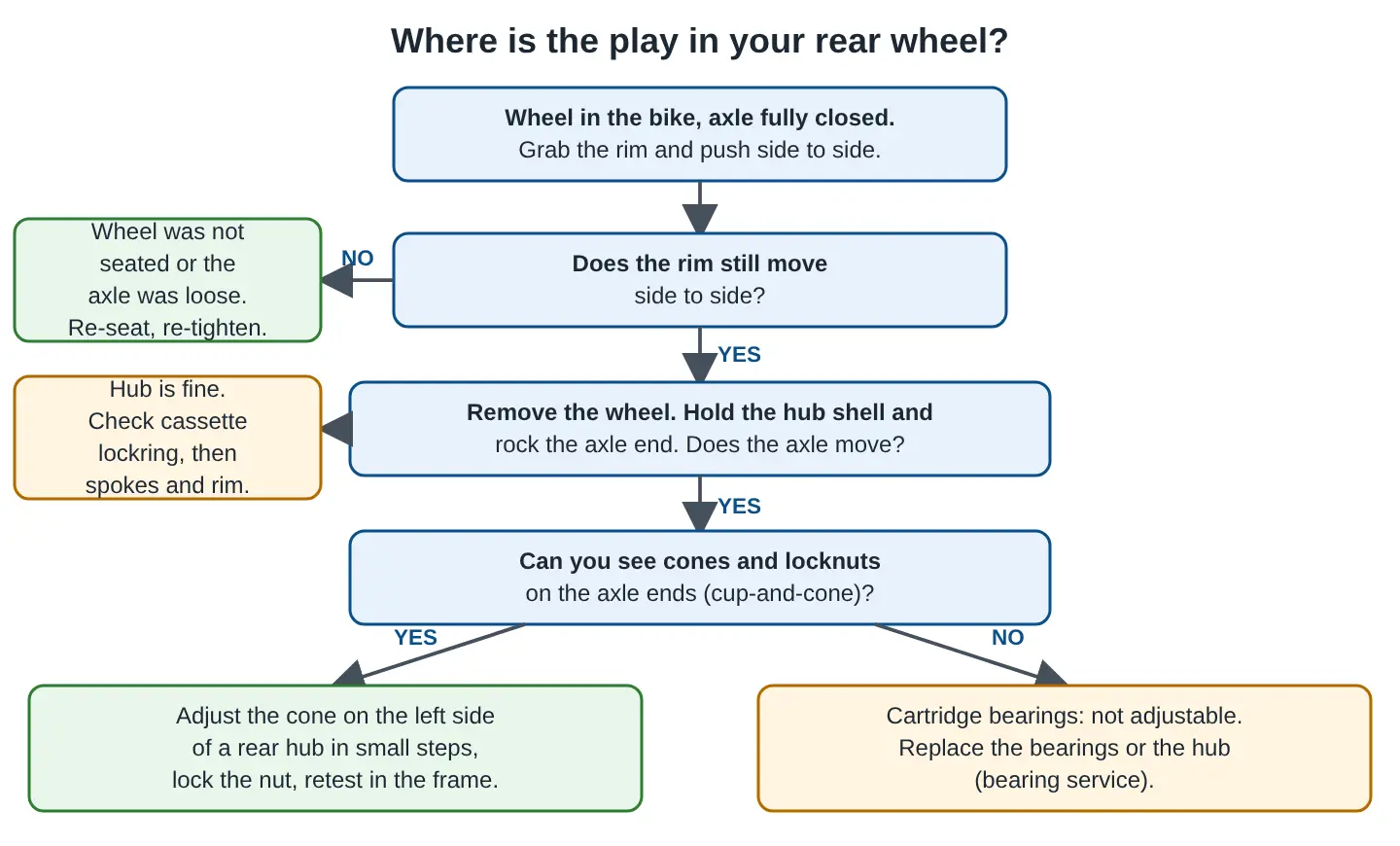
Find out where the play is
- Put the wheel in the bike and close the quick release or thru-axle fully.
- Grab the rim and push it side to side. If it is solid, the play was in how the wheel was seated, not in the hub.
- If the rim still moves, take the wheel out. Hold the hub shell and rock one end of the axle. Play here means the bearings are loose.
- If the axle is solid but the rim still moves, the cassette or the spokes are the problem, not the hub.
| What you find | Likely cause | Fix |
|---|---|---|
| Play goes away when the axle is closed | Wheel not fully seated or axle not tight enough | Park Tool: make sure the hub is fully seated in the dropouts. With a quick release, tighten the adjusting nut until the lever meets resistance at 90° from the frame or fork. Thru-axle: turn clockwise until tight. Park Tool wheel installation |
| Axle rocks inside the hub, cones and locknuts visible | Cup-and-cone bearing adjustment too loose | Adjust the left cone (steps below) |
| Axle rocks inside the hub, no cones or locknuts visible | Cartridge bearings worn | Replace the bearings or hub. Park Tool says cartridge hubs cannot be adjusted. Park Tool hub adjustment |
| Cassette moves on the hub | Loose lockring | Park Tool: tighten a standard lockring to at least 40 N·m or the maker’s value. Park Tool cassette installation. Not sure your cassette fits? See freehub body types. |
| Hub is solid but the rim flexes sideways | Loose or uneven spokes | Not a hub problem; the wheel needs truing |
Thru-axle bike and not sure which axle you have? See what thru axle you need.
How to adjust a cup-and-cone rear hub
You need two cone wrenches (Park Tool says to use the smallest size that fits), a standard wrench for the locknut, and grease if you open the hub. Cone wrench sets are sold in the common sizes. Park Tool’s procedure for a rear wheel:
- Remove the wheel. If a disc rotor blocks the left cone, take it off first.
- On a rear wheel the bearing adjustment is made on the left side only. Hold the adjusting cone with a cone wrench.
- With a second wrench, loosen the locknut.
- Turn the cone clockwise in small steps, about 1/32 of a turn at a time.
- Hold the cone still and tighten the locknut fully against it.
- Check for play. Mount the wheel, close the axle fully, and pull the rim side to side. Spin the wheel and listen for knocking.
How tight is tight enough?
Park Tool’s rule is the loosest setting with no knocking or play. Smoothness is a poor guide, because some drag is normal. Use these checks:
| Result | Meaning |
|---|---|
| Slight play with the wheel out, none once clamped in the bike | Adjustment is adequate |
| Play remains with the axle closed | Too loose. Remove the wheel and tighten the cone a little more |
| No play when you rock the axle with the wheel out of the bike | Too tight, even if it spins smoothly |
The torque for the locknut is not the same on every hub. Park Tool’s instruction is to hold the cone and fully tighten the locknut against it, and the exact figure is in the hub maker’s service manual. A torque wrench is also what you need for the cassette lockring (40 N·m minimum on a standard cassette).
When adjusting does not fix it
- If play only disappears at very tight settings, the bearing surfaces are probably worn, according to Park Tool. Check that the right-hand locknut is seated against its cone and that the cups are not loose in the shell.
- To check for pitting, trace the bearing path with a ballpoint pen. You will feel pits as the pen ball passes over them. Dull balls, rather than bright ones, should be replaced.
- Damaged cups usually cannot be replaced, so the hub would need replacing. Cones are normally available as spares.
- A wheel that slows down too quickly after you adjust it is a different problem; see why a back wheel stops spinning quickly.
- If a disc rotor rubs after you refit the wheel, fix a rubbing disc brake covers the check order.
FAQ
Which side do you adjust on a rear hub?
The left side. Park Tool says rear-wheel bearings are adjusted on the left, and that the right side stays as it is.
Can you tighten a cartridge-bearing hub?
No. Park Tool says cartridge hubs cannot be dismantled or adjusted; when worn, the whole cartridge is replaced.
Why does the wheel still wobble after the hub is adjusted?
Check the cassette lockring and the spokes next. Neither is part of the bearing adjustment.
Sources
- Park Tool: Hub Overhaul and Adjustment, Cup and Cone Style (read 2026-11-06).
- Park Tool: Wheel Removal and Installation (read 2026-11-06).
- Park Tool: Cassette Removal and Installation (read 2026-11-06).

Suryashankar Dasgupta founded Wise Wheeling. He has been cycling for more than 20 years, on geared and single-speed bikes, across many kinds of terrain. His guides cover bike repair, fit and gear, and each one is checked against manufacturer manuals, Park Tool and other primary sources before it’s published. Read how guides are made: https://wisewheeling.com/editorial-policy/