What Thru Axle Do I Need? Why 12×142 Alone Isn’t Enough
This post contains Amazon affiliate links. As an Amazon Associate I earn from qualifying purchases, at no extra cost to you.
You need an axle that matches four things: the diameter, the hub width, the overall length and the thread pitch. The size stamped on most axles, like “12×142,” only covers the first two. SRAM alone makes five different rear axles for 12×142 hubs, from 160 to 174 mm long with three different thread pitches, and only one of them fits your frame. Measure the old axle (or look up your frame’s spec), then match all four numbers before you order.
Why “12×142” isn’t enough to order a thru axle
In “12×142,” the 12 is the axle diameter in millimeters and the 142 is the hub’s width between the frame’s dropouts. Neither number tells you how long the axle is or how it threads into the frame. Length and thread are set by the frame maker, not by the hub standard. The table below lists every rear axle in SRAM’s own spare parts catalog for 12×142 and 12×148 (Boost) hubs.
| Hub | Axle length | Thread pitch | Thread length | SRAM’s fit note | Length minus hub width |
|---|---|---|---|---|---|
| 12×142 | 160 mm | M12 x 1.5 | 20 mm | Road frames | 18 mm |
| 12×142 | 164 mm | M12 x 1.5 | 10 mm | Standard frames | 22 mm |
| 12×142 | 167 mm | M12 x 1.0 | 20 mm | Santa Cruz, Scott frames | 25 mm |
| 12×142 | 170.5 mm | M12 x 1.5 | 14 mm | Giant frames | 28.5 mm |
| 12×142 | 174 mm | M12 x 1.75 | 20 mm | Standard frames | 32 mm |
| 12×148 | 170 mm | M12 x 1.5 | 10 mm | Boost frames with Shimano E-Thru interface | 22 mm |
| 12×148 | 180 mm | M12 x 1.75 | 20 mm | Boost frames | 32 mm |
| 12×148 | 188 mm | M12 x 1.75 | 20 mm | Boost split-pivot frames | 40 mm |
| 12×148 | 195 mm | M12 x 1.75 | 20 mm | Boost Trek ABP frames | 47 mm |
Three things jump out. Two axles of nearly the same length can have different pitches (167 mm at 1.0 vs 170.5 mm at 1.5). Two axles with the same pitch can have very different thread lengths (164 mm with 10 mm of thread vs 160 mm with 20 mm). And the gap between hub width and axle length runs anywhere from 18 to 47 mm, so you can’t work out the length from the hub size.
How to measure your old thru axle
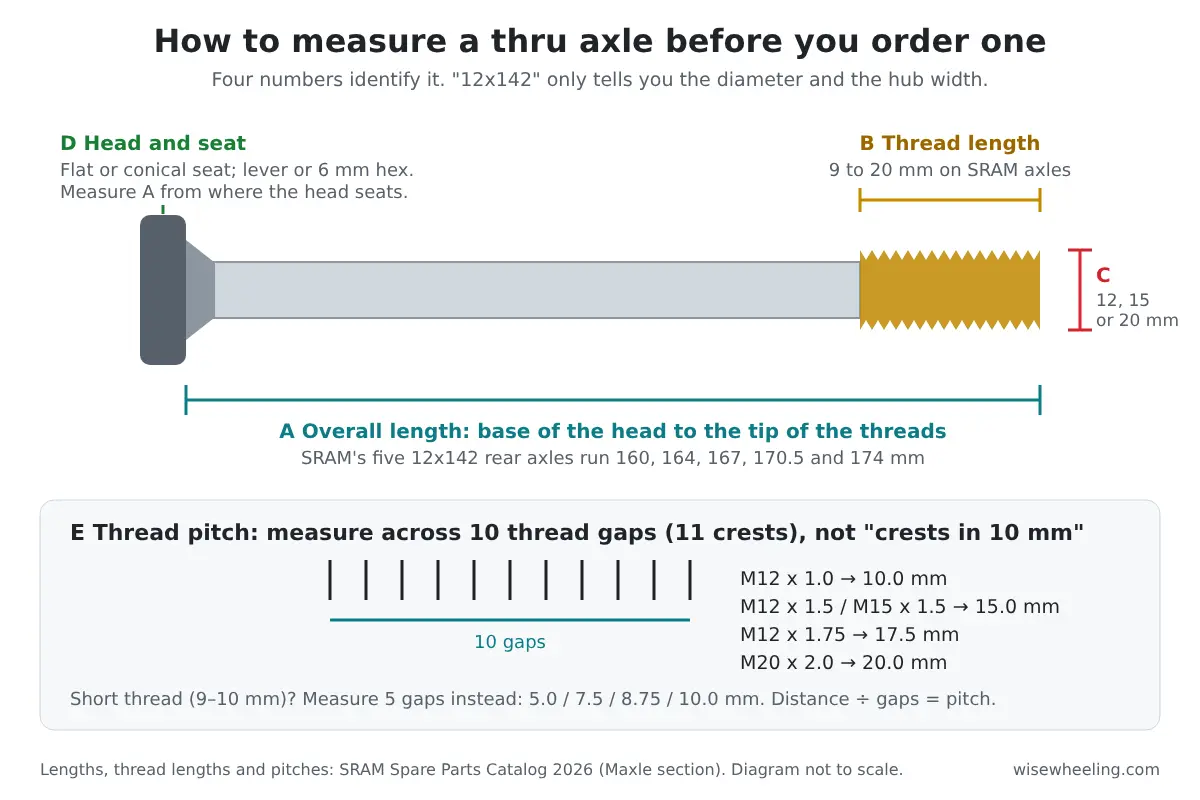
First check the axle itself. Many are laser-marked with something like “12×142 L170.5 P1.5” or “M12x1.5.” If yours is, you have most of what you need. If not, grab a digital caliper and a metric thread pitch gauge (check the current price on Amazon; both are cheap and useful for years).
- Diameter. Measure across the threads. Rear axles on modern road, gravel and mountain bikes are almost all 12 mm. Fronts are 12 mm (road and gravel), 15 mm (most mountain and some road forks) or 20 mm (downhill forks). A 12 mm thread measures a hair under 12 mm, so don’t let 11.9 throw you.
- Overall length. Measure from the base of the head, where it seats against the frame, to the very tip of the threads. Burley’s printable fit guide uses the same reference points. Don’t include a lever or a removable washer.
- Thread length. Measure only the threaded section. SRAM’s axles range from 9 to 20 mm here, and it’s part of the spec, so match it.
- Thread pitch. The distance from one thread crest to the next. Use a gauge if you have one, or the counting method in the next section.
- Head type. Note whether the head has a flat face or a conical seat, and whether it uses a lever or a 6 mm hex. TiParts’ measuring guide stresses that the head shape has to fit your frame.
Wheels Manufacturing’s printable guide says axle length is compatible within plus or minus 2 mm. Use that as a small tolerance, not a reason to buy the “close enough” axle with a different pitch.
How to find thread pitch without a gauge
The common tip is “count the thread peaks in 10 mm and divide 10 by that number.” It works for 1.0 mm threads but is shaky for telling 1.5 from 1.75. Over 10 mm, a 1.5 pitch gives 6.7 gaps and a 1.75 pitch gives 5.7, and when you’re counting peaks it’s easy to be off by one. That one-peak mistake turns 1.5 into 1.67 or 1.43, which leaves you guessing.
Here’s a better way. Pick a crest, count 10 gaps along (11 crests including the first one), and measure that distance with the caliper. Then divide by 10:
- About 10.0 mm = 1.0 pitch
- About 15.0 mm = 1.5 pitch (the 15 mm front axles in SRAM’s catalog are all M15 x 1.5)
- About 17.5 mm = 1.75 pitch
- About 20.0 mm = 2.0 pitch (SRAM’s 20×110 DH axle is M20 x 2.0)
If the threaded section is only 9 or 10 mm long, count 5 gaps instead: 5.0, 7.5, 8.75 or 10.0 mm. The spec finder below does the math and also checks your length against SRAM’s catalog.
Thru axle spec finder
How it works: pitch = distance ÷ number of gaps, rounded to the nearest common bike pitch (1.0, 1.5, 1.75 or 2.0 mm). Matches come from the SRAM 2026 Spare Parts Catalog Maxle list, using the plus-or-minus 2 mm length tolerance from Wheels Manufacturing’s axle guide.
Can you tell the thread pitch from the bike brand?
Not reliably. Some guides list one pitch per brand, but the brands’ own parts pages don’t line up with that. One popular guide gives Canyon as 1.75, yet Canyon sells a 12×142 axle with a 1.5 pitch. Trek appears in SRAM’s catalog with an M12 x 1.75 axle for Boost ABP frames. The same guide notes that older Giant Defy frames used 1.0 and newer ones use 1.5. Here’s what the makers’ own listings show:
| Brand | Hub | Pitch shown | Where it’s listed |
|---|---|---|---|
| Giant | 12×142 | M12 x 1.5, 14 mm thread | Giant Lightweight 12×142 axle; SRAM’s 170.5 mm “Giant frames” axle matches |
| Canyon | 12×142 | 1.5 | Canyon GP7412-01 |
| Specialized | 12×142 (MTB) | M12 x 1.0, 175 mm | Specialized part 177568 |
| Santa Cruz, Scott | 12×142 | M12 x 1.0, 167 mm | SRAM 2026 Spare Parts Catalog |
| Trek (Boost ABP) | 12×148 | M12 x 1.75, 195 mm | SRAM 2026 Spare Parts Catalog |
| Shimano E-Thru frames | 12×148 | M12 x 1.5, 170 mm | SRAM 2026 Spare Parts Catalog |
What if you lost the axle and can’t measure it?
Work from the frame, not the hub.
- Check your bike maker’s spare-parts page or owner’s manual for your model and year. Many list the axle by part number.
- Ask a bike shop to check the frame’s thread. With a thread gauge or a set of known axles, it’s a quick job.
- Get the hub width from the hub (end cap to end cap). It’ll be 100, 110, 142, 148 or another standard listed above. That gives you the second number of the spec.
- Use an axle maker’s fit lookup. Axle makers such as Robert Axle Project publish fit lookups by bike brand. Order by full spec, not by “fits most bikes.”
If you have your frame’s spec, the SRAM Maxle Stealth rear thru axle comes in the lengths and pitches in the table above. Check that the listing names your exact length and pitch before you buy.
Front axles: 12, 15 and 20 mm

Fronts are a little simpler because the fork maker sets the spec, and RockShox is consistent about it. Every 15 mm front axle in SRAM’s catalog uses an M15 x 1.5 thread. Lengths still depend on the fork:
| Front hub | Typical use | SRAM axle lengths | Thread |
|---|---|---|---|
| 12×100 | Road and gravel disc forks | 118.5 mm or 125 mm | M12 x 1.5 |
| 15×100 | Road (125 mm) and non-Boost MTB forks (146.5 to 148 mm) | 125, 146.5, 148 mm | M15 x 1.5 |
| 15×110 (Boost) | Boost MTB forks (Pike, Lyrik, SID, Reba and others) | 156.5 or 158 mm | M15 x 1.5 |
| 15×150 | Bluto fat-bike fork | 198 mm | M15 x 1.5 |
| 20×110 | Downhill forks (35 mm chassis) | 165 mm | M20 x 2.0 |
Notice the 15×100 road axle is 125 mm but the 15×100 MTB axle is 148 mm, on the same hub width. That’s the clearest proof that length belongs to the fork, not the hub.
Trailer hitches, trainers and other special axles
Trailer hitch axles are longer than stock because the hitch mounts on the end. Burley’s thru axle fit guide sorts its hitch axles by thread pitch and your measured axle length. They offer M12 x 1.0, 1.5 and 1.75 versions in set length ranges, and if your length isn’t listed for your pitch, they don’t have one that fits. Measure exactly as above before ordering any accessory axle.
If you’re replacing an axle because the wheel won’t sit straight or the rotor rubs after reinstalling it, read why a disc brake rubs only when riding first. A dirty dropout or an axle that isn’t fully tightened causes the same symptom.
Installing the new axle
- Clean the threads in the frame and the dropout faces. Grit here causes creaks, as covered in bike creaks when pedaling hard but not on the stand.
- Put a light film of grease on the axle threads and shaft unless the axle or frame maker says otherwise.
- Seat the wheel fully in the dropouts and slide the axle through without forcing it.
- Thread it in by hand. It should spin in freely for several turns. If it binds early, stop. A wrong pitch can damage the frame’s threads.
- Tighten to the torque printed on the axle or given in your frame or fork manual. Use a small bike torque wrench with a hex bit for hex-head axles; don’t guess with a long Allen key.
- Spin the wheel and check the brake rotor and tire for rub before you ride.
Changing hub standards at the same time? Thru-axle hubs also differ in freehub and rotor mount. See freehub body types and Center Lock vs 6-bolt rotors before buying a wheel.
When to let a shop handle it
Take it in if the axle won’t thread in by hand, if the frame’s threads look damaged or cross-threaded, if a carbon dropout is cracked, or if the axle is stuck and the hex is rounding out. Thread repair and stuck-axle removal are easy to make worse at home.
Thru axle FAQ
Are all 12×142 thru axles the same?
No. SRAM’s 2026 catalog alone lists five 12×142 rear axles: 160, 164, 167, 170.5 and 174 mm long, with M12 x 1.0, 1.5 or 1.75 threads and 10 to 20 mm of thread.
Can I use a thru axle that’s a little longer?
Only if the pitch matches and the extra length is small. Wheels Manufacturing treats plus or minus 2 mm as compatible. Too short is the bigger risk because fewer threads engage the frame.
How do I tell M12 x 1.5 from M12 x 1.75?
Measure across 10 thread gaps: 15.0 mm means 1.5 and 17.5 mm means 1.75. Counting peaks in 10 mm is less reliable because the two pitches differ by only one peak over that distance.
What thread does a Shimano E-Thru axle use?
M12 x 1.5. SRAM’s catalog lists its 170 mm 12×148 axle for “Boost E-Thru interface frames” with an M12 x 1.5 thread.
Sources
- SRAM Spare Parts Catalog 2026, Rev A (Maxle section, pages 85–86)
- SRAM Maxle Stealth Rear (AX-STE-MXLR-A1) service page
- Burley Thru Axle Fit Guide
- Wheels Manufacturing thru axle guide (via Elanus Parts)
- TiParts thru axle measuring guide
- Brand parts pages: Giant, Canyon, Specialized

Suryashankar Dasgupta founded Wise Wheeling. He has been cycling for more than 20 years, on geared and single-speed bikes, across many kinds of terrain. His guides cover bike repair, fit and gear, and each one is checked against manufacturer manuals, Park Tool and other primary sources before it’s published. Read how guides are made: https://wisewheeling.com/editorial-policy/