Best Bike Saddle for Comfort: Width Calculator and Fit Checks
The most comfortable bike saddle is the one whose width matches your sit bones and whose shape matches how you sit on the bike, not the one with the thickest padding. Measure your sit-bone width, add the allowance for your riding position, and shop for saddles in that width range. The calculator below does the arithmetic.
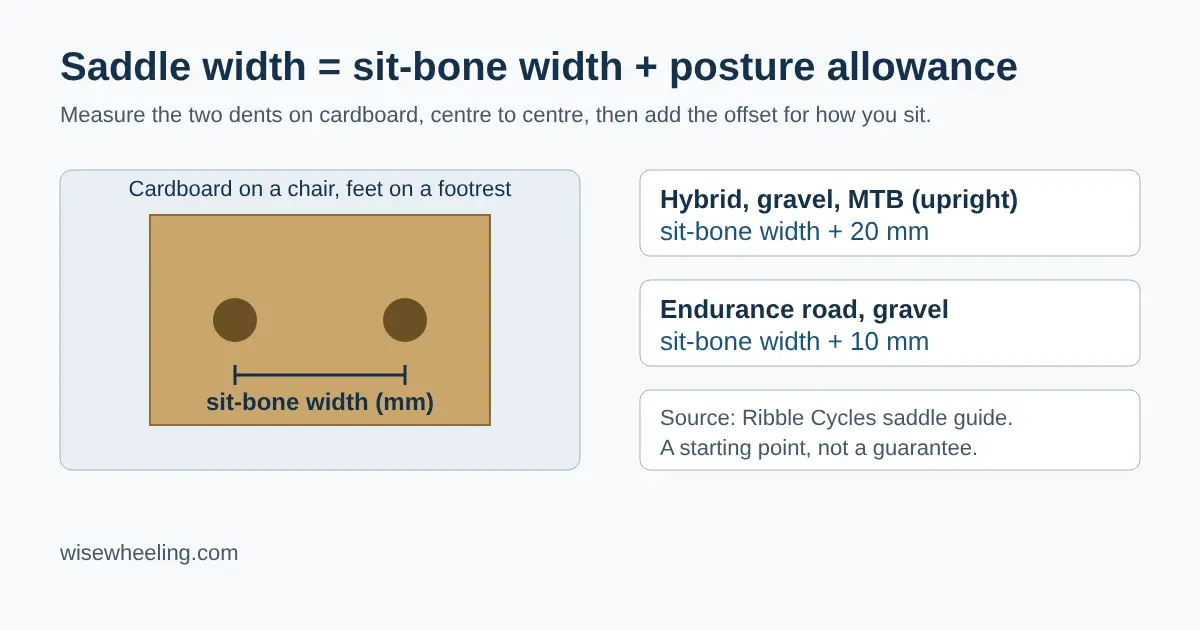
Saddle width calculator
Ribble Cycles’ saddle guide gives the rule: measure the distance between the centers of the two sit-bone dents, then add 20 mm for hybrid, gravel or mountain bike riding in an upright position, or 10 mm for endurance road or gravel riding. Treat the result as a starting point and compare it with the width printed in each saddle’s specs.
How to measure your sit bones at home
- Put a piece of corrugated cardboard on a hard chair or step.
- Sit on it with your feet on a footrest so your knees and hips are roughly where they are on the bike.
- Stand up and look for two indentations.
- Measure from the center of one dent to the center of the other. That is your sit-bone width.
This is the method Ribble describes. Specialized and Bontrager sell pressure-pad tools that do the same job in a shop, and each brand publishes its own width chart, so the number you get may map to a different size from brand to brand.
Which problem points to which fix
Soreness is not always the saddle's fault. This table is a diagnostic guide built from how saddle and position interact, so use it to decide what to change first. Change one thing at a time and ride long enough to feel the difference.
| What you feel | Likely cause | Try first |
|---|---|---|
| Pressure or numbness in the center, edges seem to disappear | Saddle too narrow, or a position that loads soft tissue | Re-measure and go wider; try a saddle with a cutout or relief channel |
| Inner-thigh rubbing or chafing | Saddle too wide or too long at the back | Try a narrower model; check shorts and seat height |
| Sliding forward, constant shifting | Nose tilted down, or saddle too far forward | Check tilt and fore-aft position |
| Pressure on the hands and wrists | Saddle tilted nose-down, or reach too long | Level the saddle, then check reach (see common bike fit problems) |
| Hip rocking, soreness at the back of the knee | Saddle too high | Lower it a few millimeters at a time (see seat height for knee pain) |
Saddle type by bike
| Bike and posture | Width allowance | What to look for |
|---|---|---|
| Hybrid or commuter, upright | Sit-bone width + 20 mm | Moderate padding, short nose, stable rear (see hybrid bikes and commuter bikes) |
| Mountain bike, upright | Sit-bone width + 20 mm | Cover that does not snag shorts, shape that lets you move on descents |
| Endurance road or gravel | Sit-bone width + 10 mm | Firmer shell with a cutout or channel, since you stay seated for hours |
More padding is not automatically more comfort. A saddle that is the wrong width stays uncomfortable however much foam sits on top of it, which is why width comes before padding in the steps above.
Adjust before you buy
Park Tool's saddle and seatpost guide covers the mechanics. Loosen the clamp, slide the saddle fore or aft within the max-adjustment lines marked on the rails, and change the angle the same way. Before tightening, look down the length of the bike to be sure the saddle is straight. Do not raise the seatpost past its minimum insertion mark, and tighten the collar bolt to the manufacturer's specified torque, which is often printed on the collar or on the maker's website.
If the saddle keeps slipping or tilting after you tighten it, see how to fix a loose bike seat.
When to replace the saddle
Replace it when position is dialed in and the same pain returns on every ride, when the shell is cracked, a rail is bent, or the cover has worn through. Buy from a shop or brand with a return or trial policy if you can, since the only real test is a long ride on your own bike.
Numbness that does not go away after a ride, or pain that gets worse, is a reason to stop riding that setup and talk to a doctor.

Suryashankar Dasgupta founded Wise Wheeling. He has been cycling for more than 20 years, on geared and single-speed bikes, across many kinds of terrain. His guides cover bike repair, fit and gear, and each one is checked against manufacturer manuals, Park Tool and other primary sources before it’s published. Read how guides are made: https://wisewheeling.com/editorial-policy/