BMX Bike Weight Limit: What to Check for a Heavy Rider
There is no single weight limit for BMX bikes. Each maker sets one per model, it lives in the owner’s manual or spec sheet, and many makers count rider, luggage and bike together rather than rider alone. If you are a bigger rider, find that number for the exact bike first, then check the parts that decide how well a complete bike holds up: frame steel, rims, cranks, hubs and stem.
Check your total load against the maker’s limit
Enter the limit printed in the manual or on the spec sheet, say whether it counts the rider only or everything together, and add your numbers. The tool does not know any bike’s rating; it only does the arithmetic.
How makers state the limit
Read the wording carefully. The Kent BMX and freestyle manual, for example, gives maximums as "rider+luggage+bike" for each bike class: 320 lb (145 kg) for mountain and trekking/comfort/cruiser bikes, 298 lb (135 kg) for racing bikes and 231 lb (105 kg) for children's bikes (Kent manual). Those are one brand's figures, not a BMX standard, and the same manual says not to use that bike for freestyle and stunt riding, jumping or competitive events. A bike rated for casual riding is not rated for park or street abuse.
Retail listings for the same model often disagree with each other, so a store page is not a rating. When a number is missing or conflicting, ask the maker or the shop in writing and keep the answer.
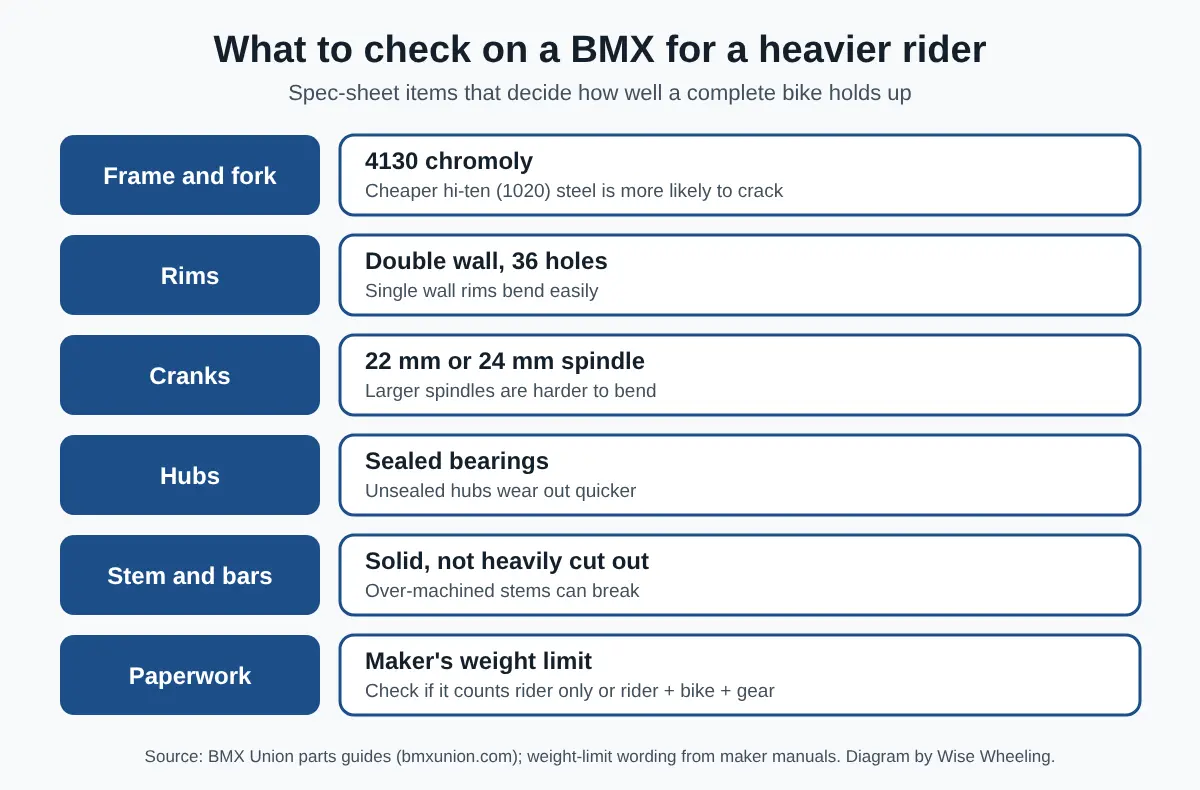
Parts that decide how a BMX holds up
| Part | What to look for | Why |
|---|---|---|
| Frame and fork | 4130 chromoly, ideally full chromoly | BMX Union compares a hi-ten (1020) frame, fork and bars with chromoly and says the 1020 parts are more likely to crack and break |
| Rims | Double wall, 36 holes | Single wall rims are typical on entry-level complete bikes and tend to bend easily; most 20-inch BMX rims are 36-hole double wall |
| Cranks | 22 mm or 24 mm spindle | Larger spindles add strength; 24 mm is aimed at heavy street riding with big drops and grinds |
| Hubs | Sealed bearings | Unsealed bearings wear out quicker |
| Stem | Solid, not heavily cut out | A weak stem can break under the load a BMX stem takes |
| Chain | Thicker side plates, heat-treated pins | Cheaper chains break more often |
Sources: BMX Union's frame and parts guide, crank size guide and complete-bike comparison. That last article ties breakage to riding style and skill rather than rider size, so treat the table as a durability checklist, not a weight rating.
Pick the right frame size
Bigger riders usually need a longer bike, and that is a separate question from strength. BMX Union's rough guide for 20-inch bikes by top tube length: riders in the low 5-foot range use 20 to 20.5 in, mid to upper 5-foot riders about 20.75 in, and riders from the upper 5-foot range to 6 ft and taller use 21 in or more (BMX Union). The same article notes that 24-inch and 26-inch cruiser BMX options exist. Compare top tube length and wheel size on the spec sheet instead of relying on a label like "adult."
Keep it solid after you buy
- Check tire size and pressure against the sidewall; the bike tire size chart explains the markings.
- Tighten stem bolts to the maker's number; the stem bolt torque guide lists typical ranges.
- Pick pedals on purpose; clipless vs flat pedals covers the trade-offs.
- If a wheel goes out of true or a spoke breaks, the replacement spoke needs the right length; see how to measure spoke length.
FAQ
How much weight can a BMX bike hold?
It depends on the model. Makers publish different limits, some for rider only and some for rider, gear and bike combined. Use the number in your bike's manual, and ask the maker if it is missing.
Is chromoly worth it for a bigger rider?
BMX Union describes 4130 chromoly as stronger and lighter than hi-ten steel, and says the hi-ten parts on its example budget bike are more likely to crack. It is not a guarantee of a particular weight rating, so still check the maker's limit.
Suryashankar Dasgupta founded Wise Wheeling. He has been cycling for more than 20 years, on geared and single-speed bikes, across many kinds of terrain. His guides cover bike repair, fit and gear, and each one is checked against manufacturer manuals, Park Tool and other primary sources before it’s published. Read how guides are made: https://wisewheeling.com/editorial-policy/