Best Commuter Bike Helmets: Lab-Rated Picks and Fit Check
The best commuter bike helmet is one that scores well in independent crash testing, fits your head without pressure points, and is comfortable enough that you wear it on every ride. In Virginia Tech’s 2026 ratings, five urban helmets earned the top 5 stars, and the cheapest of them lists at $120. A rating only helps if the helmet sits level and the straps are adjusted, so the fit check below is part of the buying decision.
Urban helmets rated 4 or 5 stars
Virginia Tech’s helmet lab, working with the Insurance Institute for Highway Safety, has rated 313 bike helmets with its STAR system. Each helmet takes 24 impact tests, at six locations and at medium and high impact energies, and the lab recommends choosing a helmet rated 4 or 5 stars. The score is the number under the stars; lower is better. This table lists every helmet in the lab’s Urban category that earned 4 or 5 stars. Prices are the list prices Virginia Tech recorded, checked October 27, 2026.
| VT rank (of 313) | Helmet | Stars | Score (lower is better) | Price recorded by VT |
|---|---|---|---|---|
| 3 | HEXR Miden RLS | ★★★★★ (5) | 6.93 | $150 |
| 24 | Specialized Mode | ★★★★★ (5) | 8.80 | $120 |
| 27 | Unit 1 Aura | ★★★★★ (5) | 9.01 | $250 |
| 28 | Giant/Liv Novo MIPS | ★★★★★ (5) | 9.02 | $150 |
| 40 | Unit 1 Neon | ★★★★★ (5) | 9.53 | $200 |
| 86 | Lazer Anverz NTA MIPS | ★★★★☆ (4) | 10.99 | $200 |
| 92 | ABUS Pedelec 2.0 MIPS | ★★★★☆ (4) | 11.14 | $200 |
| 109 | Bern Major MIPS | ★★★★☆ (4) | 11.52 | $130 |
| 125 | Sweet Protection Promuter MIPS | ★★★★☆ (4) | 11.96 | $200 |
| 126 | Airnoggin Head Trauma Protection System | ★★★★☆ (4) | 12.05 | $99 |
| 137 | Lazer Cruizer MIPS | ★★★★☆ (4) | 12.32 | $125 |
| 146 | Trek Charge WaveCel | ★★★★☆ (4) | 12.56 | $175 |
| 147 | Bern Union MIPS | ★★★★☆ (4) | 12.58 | $110 |
| 159 | Thousand Chapter MIPS | ★★★★☆ (4) | 12.91 | $135 |
Virginia Tech lists e-bike helmets in a separate E-bike (NTA) tab, so if you ride a fast e-bike, check that list as well. Ratings can change when the lab adds helmets, so open the lab’s page before you buy.
What the full urban list shows about price and MIPS
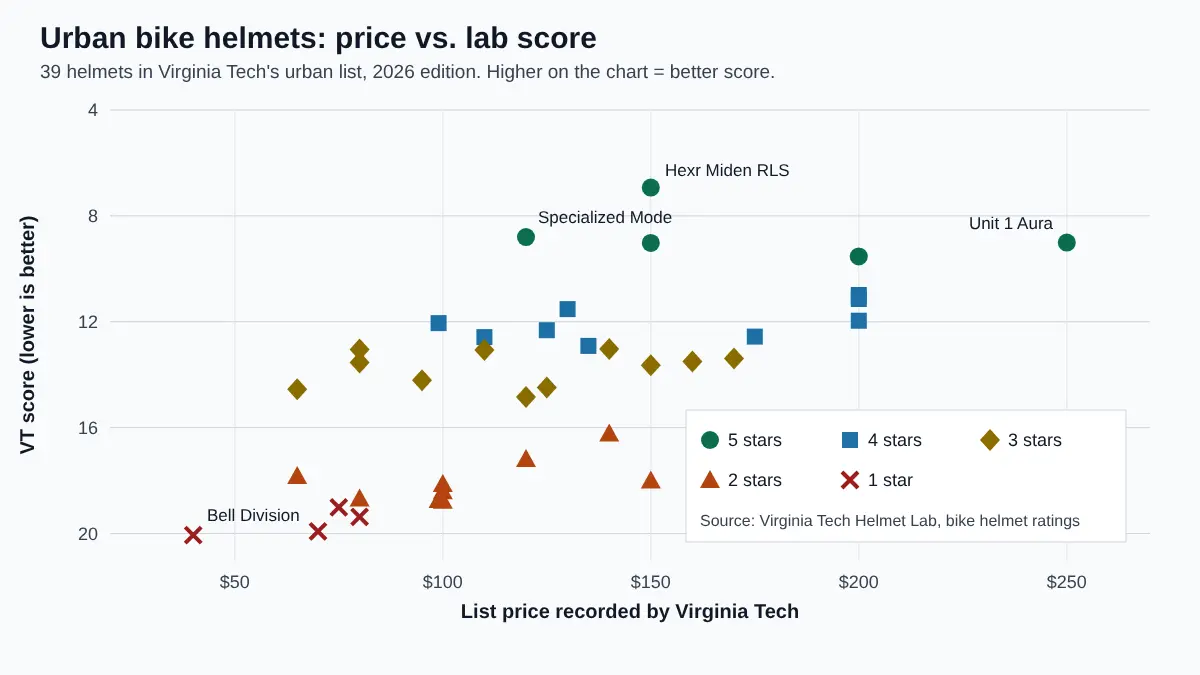
Tallying the lab’s 39 urban helmets gives two patterns. All five 5-star helmets list at $120 or more, and of the 15 helmets listed at $100 or less, only one (the $99 Airnoggin) reached 4 stars. But a higher price is no guarantee: the $200 Lazer Anverz NTA MIPS got 4 stars, and the $160 Lazer Urbanize NTA MIPS got 3. Also, “MIPS” in a model name says little about the result. Sixteen of the 39 have MIPS in the name, and their ratings run from 5 stars (Giant/Liv Novo MIPS) down to 1 star (Triple 8 Dual Certified MIPS). Use the finder to see every helmet that fits your budget.
Urban helmet finder
Source: Virginia Tech Helmet Lab, urban category, 2026 edition. Stars shown as the lab reports them; the list changes as new helmets are tested.
What the federal standard does and does not tell you
Any helmet marketed for bicycle riding in the U.S. has to meet the CPSC’s bicycle helmet standard, 16 CFR part 1203. It is a pass/fail minimum: no sample may exceed 300 g of peak acceleration in the impact tests, the helmet must leave at least 105° of side vision, and the straps must not stretch more than 1.2 inches (30 mm). A compliance label inside the helmet also carries the month and year it was made. Because the standard only sets a minimum, it can’t tell you which compliant helmet protects better, and that is the gap the star ratings fill.
How to fit a commuter helmet
A helmet that is too loose or sits too far back protects less than the rating suggests. The Bicycle Helmet Safety Institute’s fitting guide boils it down to an eyes, ears, mouth check:
- Level and low. Adjust the pads or the ring so the helmet sits level, with the front just above your eyebrows (or just above your glasses frame). Use the thinnest pads, or remove the top pad, to sit lower.
- Ears. Adjust the rear straps, then the front straps, so the Y where the side straps meet sits just below each ear.
- Eyes. Look up. You should barely see the front rim of the helmet.
- Mouth. Snug the chin strap, then open your mouth wide. You should feel the helmet pull down on your head.
- Shake test. Shake your head hard. Push the front edge up and back: if it moves more than about an inch, tighten the front strap. Pull up on the back edge: if it moves more than an inch, tighten the rear strap. If it bumps your glasses, tighten the nape strap.
Fit self-check
Tick each check your helmet passes, then press the button. Anything unticked comes back with the fix from the guide above.
When to replace a commuter helmet
Replace the helmet after any crash in which your head hit something, and replace it if the foam is cracked. The CPSC requires a label warning that impact damage may not be visible, so a helmet that looks fine after a hard hit still shouldn’t be reused. On age, the Bicycle Helmet Safety Institute’s replacement page says most manufacturers now recommend replacing a helmet after five years, while noting a 2015 study of 675 used helmets, some up to 26 years old, found no significant change in impact performance with age. The practical rule is to follow the interval in your helmet’s manual and check the manufacture date on the compliance label.
Choosing among helmets with similar ratings
Once a helmet has 4 or 5 stars and fits, the remaining differences are about daily use, and none of them are part of the lab score. Check whether the pads come out for washing, whether the arms of your glasses sit comfortably under the straps, whether the buckle pinches, and whether it fits a thin cap if you ride in cold weather. If you are still choosing a bike, see how to choose a commuter bike; for the rest of the kit and the riding itself, the guides to commuter bike locks and city riding safety cover it, and the helmet rules in pro racing explain why racers wear them.
If you ride off-road as well, see why mountain bike helmets have visors before you pick a trail helmet.

Suryashankar Dasgupta founded Wise Wheeling. He has been cycling for more than 20 years, on geared and single-speed bikes, across many kinds of terrain. His guides cover bike repair, fit and gear, and each one is checked against manufacturer manuals, Park Tool and other primary sources before it’s published. Read how guides are made: https://wisewheeling.com/editorial-policy/