Bike Tire Size Chart: Why a “26-Inch” Tire Might Not Fit
This post contains Amazon affiliate links. As an Amazon Associate I earn from qualifying purchases, at no extra cost to you.
A bike tire fits a rim only when the two share the same bead seat diameter (BSD): the three-digit number in the ISO marking on the sidewall, like the 622 in 37-622. The inch label doesn’t tell you that. “26-inch” covers at least five different rims (559, 571, 584, 590 and 597 mm), and a 27-inch tire won’t go on a 700c wheel even though the two are only 8 mm apart. Type whatever is printed on your tire into the decoder below to get its BSD, the lookalike sizes it won’t swap with, and a quick rim-width check.
Tire size decoder: type what’s on your sidewall
How it works: markings are matched to bead seat diameters from Sheldon Brown’s tire sizing tables and Park Tool’s fit standards chart. Decimal inch widths are converted at 25.4 mm per inch (actual inflated width varies with the rim). The rim check uses Park Tool’s loose rule of a tire 1.5 to 2 times the rim’s inner width. The rim-measuring estimate subtracts about 10 mm from the outside diameter, per Sheldon Brown’s rim measuring guide, so treat it as a shortlist, not a final answer.
How to read the three size systems on a tire
Most tires carry two or three size markings at once. Only one of them is a real measurement you can match to a rim.
If a new set of tires feels sluggish even though the size code matches, see why new bike tires can make a bike feel slower.
| System | Example on the sidewall | What the numbers mean | Safe to buy by it? |
|---|---|---|---|
| ISO / ETRTO | 37-622, 54-559 | First number: inflated width in mm. Second number: bead seat diameter in mm. | Yes. Match the second number. |
| French | 700 x 28C, 650B | Rough old outside diameter plus a letter code. The “C” is part of the code, not a size. | Yes for 700C and 650B. 650A, 650C, 700A and 700B are each different rims. |
| Inch, decimal | 29 x 2.4, 26 x 1.95 | Approximate outside diameter x width in inches. | Mostly. Rare exceptions: OS 20-inch BMX and very old 26 x 1.25/1.375. |
| Inch, fraction | 26 x 1 3/8, 27 x 1 1/4 | Old outside-diameter code. Different system from decimal sizes. | No. Several rims share the same label. |
Park Tool puts it bluntly: the inch number “has no actual inch measurement associated with it” and is “simply a code of the vaguely approximate outside tire diameter.” Its rule of thumb is the one that saves the most wasted orders: tires marked with fractions don’t interchange with tires marked in decimals, so a 26 x 1-1/2 is not a 26 x 1.5 (Park Tool). Rims are labeled the same way, just reversed in emphasis: on a rim marked 622×19 or 19-622, the bigger number is the BSD and the smaller one is the inner width between the rim walls.
Which “same size” tires actually don’t swap?
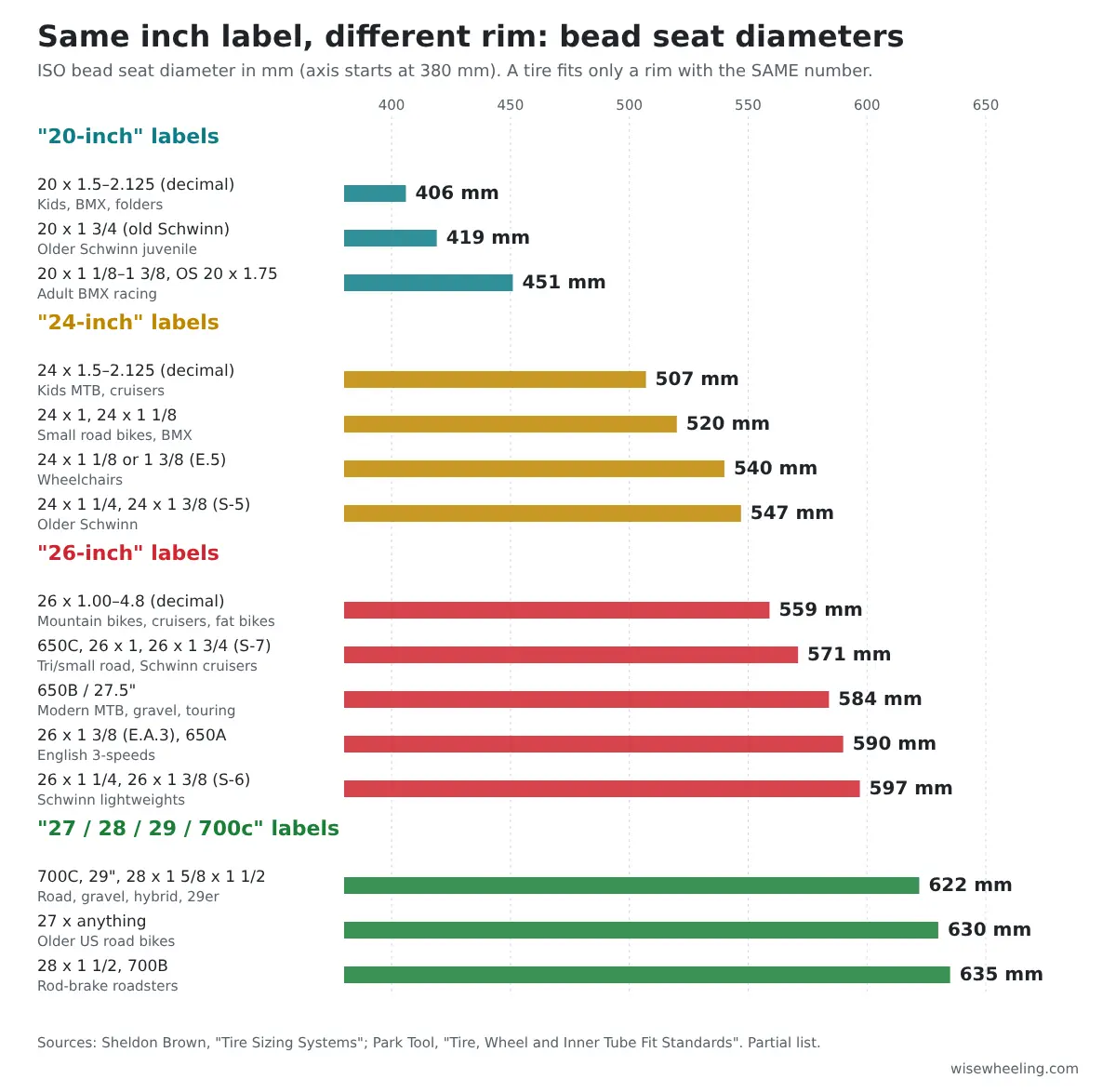
These are the size families that cause most wrong orders in the US: kids’ 20- and 24-inch bikes, garage-find Schwinns and English 3-speeds, and old 27-inch road bikes. Every row in a group gets called by the same inch name, and none of them swap.
| Label you might see | ISO BSD | Typical bikes | Gets confused with |
|---|---|---|---|
| 20 x 1.5 to 2.125 (decimal) | 406 mm | Kids’ bikes, most BMX, folders | 451 (fractional 20-inch, OS BMX race) |
| 20 x 1 3/4 (fraction) | 419 mm | Older Schwinn juvenile | 406 |
| 20 x 1 1/8, 1 1/4, 1 3/8; OS 20 x 1.6 to 1.85 | 451 mm | Adult BMX racing | 406 |
| 24 x 1.5 to 2.125 (decimal) | 507 mm | Kids’ mountain bikes, cruisers | 520, 540, 547 |
| 24 x 1, 24 x 1 1/8 | 520 mm | Small road bikes, BMX | 507, 540 |
| 24 x 1 1/8 or 1 3/8 (E.5), 600A | 540 mm | Most wheelchairs | 520, 547 |
| 24 x 1 1/4, 24 x 1 3/8 (S-5) | 547 mm | Older Schwinn | 540 |
| 26 x 1.00 to 4.8 (decimal) | 559 mm | Mountain bikes, cruisers, fat bikes | 571 (26 x 1 3/4 fraction) |
| 650C, 26 x 1, 26 x 1 3/4 (S-7) | 571 mm | Small tri/road bikes, Schwinn middleweight cruisers | 559, 584 |
| 650B, 27.5″, 26 x 1 1/2* | 584 mm | Modern trail bikes, gravel, touring | 559 (26-inch MTB) |
| 26 x 1 3/8 (E.A.3), 650A | 590 mm | English 3-speeds, department-store 10-speeds | 597 |
| 26 x 1 1/4, 26 x 1 3/8 (S-6) | 597 mm | Schwinn “lightweights” | 590 |
| 700C, 29″, 28 x 1 5/8 x 1 1/2 | 622 mm | Road, gravel, hybrid, 29er MTB | 630 (27-inch) |
| 27 x anything (27 x 1 1/4, 27 x 1 3/8) | 630 mm | US road bikes through the early 1980s | 622 (700C) |
| 28 x 1 1/2, 700B | 635 mm | Rod-brake roadsters | 622 |
26 x 1.75 vs 26 x 1 3/4: the classic trap
Mathematically they’re the same number. On a bike they’re 12 mm apart. 26 x 1.75 is a decimal mountain-bike size on a 559 mm rim; 26 x 1 3/4 is an old Schwinn cruiser size on a 571 mm rim (Sheldon Brown and Michelin both list it at 571). A 559 tire is too small to go onto a 571 rim, and a 571 tire is too big to stay seated on a 559 rim. If your cruiser is a vintage Schwinn, check the ISO number before you trust the label.
26 x 1 3/8: two different rims

Most English 3-speeds and department-store 10-speeds use 26 x 1 3/8 on a 590 mm rim (also called E.A.3 or 650A). Schwinn’s lightweights used a 26 x 1 3/8 on a 597 mm rim, marked S-6. Same label, 7 mm difference, no swap (Sheldon Brown). If your tire or rim carries Schwinn’s S-6 designation, you want 597.
Is 27-inch the same as 700c?
No. 27-inch is 630 mm and 700C is 622 mm, so the tires don’t interchange even though they look almost identical. 27-inch was the standard on mass-market US road bikes until it went out of fashion in the early 1980s (Sheldon Brown), and 27 x 1 1/4 tires are still made. The one thing the two sizes can share is the inner tube: Park Tool notes a tube for a 630 tire also fits a 622 tire.
Is 29er the same as 700c?
Yes, both are 622 mm. “29 inch” is a marketing name for wide 622 tires (Sheldon Brown). So a 700 x 40C gravel tire and a 29 x 2.4 trail tire fit the same rim diameter. Whether they fit your bike depends on rim width and frame/fork clearance, not diameter. See putting road tires on a mountain bike for the width side of that swap.
Where the size charts disagree: 26 x 1 1/2
Here’s one most charts won’t tell you. Sheldon Brown lists 26 x 1 1/2 as 584 mm (650B). Park Tool’s chart lists “26 x 1 1/2” as 571. Michelin’s chart has both: a 26 x 1 1/2 CS at 40-571, and 26 x 1 1/2 x 1 3/8 and 26 x 1 1/2 x 2 at 584 (Michelin). So if a tire or rim just says 26 x 1 1/2, don’t guess. Read the ISO number, or compare against the old tire. The decoder flags this one as ambiguous on purpose.
No readable size? How to measure the rim
Sidewalls wear and old rims lose their stickers. You can still narrow it down with a tape measure, following Sheldon Brown’s rim measuring method:
- Remove the tire so you’re measuring the bare rim.
- Lay a tape measure across the rim and slide one end until you get the largest reading between two opposite points. Repeat at a couple of angles and average.
- Subtract about 10 mm. The rim’s outside diameter is generally about 10 mm larger than the BSD, depending on how tall the rim walls are.
- Match the result to the closest standard size (the decoder’s second box does this). If two sizes sit within a few millimeters (584/590/597 or 622/630/635), a tape measure can’t settle it. Compare against the old tire or ask a shop.
- On a built wheel, the hub gets in the way. Sheldon Brown’s alternative is to wrap a narrow metal tape (about 1/4 in wide) around the rim well, divide by pi, then add twice the height from the well up to the bead seats. Don’t use a cloth sewing tape; it stretches.
Measuring the inner rim width for the rim-width check is easier with a digital caliper than a ruler: measure between the rim walls, not across the outside.
Which inner tube fits your tire?
Tubes are more forgiving than tires because they stretch, but Park Tool gives two limits (source):
- Diameter: match the BSD. Very close sizes can share a tube, like 630 and 622.
- Width: pick a tube whose printed width range includes your tire. A tube that’s too narrow gets thin when inflated and punctures more easily. One that’s too wide is hard to fit inside the tire, and part of it can stick out and blow out when you inflate it.
- Valve: match the rim hole (Presta or Schrader) and pick a stem long enough for deep rims; Park Tool notes tall rims need 60 or 80 mm valves. Not sure which valve you have? See what a Presta valve is and how it fits.
If a new tube left a bulge or wobble in the tire, the size may be fine and the bead just isn’t seated; here’s how to fix a tire bump after changing a tube.
Will a wider (or narrower) tire fit my rim?
Diameter decides whether a tire fits at all. Rim width decides whether it fits well. Park Tool’s loose rule is a tire width 1.5 to 2 times the rim’s inner width, and gives the example of a 25 mm rim taking roughly 37 to 50 mm tires (Park Tool; Sheldon Brown uses 1.45 to 2.0). Here’s that rule worked out for common inner widths:
| Rim inner width | Tire width by Park Tool rule (1.5–2x) | Same in inches |
|---|---|---|
| 17 mm | 25.5–34 mm | 1.00–1.34 in |
| 19 mm | 28.5–38 mm | 1.12–1.50 in |
| 21 mm | 31.5–42 mm | 1.24–1.65 in |
| 23 mm | 34.5–46 mm | 1.36–1.81 in |
| 25 mm | 37.5–50 mm | 1.48–1.97 in |
| 30 mm | 45–60 mm | 1.77–2.36 in |
| 35 mm | 52.5–70 mm | 2.07–2.76 in |
| 40 mm | 60–80 mm | 2.36–3.15 in |
What most guides skip: modern road tires routinely run narrower than this rule. Michelin says that since 2021 a 28 mm tire is designed to measure 28 mm on a 19 mm rim (before that, a 17 mm rim), just under 1.5x. On a pre-2021 narrow rim, a new tire may measure narrower than the label (Michelin). So treat the rule as a sanity check and the tire maker’s rim chart as the final word. For choosing the width itself, see how to choose the right bike tire width. And remember frame and fork clearance: a tire that suits the rim can still rub the chainstays.
What to write down before you order a tire or tube
- The ISO number from the tire (e.g. 40-622). If you only find an inch size, run it through the decoder and check for an “ambiguous” warning.
- The rim’s inner width (often printed as 622×21 or 21-622) and whether it’s tubeless-ready, if you plan to run tubeless.
- Your frame and fork clearance if you’re going wider than stock.
- For tubes: the valve type and the stem length your rim needs.
- A set of plastic tire levers such as the Park Tool TL-1.2 (check the current price on Amazon) makes the swap easier.
If your old bike turns out to use a rare size like 597, 590 or 630, tires still exist, but local shops may need to order them. For how 26-inch mountain bike wheels fit in today, see whether 26-inch mountain bikes are obsolete.
FAQ
Can I put 27.5 tires on 26-inch rims?
No. 27.5 is 584 mm and a modern 26-inch mountain bike rim is 559 mm. The bead won’t reach the rim’s bead seat. You’d need new wheels, and the bike needs the clearance for them.
What does the “C” in 700c mean?
Nothing you can measure. It’s a letter in the old French system, which once coded tire width. Park Tool calls it “simply part of the code system.” 700A, 700B and 700C are three different rims, and 650B and 650C don’t interchange either.
Can I use a 700c tube in a 27-inch tire?
Generally yes, if the width range fits. Park Tool notes a tube for 630 (27-inch) also fits 622 (700c), because tubes stretch and the sizes are only 8 mm apart. The tires and rims themselves don’t swap.
Can I put a wider tire on the same rim?
Usually, if the diameter (BSD) matches, the width stays roughly within 1.5 to 2 times the rim’s inner width, and the frame has clearance. Check the tire maker’s approved rim width list for the final call.
Where is the ISO size on a tire?
On the sidewall, usually in smaller type near the inch or French size: two numbers joined by a dash, like 47-559 or 32-630. The larger number is the bead seat diameter.

Suryashankar Dasgupta founded Wise Wheeling. He has been cycling for more than 20 years, on geared and single-speed bikes, across many kinds of terrain. His guides cover bike repair, fit and gear, and each one is checked against manufacturer manuals, Park Tool and other primary sources before it’s published. Read how guides are made: https://wisewheeling.com/editorial-policy/