How to Raise Bike Handlebars: Spacers, Stem Flip, Quill
This post contains Amazon affiliate links. As an Amazon Associate I earn from qualifying purchases, at no extra cost to you.
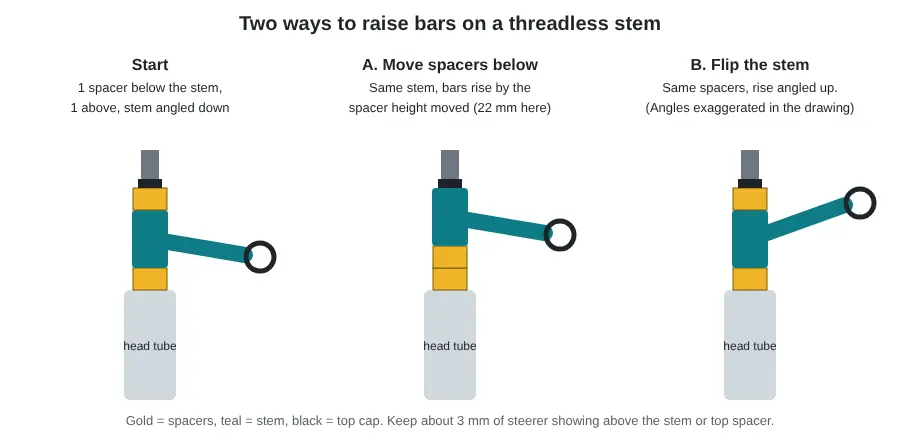
On most modern bikes you raise the handlebars by moving spacers from above the stem to below it, or by flipping the stem so its rise angles upward. Both need only hex keys and a little time. If you have an older bike with a quill stem, you loosen one bolt and slide the stem up to its marked limit. If none of that gives enough height, you need a stem or bar with more rise.
Which method raises the bars, and by how much
| Method | Typical gain | Works on | Watch out for |
|---|---|---|---|
| Move spacers from above the stem to below | Equal to the spacer height moved (spacers come in several thicknesses) | Threadless stems | Only possible if you have spacers above the stem to move; the steerer must still stick out about 3 mm above the stem |
| Flip the stem | Roughly 2 × stem length × sin(rise angle), see calculator below | Threadless stems with a rise angle | Does nothing on a flat 0° stem; the stem face and logos end up upside down |
| Raise a quill stem | Up to the max-height mark on the stem | Threaded steerers with quill stems | Never pull the stem past the limit or minimum-insertion mark |
| Swap to a higher-rise stem | Depends on the stem; the rise angle and length decide it | Any stem type, if the clamp sizes match | Steerer and bar diameters must match exactly |
| Riser handlebar | Depends on the bar; rise is the rise measured at the grips | Mostly flat-bar bikes | Bar clamp diameter, brake and shifter positions |
Moving spacers also shortens or lengthens reach a little, because the stem sits on a slightly sloped steerer. Flipping a stem changes reach as well.
Handlebar height change calculator
Flipping a stem tilts it by twice its rise angle, so the gain depends on length and angle. This is plain trigonometry, not a manufacturer spec, so use it as an estimate and measure the real bar height with a ruler before and after.
How to raise handlebars on a threadless stem
Most bikes made in recent decades use a threadless stem that clamps around the outside of the steerer tube. A top cap and bolt on top set the headset bearing preload, per Park Tool. Raising the bars here means rearranging spacers or flipping the stem, and it also disturbs the headset adjustment, so plan to reset it.
Tools
- Hex keys in the sizes your stem and top cap bolts need (commonly 4, 5 or 6 mm; check yours)
- A torque wrench with a hex bit is strongly recommended, especially for carbon bars or steerers
- Carbon assembly paste if any part is carbon (Park Tool recommends assembly compound where a carbon bar meets the stem)
- A ruler or tape to record bar height before you start
Steps
- Measure and note the current bar height from the floor or from the top tube so you can compare.
- Support the front end. Park Tool suggests securing the fork with a strap or zip tie if the bike is in a repair stand, because the top cap is the only thing holding the fork in the frame.
- Remove the top cap bolt and cap. Loosen the stem pinch bolts on the side of the stem. Slide the stem off, keeping the spacers in order. Take a photo of the cable routing before you free the handlebar if the cables are short.
- Move spacers from above the stem to below it, keeping the total spacer stack the same so the stem still sits just above the steerer top. To flip instead, remove the faceplate, rotate the stem, and reinstall it with the rise pointing up.
- Confirm the steerer tube ends about 3 mm below the top of the stem or top spacer. If it is flush or above, you cannot preload the headset (Park Tool).
- Reinstall the top cap and snug the bolt. Center the bars, set the lever and bar angle, then tighten the faceplate bolts evenly in an X pattern. Park Tool gives a typical faceplate and pinch bolt torque of 4–6 Nm, but use the figure printed on your stem when there is one (our stem bolt torque chart explains how to find it).
- Set the headset preload: snug the top cap until there is slight resistance, then hold the front brake and rock the bike. If you feel play, loosen the pinch bolts, turn the top cap about 1/8 turn, retighten and recheck. When the play is gone and the bars still turn freely, torque the pinch bolts.
- Check that the bars and levers did not shift, then take a short test ride in a quiet area and recheck the bolts.
If the front end knocks or clunks afterward, see why a front end knocks under braking. If the bars slip in the stem, see why handlebars slip in the stem.
Spacer limits and carbon steerers
- Do not stack too many spacers above the stem. Park Tool notes that manufacturers generally recommend no more than 20 mm of additional stack height between the stem and the upper headset race, and that too many spacers can stress a carbon steerer and lead to failure (Park Tool, steering column length). Check your fork maker’s limit.
- Carbon steerer: the steerer must go all the way through the stem. Park Tool says this is critical, which means a spacer goes on top of the stem when the steerer is short of the stem top.
- If the steerer was cut short, you may have nothing left to move. The fork cannot be un-cut. In that case a stem with more rise, or a riser bar, is the fix.
- Clamp sizes must match. Park Tool warns that wrong clamp diameters can be a safety hazard, so measure the steerer and bar at the clamp point and match the stem.
How to raise a quill stem
Older bikes and some budget bikes have a threaded steerer and a quill stem that slides inside the steerer and is held by a wedge. Park Tool’s quill stem guide is the reference here.
- Loosen the stem binder bolt on top of the stem a few turns (do not remove it).
- If the stem will not move, tap the bolt head gently with a mallet to release the wedge. Park Tool says to strike the bolt with a mallet and punch if the stem stays stuck.
- Pull the stem up to the desired height. Do not exceed the maximum height or minimum insertion mark, which is usually printed on the quill. That mark must stay inside the steerer tube.
- Straighten the bars with the front wheel, tighten the binder bolt to the manufacturer’s specification, and check that the bars do not twist under load.
If you need more height than the limit mark allows, look at a taller quill stem or an adapter designed for your steerer size. Shop by your bike’s steerer diameter, not by brand: quill stem adapters and riser stems.
How to adjust the handlebar angle
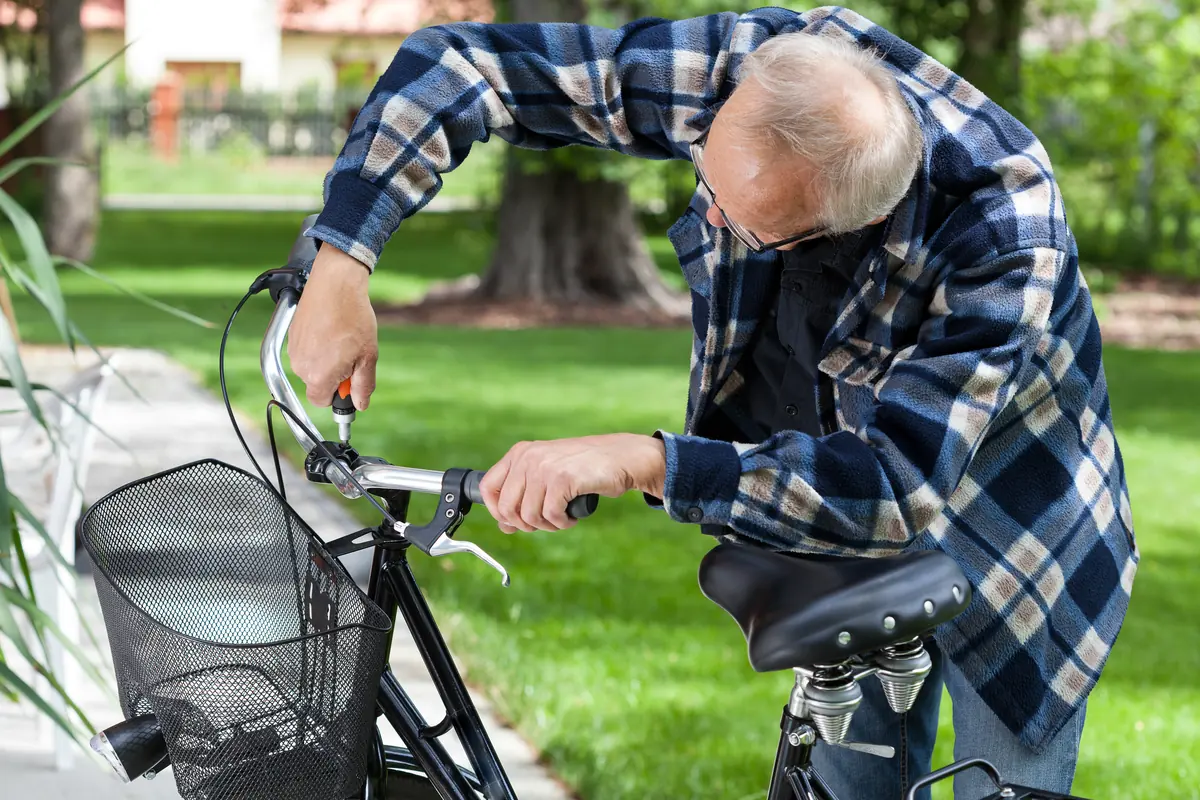
Angle is separate from height. Loosen the faceplate bolts a little, rotate the bar until the levers sit where your wrists stay straight, then tighten the bolts evenly in an X pattern. Park Tool also notes the gap between the stem and faceplate should be even top and bottom. Your wrists should feel straight and relaxed, not bent back.
When the bars still are not high enough
- A higher-rise stem. Keep the clamp diameter and length the same so reach does not change much: stems with more rise.
- A riser handlebar on flat-bar bikes: riser bars. Match the bar clamp diameter to the stem.
- A different bike size or setup. If the bars have to go up more than a few centimeters, the frame may be too small. Use our bike frame size calculator and read common bike fit problems.
If your comfort problem is the type of bar rather than its height, compare flat bar and drop bar setups.
Common questions
Do I need a torque wrench? It is the safest way to avoid over- or under-tightening, especially with carbon parts. If you do not have one, use a short hex key without a cheater bar, tighten evenly and check often.
Will raising the bars help back or neck pain? Raising the bars gives a more upright position, which some riders find easier on the back and hands, but pain has many causes. See a professional bike fitter, or a doctor for lasting pain.
Do I have to adjust the headset afterward? Yes. Any time the stem comes off, recheck bearing preload as in step 7 above.
Is flipping the stem always an option? No. Only stems with a rise angle change the bar height when flipped, and some stems have a face designed for one direction. A 0° stem does not change anything.

Suryashankar Dasgupta founded Wise Wheeling. He has been cycling for more than 20 years, on geared and single-speed bikes, across many kinds of terrain. His guides cover bike repair, fit and gear, and each one is checked against manufacturer manuals, Park Tool and other primary sources before it’s published. Read how guides are made: https://wisewheeling.com/editorial-policy/