Best Bike for Commuting to Work: Types, Features, Checks
For most commutes, the best bike is a hybrid or city bike with fenders, a rear rack, disc brakes and wide tires. Giant sells its Escape City Disc 2 with a fender, rack and kickstand included, and Trek’s Verve and FX frames have mounts for all three, so you can buy a bike that is ready for work or add parts later. If your route is long, hilly or you need to arrive without sweating, an e-bike is the other serious option.
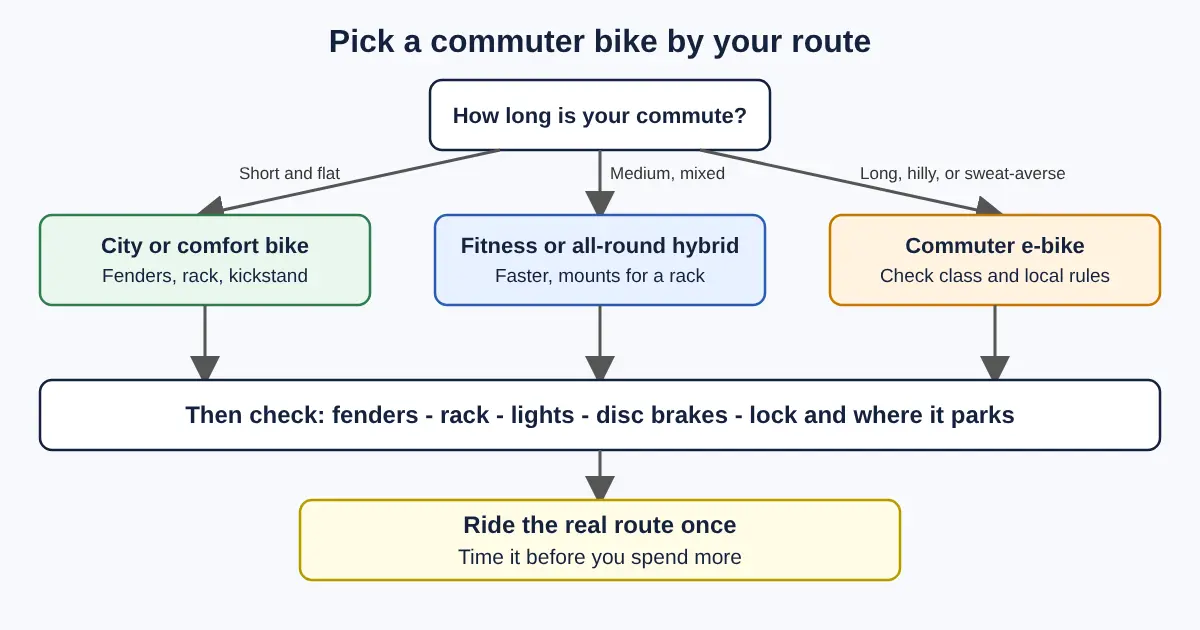
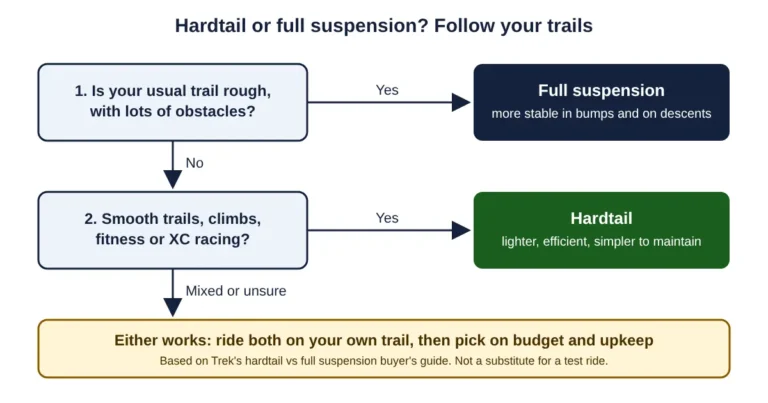
Which bike type fits your commute?
| Bike type | Fits best when | Trade-off |
|---|---|---|
| City or comfort bike | Short, flat trips and a work outfit you want to keep clean | Heavier and slower; upright position catches wind |
| Fitness hybrid | Medium trips on pavement and you want a quicker ride | Fewer commuter extras unless you add them |
| All-round hybrid | Rough pavement, paths or gravel along the way | Slightly more cost and weight than a fitness bike |
| Gravel bike | Long routes mixing pavement and unpaved sections | Drop bars suit some riders less; compare with a hybrid |
| Commuter e-bike | Hills, long distances, or no showers at work | Higher cost, charging, heavier to carry or store |
What commuter-ready bikes actually include
| Bike | Equipment or mounts per the maker | Tires |
|---|---|---|
| Giant Escape City Disc 2 (2025) | Fender, rack and kickstand included; Tektro HD-R280 disc brakes | 700x38c stock, up to 45 mm fit |
| Trek Verve+ 2 Gen 3 (e-bike) | Integrated lights, rear kickstand, rack rated 25 kg / 55 lb, and fenders | 27.5 x 2.4 in max, with or without fenders |
| Trek Verve 3 | Mounts for fenders, rack and kickstand; 300 lb total weight limit (bike, rider and cargo) | 700x45c with or without fenders |
| Trek FX Gen 4 | Mounts for rear rack, fenders, frame bag, low-rider front rack and a kickstand | Up to 40 mm with or without fenders |
Fenders and a rack are the two items that turn a normal bike into a work bike: one keeps spray off your clothes, the other keeps a bag off your back. Lights, a kickstand and a lock complete the setup, so count those into the budget.
If you carry food on that rack, our guide to carrying a pizza on a bike shows four setups that keep it flat.
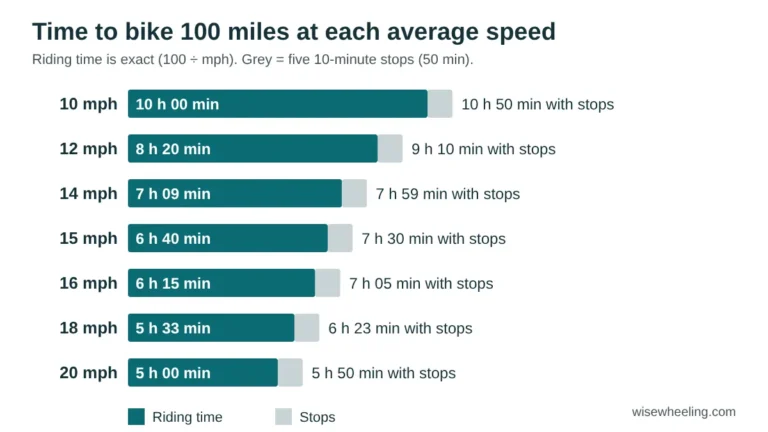
Commute time calculator
Enter your one-way distance and the average speed you expect. Stops at lights count too, so use a realistic average, not your top speed.
E-bikes: know the class
US law and many trail rules sort e-bikes into three classes. PeopleForBikes describes them this way: Class 1 assists only while you pedal and stops at 20 mph, Class 2 can propel the bike without pedaling and stops assisting at 20 mph, and Class 3 assists only while you pedal and stops at 28 mph. The motor must be under 750 watts and the bike must have fully operable pedals (PeopleForBikes). State and local rules differ, so check yours before buying, especially for Class 3.
Before the first ride to work
- Ride the route once on a weekend and time it.
- Fit fenders and a rack, or choose a bike that includes them.
- Add front and rear lights if the bike does not have them built in.
- Pick a lock and the place you will park; see bike locks for commuters.
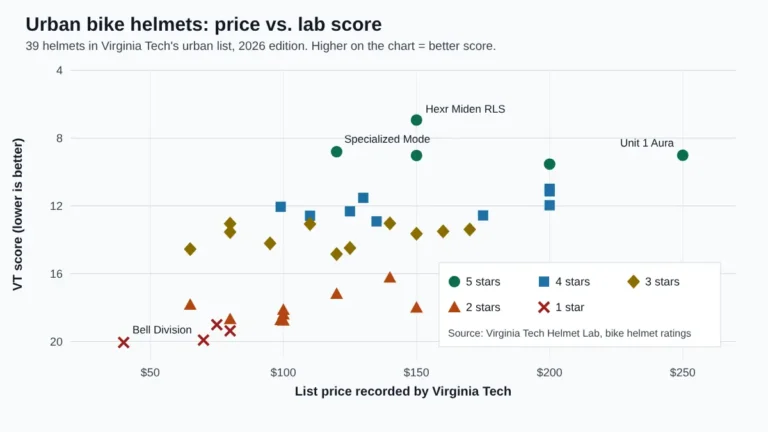
- Wear a helmet with the CPSC certification label (16 CFR 1203); see commuter helmet ratings.
Route-specific riding habits are covered in cycling safety tips for city riding, and if you are still deciding on a style, start with the best hybrid bike for beginners.
Bike specifications change each model year. Check the maker's page for the exact model before you buy.

Suryashankar Dasgupta founded Wise Wheeling. He has been cycling for more than 20 years, on geared and single-speed bikes, across many kinds of terrain. His guides cover bike repair, fit and gear, and each one is checked against manufacturer manuals, Park Tool and other primary sources before it’s published. Read how guides are made: https://wisewheeling.com/editorial-policy/