How to Fix a Rubbing Disc Brake: Check in This Order
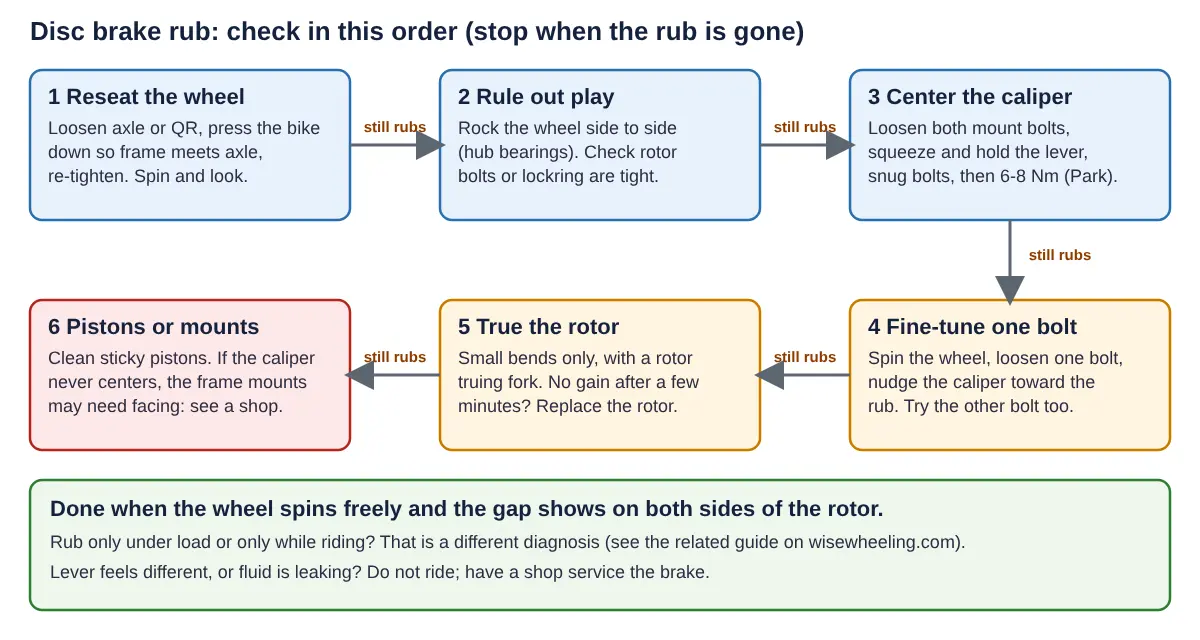
Most disc brake rub can be fixed in a few minutes with no new parts: reseat the wheel, then re-center the caliper over the rotor. Do those two first, in that order. Park Tool names caliper misalignment as the main cause of rub and an improperly seated wheel as the first thing to rule out. If the rub survives both, work down the list below: hub play, a bent rotor, sticky pistons, and finally frame mounts that aren’t square.
What does your rub look like?
Use this table to jump to the likely cause. The order of fixes below still applies if you can’t tell.
| What you notice | Likely cause | Go to |
|---|---|---|
| Rub began right after a wheel, tire or tube change, or after the bike came off a rack | Wheel not fully seated in the dropouts | Step 1 |
| Wheel rocks side to side at the rim, or the rotor wobbles on the hub | Hub bearing play, or a loose rotor bolt or lockring | Step 2 |
| A steady scrape that stays in one place against one pad | Caliper off-center over the rotor | Steps 3 and 4 |
| A rhythmic tick or rub at the same point every wheel turn | Rotor bent at one spot | Step 5 |
| One pad sits close to the rotor and the other seems to retract normally | Sticky piston | Step 6 |
| Caliper will not center no matter what you do | Frame or fork mount not square to the rotor | Step 7 |
| Rub appears only when riding hard or on bumps, never on the stand | Load-related flex rather than alignment: see disc brake rubs only when riding | Related guide |
How to fix a rubbing disc brake, step by step
Put the bike in a stand, or upside down on the ground, so the wheel spins freely. Backlighting the caliper with a light or a sheet of paper makes the gap easier to see. Park Tool’s hydraulic disc brake alignment guide follows the same sequence and says it applies regardless of brand or model.
Step 1: Reseat the wheel
Park Tool lists an improperly seated wheel as a cause of pad and rotor rub on both thru-axle and open-dropout bikes. With the bike on the floor, loosen the quick-release lever (or axle nut), press down on the bike so the frame and axle are in contact, then re-tighten and spin the wheel. On a thru-axle bike, do the same with the axle and tighten it to the maker’s torque.
Step 2: Rule out play at the hub and rotor
Rock the wheel side to side by the rim. Park Tool says any play at the hub should be fixed before you align anything. Also check that the rotor is secured: rotors bolt on with six bolts or a Center Lock lockring, and a loose one keeps the rotor from sitting fully on the hub. The Center Lock vs 6-bolt rotor guide covers the tools and torque.
Step 3: Center the caliper
- Loosen both caliper mounting bolts until the caliper body slides freely from side to side.
- Squeeze the brake lever and hold it. This clamps the pads on the rotor and centers the caliper.
- While still holding the lever, snug both bolts.
- Release the lever and spin the wheel. If it runs free, tighten both bolts to full torque, about 6–8 Nm according to Park Tool, then recheck. Use your brake maker’s figure if it differs.
The process is the same for front and rear brakes. On some bikes the mounting bolts sit under the chainstay or on a bracket.
Step 4: Fine-tune one bolt at a time
If a light rub remains, spin the wheel and loosen one bolt, then push the caliper in the direction of the rub until a gap shows on both sides of the rotor. If that bolt doesn’t find a good position, try the other one. Keep fingers and tools clear of the spinning wheel. Retighten each bolt to the full torque when the rub is gone.
Some brakes use conical washers to keep the caliper square. Park Tool warns not to add washers if none were designed to be there, because the pads will no longer line up with the rotor.
Step 5: True a bent rotor
Park Tool notes that some sideways movement of a spinning rotor is normal, but a significantly bent rotor makes alignment difficult or impossible. Find the spot that closes the gap, rotate it out of the caliper, and flex it back with a rotor truing fork, starting with a small amount of force and checking after each attempt. Be careful: rotor edges can be sharp.
Park Tool’s rotor truing guide gives a practical limit: if the rotor shows no improvement within a few minutes of trying, it has probably reached the end of its life, and a rotor that was badly bent by an impact is best replaced.
Step 6: Free sticky pistons
Dust and dirt can build up on one or both caliper pistons and make them stick, so one pad drags while the other retracts. Park Tool says you can often still get a workable alignment with sticky pistons, and points to its video on cleaning them. If the pistons clearly stay uneven, a shop visit is the safe route. If the lever feels different from normal or you see fluid, don’t ride the bike until the brake is serviced.
Step 7: Check whether the frame mounts are square
If nothing gives an acceptable alignment, the caliper mounts on the frame or fork may not be square to the rotor. Park Tool describes facing the mounts with its DT-5.2 tool for this case; see its mount facing guide. That is a shop job for most home mechanics.
Home fix or shop?
| Problem | Reasonable at home | Better at a shop |
|---|---|---|
| Caliper off-center | Yes: Steps 3 and 4 | If it will not center |
| Slightly bent rotor | Yes, with a truing fork and small corrections | If it will not straighten in a few minutes: replace it |
| Hub bearing play | Only if you own the tools and know the hub | Usually |
| Sticky pistons | Cleaning, if you are comfortable | If they stay uneven |
| Frame mounts not square | No | Yes: facing tool |
| Fluid leak or changed lever feel | No | Yes, and do not ride |
If the rub is gone but the brakes now squeal or feel weak, why disc brakes squeal and when to replace disc brake pads cover the next checks. If the lever pulls all the way to the bar, see brake lever pulls to the handlebar. For a general adjustment routine on rim and disc brakes, use how to adjust bike brakes. Fitting a larger rotor or a different mount? Check which disc brake adapter you need first.
FAQ
Is a little disc brake rub normal?
Some lateral movement in a spinning rotor is normal, according to Park Tool. A faint rub that doesn’t slow the wheel is common, but it is easy to fix with the caliper-centering steps above, so it is worth doing.
Do mechanical disc brakes rub for the same reasons?
The causes overlap (seating, play, bent rotor, alignment), but cable drag can stop pistons retracting fully on mechanical brakes. Park Tool has a separate alignment article for cable-actuated disc brakes.

Suryashankar Dasgupta founded Wise Wheeling. He has been cycling for more than 20 years, on geared and single-speed bikes, across many kinds of terrain. His guides cover bike repair, fit and gear, and each one is checked against manufacturer manuals, Park Tool and other primary sources before it’s published. Read how guides are made: https://wisewheeling.com/editorial-policy/