Brake Lever Pulls to the Handlebar? Fix It in This Order
This post contains Amazon affiliate links. As an Amazon Associate I earn from qualifying purchases, at no extra cost to you.
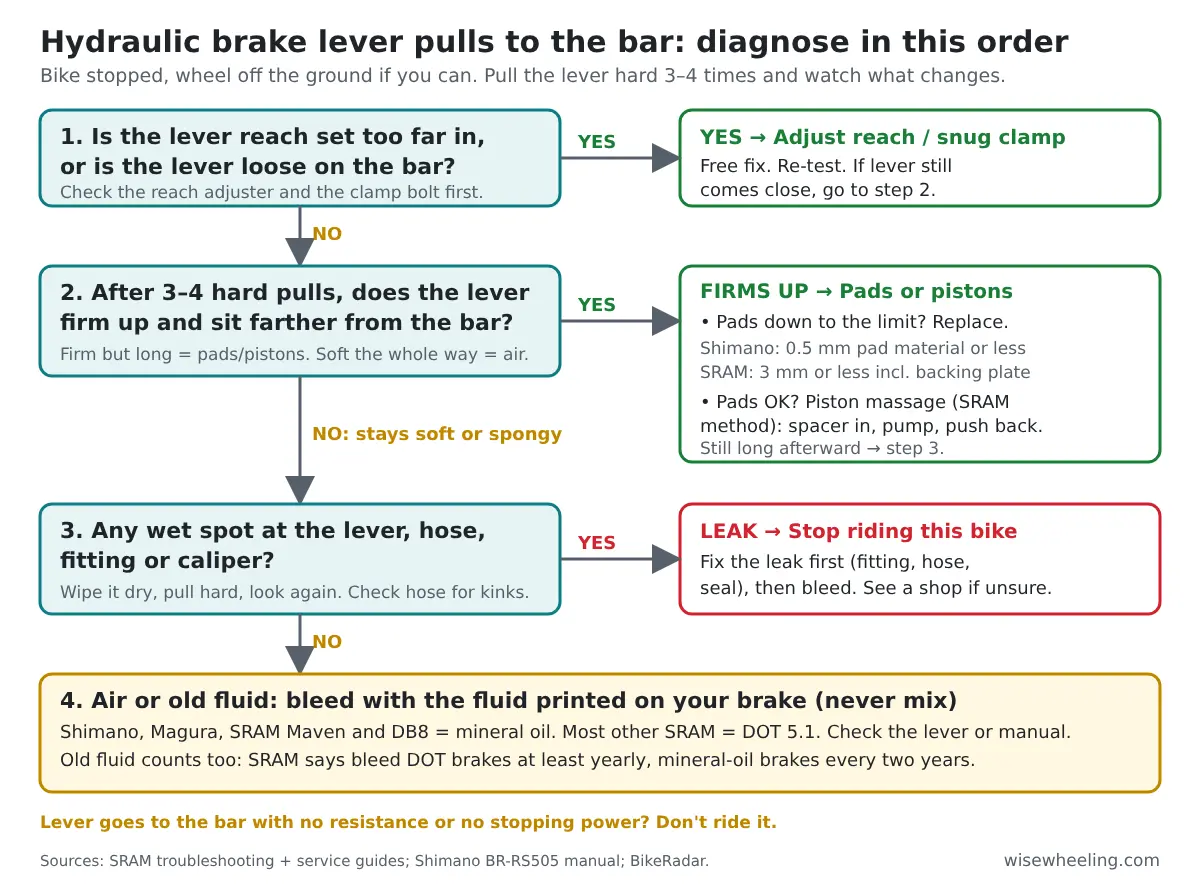
When a hydraulic brake lever pulls close to the handlebar, check in this order: lever reach and clamp, pad wear, stuck pistons, leaks, then air or old fluid. Pump the lever 3–4 times. If it firms up, suspect pads or pistons. If it stays soft, suspect air or old fluid, and bleed with the exact fluid your brake takes. If the lever goes to the bar with no resistance, don’t ride.
Most guides jump straight to bleeding. That’s the slowest fix when the real cause is worn pads you can check in two minutes, and the wrong fluid can wreck your seals. This guide gives you the order, the pad limits that differ by brand, and a fluid chart.
How to diagnose a brake lever that pulls to the handlebar
Free tool: lever-feel triage and pad limit check
1. Lever-feel triage
2. Brake pad limit check
How it works: the triage encodes the order of the flowchart above. The pad check compares your reading to the limits in the SRAM service guide (3 mm, material plus backing plate) and the Shimano BR-RS505 dealer manual (0.5 mm of pad material). Other brands: use your model's manual.
Step 1: Rule out lever reach and a loose clamp
It sounds too simple, but a reach adjuster turned all the way toward the bar makes a healthy lever feel like it has no travel. On many good brakes the lever position can be changed without tools, and turning the adjuster moves the blade away from the bar (Bike Magazin). While you're there, grab the lever and check that the whole clamp isn't rotating on the bar.
Step 2: Do the pump test
With the bike stopped, squeeze the lever hard three or four times. This is a mechanic's rule of thumb, not a manufacturer spec, but it separates the causes fast:
- Lever firms up and sits farther from the bar: the pistons weren't pushing the pads out to the rotor. Go to Step 3.
- Lever stays soft or spongy the whole way: likely air or old fluid. Skip to Step 5, but do Step 4 first.
- No resistance at all: stop. Shimano's manual says to stop using the brakes if you feel no resistance when depressing the lever.
Step 3: Check pad wear (the limit depends on the brand)
Here's the trap: the two big brands measure differently. Shimano's limit applies to the pad material alone. SRAM's counts the pad and the backing plate together. Reading a SRAM pad with Shimano's rule, or the reverse, gives you a wrong answer.
| Shimano | SRAM | |
|---|---|---|
| Pad limit | 0.5 mm or less: replace | 3 mm or less: replace |
| What you measure | Pad material only | Pad material plus backing plate |
| Rotor minimum | Stop using at 1.5 mm or less | 1.55 mm (1.85 mm rotor) or 1.7 mm (2 mm rotor), or the minimum printed on the rotor |
Pull the pads and measure with a digital caliper. Oil or grease on the pads is another problem: Shimano says contaminated pads must be replaced. For pad choice and wear by brand, see our guide to when to replace disc brake pads.
If the pads are fine: piston massage
SRAM's fix for pistons that aren't advancing evenly: remove the wheel and pads, fit a pad spacer, squeeze the lever until the pistons contact the spacer, push them back with a plastic tire lever, and repeat until they move smoothly. It can take several rounds (SRAM). If pads stay long after that, move on.
Step 4: Look for leaks and a hose problem
Wipe the lever, hose, fittings and caliper dry, pull the lever hard, and look again for a wet spot. Check the hose for kinks. If the hose was cut to length when the brakes were installed, SRAM says the system must be bled, and tells you to torque the compression nut to 8 Nm and not install the olive backwards, because air gets in easily otherwise. A torque wrench covers that job.
Step 5: Bleed with the right fluid (never mix)
If the lever stays soft and there is no leak, air or old fluid is the usual cause. Before you buy anything, find out what your brake takes. Mineral oil and DOT fluid are not interchangeable, and BikeRadar warns that mixing them degrades the seals. Use a bleed kit dedicated to one fluid type.
| Brake | Fluid | Bleed interval (where stated) | Notes |
|---|---|---|---|
| Shimano | Shimano mineral oil | Bleed when the lever feels sluggish | Shimano says use only genuine mineral oil, from a freshly opened container; never reuse drained oil. |
| Magura | Royal Blood mineral oil | Not stated in sources used | Blue oil. |
| SRAM Maven | Maxima mineral brake oil | Every 2 years (SRAM) | SRAM says other oils void the warranty. |
| SRAM DB8 | Mineral oil | Every 2 years (SRAM) | SRAM's other mineral-oil brake. |
| Other SRAM (e.g. Code, Guide, Level, road) | DOT 5.1 | At least once a year (SRAM) | BikeRadar says DOT 4 can also be used but has a lower boiling point. Confirm for your model. |
| Hope | DOT 5.1 | Not stated in sources used | Per BikeRadar. |
| Campagnolo Ekar | Campagnolo red mineral oil | Not stated in sources used | Compatible with Royal Blood only after flushing the red fluid fully (BikeRadar). |
| Tektro / TRP, Clarks, Promax | Mineral oil | Not stated in sources used | Check your model. |
| Hayes, some Formula | DOT (grade not confirmed here) | Not stated in sources used | Read the reservoir cap or manual. |
Buy the fluid that matches the table: Shimano mineral oil, SRAM DOT 5.1 fluid, or a bleed kit for your brand. Check the current price on Amazon. Wear gloves and eye protection. DOT fluid is corrosive to paint and both fluids are harmful to skin and eyes, so keep isopropyl alcohol and rags nearby.
If you are not comfortable bleeding brakes, this is a good shop job. A bad bleed is a safety problem, not a cosmetic one. Also see our guides to fixing a rubbing disc brake and why disc brakes squeal for the other common brake complaints.
Lever got long on a descent, then came back?
Shimano warns that continuous braking can cause a sudden increase in lever stroke, called vapor lock, and that water in old oil is the cause. The fix on the trail is to release the lever briefly. The fix at home is a full bleed with fresh oil. On long descents, brake in short bursts rather than dragging.
Mechanical (cable) brakes: lever pulls to the bar
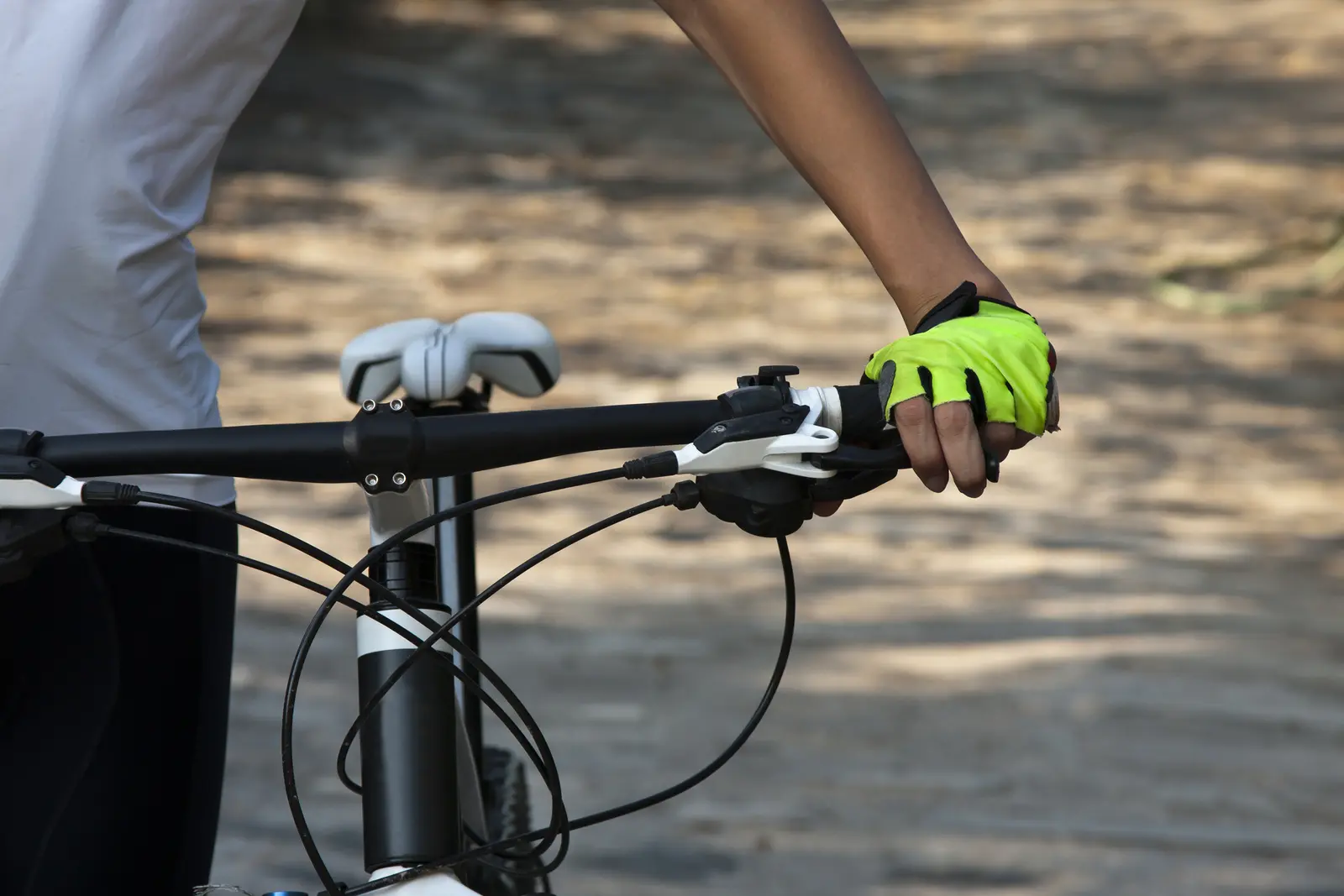
No fluid here, so no bleeding. Cable slack is the usual cause: turn the barrel adjuster out (counter-clockwise) a turn or two to take it up. If it runs out, re-clamp the cable at the caliper. New cables also stretch and settle in. Our guide to how to adjust bike brakes walks through it, and disc brake rub only when riding covers the opposite problem.
FAQ
Can I just keep riding with a spongy lever?
No. A lever that pulls closer to the bar than usual leaves you less reserve when you need to stop hard. If it goes to the bar with no resistance, stop riding until it is fixed.
Does a worn rotor make the lever pull to the bar?
Check it anyway. Shimano says to stop using a rotor at 1.5 mm or less, and SRAM gives 1.55 mm for a 1.85 mm rotor and 1.7 mm for a 2 mm rotor. I have not found a manufacturer source that ties rotor wear directly to lever travel, so treat it as a safety check, not a diagnosis.
How often should I bleed hydraulic brakes?
SRAM says at least once a year for DOT brakes and every two years for mineral-oil brakes. Bleed sooner if the lever feels soft.
Sources
- SRAM: disc brake troubleshooting
- SRAM: brake service guide
- SRAM support: Do Maven brakes use mineral oil or DOT fluid?
- Shimano BR-RS505 dealer manual (hosted on manualsnet)
- BikeRadar: brake fluid, mineral oil vs DOT
- Bike Magazin: brake lever pushes through

Suryashankar Dasgupta founded Wise Wheeling. He has been cycling for more than 20 years, on geared and single-speed bikes, across many kinds of terrain. His guides cover bike repair, fit and gear, and each one is checked against manufacturer manuals, Park Tool and other primary sources before it’s published. Read how guides are made: https://wisewheeling.com/editorial-policy/