Center Lock vs 6-Bolt Rotors: What Fits, What Torque, What Tool
This post contains Amazon affiliate links. As an Amazon Associate I earn from qualifying purchases, at no extra cost to you.
Center Lock and 6-bolt are two different ways of fixing a disc rotor to the hub, and a rotor only bolts straight onto a hub with the same interface. A 6-bolt rotor can still go on a Center Lock hub if you add an adapter, but a Center Lock rotor can’t be fitted to a 6-bolt hub at all. Once the rotor fits, the torque is different too: 6-bolt rotor bolts take a light 2 to 6.2 N·m depending on the brand, while a Center Lock lockring goes to a much higher 40 N·m (about 350 in-lb) on Shimano, SRAM and Magura parts. The checker below gives you the answer for your exact hub, rotor and axle.
Rotor fit checker: will this rotor go on your hub?
How the checker works: fit rules come from Park Tool’s rotor guide; torque figures, adapter limits and lockring tools come from Shimano’s DM-BR0005 dealer manual, SRAM’s MTB disc brake user manual (95-5018-019-100 Rev M) and Magura’s rotor assembly instructions, all linked in the table below.
Rotor torque and tools by brand
No single manufacturer publishes this side by side, so here it is pulled from each brand’s own document. The 6-bolt numbers differ more than most riders expect: Shimano’s range tops out at 4 N·m, while SRAM’s figure is 6.2 N·m. Use the number for the rotor you’re installing, not the last one you remember.
| Brand (source) | 6-bolt rotor bolts | Bolt notes | Center Lock lockring | Lockring tool |
|---|---|---|---|---|
| Shimano (DM-BR0005) | 2.0–4.0 N·m (17–35 in-lb) | Given in the SM-RTAD05 adapter steps; the bolts supplied with that adapter are Torx T15. Turn the rotor clockwise while tightening in the numbered star order. | 40 N·m (350 in-lb) | TL-FC36 (external notches) |
| SRAM (MTB disc brake manual, Rev M) | 6.2 N·m (55 in-lb), T25 | New, threadlock-prepped bolts; one turn at a time in an alternating sequence. | 40 N·m (354 in-lb), SRAM lockrings | ø44 mm 16-notch external bottom bracket tool |
| Magura (rotor assembly instructions) | 6 N·m (53 in-lb), T25 | Fresh medium-strength threadlocker on every bolt; turn the rotor against the wheel’s direction of rotation, tighten crosswise. | 40 N·m (354 in-lb); MDR-S 8H 203 uses the hub maker’s figure | External (Park BBT-69.2) mainly for thru-axle hubs; internal (Park FR-5.2) mainly for QR hubs |
| Park Tool (general guidance) | About 4–6 N·m typical; usually T25 | No grease or oil. If the bolts have no pre-applied threadlocker, put thread prep (TLR-1) in the hub holes. | To the maker’s spec (Park’s example: 40 N·m) | Internal splines: FR-5.2 family. External notches: BBT-9, BBT-69.4 or BBT-169 |
Those 40 N·m lockrings are the reason a little 2–10 N·m beam or click wrench isn’t enough for a Center Lock bike. You need a wrench that reaches 40 N·m, plus the right socket-style tool. For 6-bolt rotors, the low-range wrench is the one that matters, because the bolts are small M5 fasteners and the figures are low.
How to tell which rotor mount you have
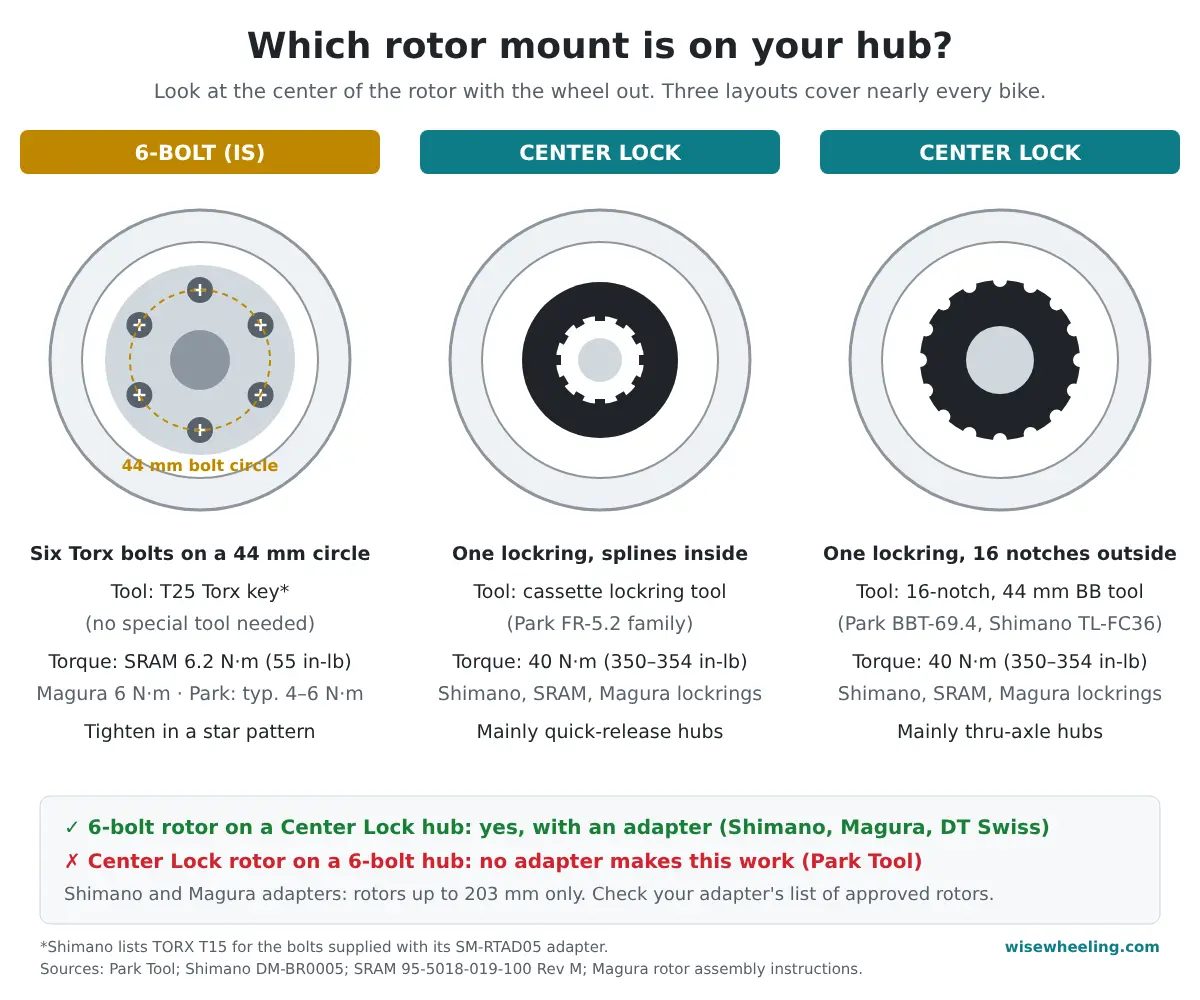
Take the wheel out and look at the middle of the rotor:
- Six small Torx bolts in a ring: 6-bolt, also called IS (International Standard). The bolts sit on a 44 mm bolt circle and are usually M5 with a T25 head (reference).
- One big round lockring and no bolts: Center Lock, Shimano’s patented splined interface. The rotor slides onto splines on the hub and the lockring clamps it.
- A lockring sitting on top of six bolts: a 6-bolt rotor on a Center Lock adapter. The hub is Center Lock.
Then check which way the lockring takes a tool. Splines on the inside of the ring look just like a cassette lockring and take a cassette tool. Notches around the outside take a 16-notch bottom bracket tool. Park Tool points out that an internally splined lockring can’t be reached on some hub axle sizes, because the tool won’t pass over the axle end; the fix is an externally notched lockring. Magura puts it more simply: external for thru-axle hubs, internal for quick-release hubs. If you already work on your own cassette, the internal-spline tool is likely in your box (see our freehub body guide for the cassette side of that tool).
Can you put a 6-bolt rotor on a Center Lock hub?
Yes. An adapter splines onto the hub, the rotor bolts to the adapter, and the lockring holds the whole stack on. Shimano (SM-RTAD05), Magura and DT Swiss all make one. What the adapter boxes don’t shout about are the limits:
- Size cap. Shimano’s SM-RTAD05 is rated for rotors up to 203 mm; bigger rotors can damage it under braking. Magura’s adapter has the same 203 mm cap.
- Not every rotor is allowed. Shimano says the SM-RTAD05 can’t be used with 6-bolt rotors that already have an aluminum adapter (SM-RT86 and SM-RT76). Magura approves its adapter only for STORM, STORM HC, STORM SL 2, MDR-C and MDR-S rotors, never MDR-P, and never with ABS sensor rings.
- A little extra play. Shimano warns that the adapter’s design leaves more play in the rotor than a direct mount, so the rotor can touch the pads or even the caliper body. If you hear a new tick or rub after fitting one, that’s the first suspect; our rubbing disc brake guide walks through realigning the caliper.
Torque the six rotor bolts into the adapter first (Shimano: 2.0–4.0 N·m in the numbered star order), then fit the lockring to 40 N·m. Shimano’s adapter steps include a washer before the lockring goes on.
Can you put a Center Lock rotor on a 6-bolt hub?
No. Park Tool states it plainly: a 6-bolt rotor can be adapted to Center Lock, but a Center Lock rotor can’t be adapted to 6-bolt. If your hub has six threaded holes, shop for 6-bolt rotors only. That one-way rule is the most useful thing to know when you’re choosing wheels: a Center Lock hub can take either rotor type (within the adapter limits above), while a 6-bolt hub can only ever take 6-bolt rotors.
Center Lock vs 6-bolt: which is better?
Neither one brakes better on its own. Rotor size and pads decide stopping power; the mount decides how the rotor is held on and what you need to service it. Here’s how they compare on the things that actually affect your garage time:
| What matters | 6-bolt | Center Lock |
|---|---|---|
| Tool to remove or fit a rotor | A T25 Torx key (on most brands) | Cassette lockring tool or 16-notch BB tool, plus a wrench big enough for 40 N·m |
| Fasteners per rotor | Six small bolts, tightened in a star pattern | One lockring |
| Typical torque | 2–6.2 N·m depending on brand | 40 N·m on Shimano, SRAM and Magura lockrings |
| Thread care | Threadlocker on the bolts; never grease or oil | Park says no grease on any part |
| Rotor choice on that hub | 6-bolt rotors only | Center Lock rotors, or 6-bolt with an adapter (up to 203 mm on Shimano and Magura adapters) |
| Field fix with a multi-tool | Yes, if it has T25 | Not without the lockring tool |
Our take: if you’re buying wheels and want the most rotor options, Center Lock keeps both doors open. If you’d rather fix everything trailside with one small key, 6-bolt is simpler. And if you already own one type, stick with it. Switching means a new hub or wheel, which costs far more than the rotor.
How to install each type
6-bolt rotor
- Check the arrow on the rotor. It points in the wheel’s direction of travel; if there’s no arrow, the printed side faces out (Park Tool).
- Use new bolts with pre-applied threadlocker (SRAM calls for new, threadlock-prepped bolts). If yours have none, Park suggests thread prep such as Park Tool TLR-1 in the hub holes. No grease or oil: it can migrate to the braking surface.
- Start all six bolts by hand. Rotate the rotor against the bolts to take up the slack (Shimano: clockwise; Magura: against the direction of rotation) and hold it there.
- Tighten in a star pattern, a turn at a time, to your brand’s figure from the table.
- Degrease the rotor with brake cleaner or alcohol before the wheel goes back in (Magura).
Center Lock rotor
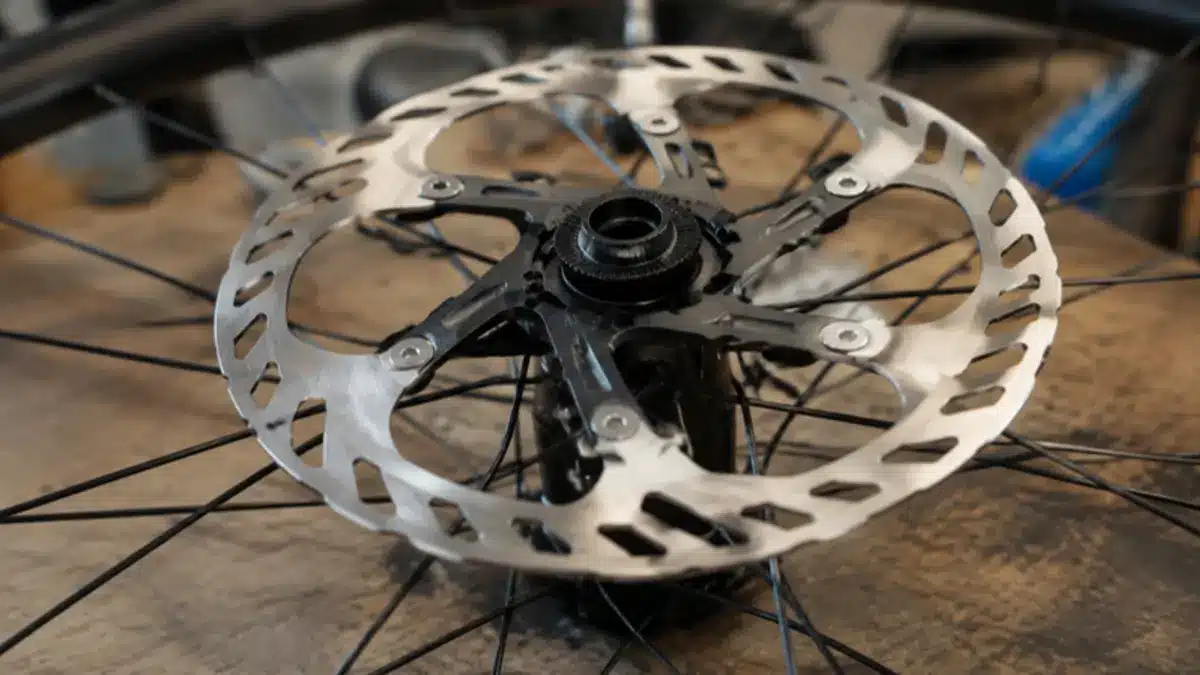
- Line up the rotor’s splines with the hub’s and slide it on, arrow pointing in the direction of travel.
- Thread the lockring on clockwise by hand. No grease (Park Tool).
- Torque it to 40 N·m with the right tool: Park Tool FR-5.2 for internal splines, or a 16-notch, 44 mm tool such as the Park Tool BBT-69.4 or Shimano TL-FC36 for external notches. Park’s rule of thumb: 40 N·m is about 44 lb of effort 8 inches from the lockring.
- Wear gloves. Shimano warns not to touch the rotor’s outer edge while using the lockring tool, because it can cut your hands.
Changing rotor diameter at the same time? The caliper has to move too, and that’s a separate adapter. Our disc brake adapter finder covers which caliper adapter goes with which rotor size. New rotors also want new pads; see when to replace disc brake pads for wear limits by brand.
Tools for the job
- 6-bolt: a T25 Torx bit or key (check your rotor; Shimano’s adapter bolts are T15) and a low-range bike torque wrench that reads 2–6 N·m.
- Center Lock, internal splines: Park Tool FR-5.2 cassette lockring tool.
- Center Lock, external notches: Park Tool BBT-69.4 or Shimano TL-FC36, plus a 3/8-inch drive torque wrench that covers 40 N·m.
- 6-bolt rotor on a Center Lock hub: Shimano SM-RTAD05 adapter (rotors up to 203 mm).
Check the current price on Amazon; tool prices move around a lot. A shop can swap a rotor for you, so if you’d only use a 40 N·m wrench once, paying for the job can make more sense than buying one.
Mistakes that cause rub, noise or a loose rotor
- Using one torque number for every rotor. 6.2 N·m is SRAM’s figure; Shimano’s range stops at 4 N·m.
- Greasing the bolts or lockring. Park Tool says no grease; on 6-bolt rotors, oil can creep onto the braking surface and cause noise and weak brakes (our disc brake squeal guide covers contamination).
- Reusing old bolts with spent threadlocker. SRAM specifies new, threadlock-prepped bolts.
- Buying an internal-spline lockring for a thru-axle hub. The tool may not fit over the axle end; use an externally notched ring.
- Putting a 220 mm rotor on a Center Lock adapter. Shimano’s and Magura’s adapters stop at 203 mm.
- Ordering the wrong rotor type online. Check that the listing title says Center Lock or 6-bolt to match your hub before you buy.
Safety note: a rotor is a brake part. If a bolt strips, a lockring won’t reach torque, or the rotor moves on the hub after tightening, don’t ride it. Take it to a shop.
Center Lock and 6-bolt FAQ
Can I use a cassette tool on a Center Lock rotor?
Yes, if the lockring has internal splines. Park lists its FR-5.2 cassette lockring tools for internally splined rotor lockrings. Externally notched lockrings need a 16-notch, 44 mm bottom bracket tool instead.
Is 40 N·m really right for a rotor lockring?
For Shimano, SRAM and Magura lockrings, yes: Shimano lists 40 N·m (350 in-lb), and SRAM and Magura list 40 N·m (354 in-lb). Other lockrings may differ, so use the figure from whoever made the lockring.
Can I reuse 6-bolt rotor bolts?
SRAM’s manual calls for new, threadlock-prepped bolts, and Magura says to apply fresh medium-strength threadlocker to every bolt. If you reuse bolts, at least re-prep the threads; Park suggests thread prep in the hub holes when the bolts have none.
Do Center Lock rotors work on quick-release and thru-axle hubs?
Yes. The rotor is the same; only the lockring changes. Quick-release hubs usually use an internally splined lockring, thru-axle hubs an externally notched one.
Sources
- Park Tool: Disc Brake Rotor Removal & Installation
- Shimano Dealer’s Manual DM-BR0005, Disc Brake (SM-RTAD05 section)
- SRAM MTB Disc Brakes and Shifters User Manual, 95-5018-019-100 Rev M
- Magura brake rotor assembly instructions
- Wikipedia: Bicycle brake (disc mounting standards)

Suryashankar Dasgupta founded Wise Wheeling. He has been cycling for more than 20 years, on geared and single-speed bikes, across many kinds of terrain. His guides cover bike repair, fit and gear, and each one is checked against manufacturer manuals, Park Tool and other primary sources before it’s published. Read how guides are made: https://wisewheeling.com/editorial-policy/