Bike Feels Unstable After Changing Front Tire? What to Check
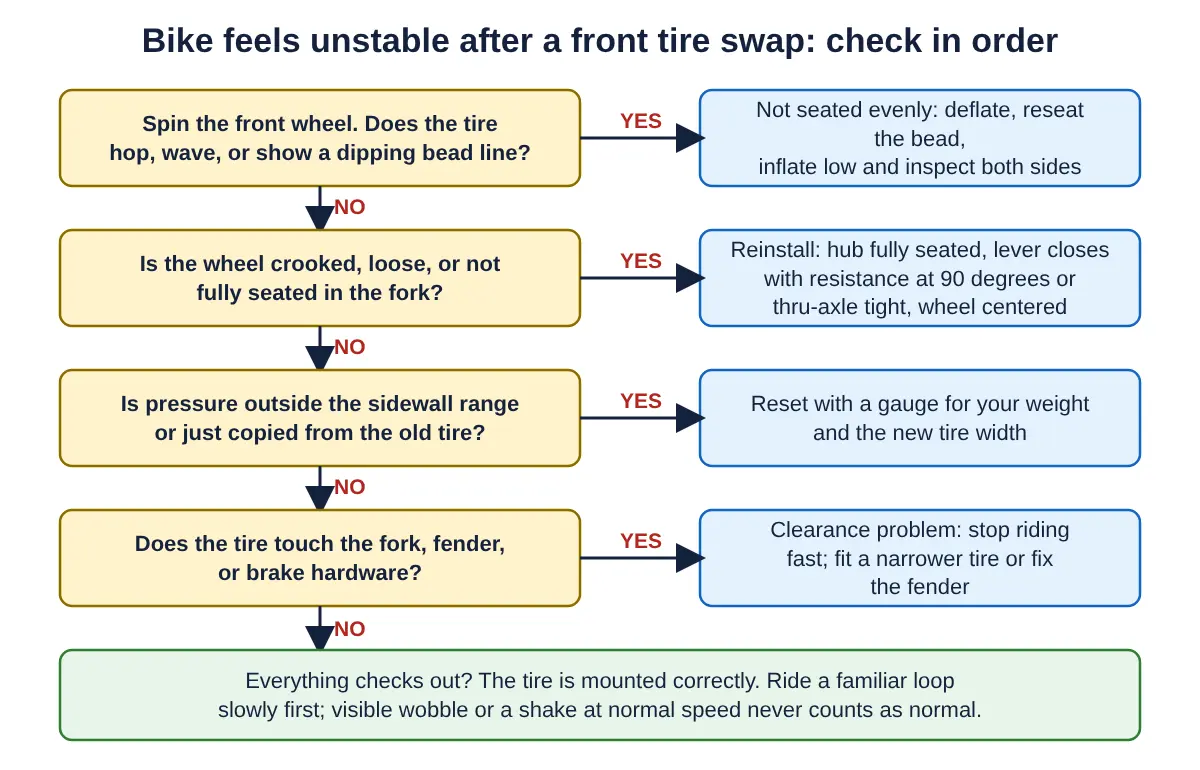
A bike that feels unstable after a front tire swap usually has one of three problems: the tire bead is not seated evenly, the front wheel is not fully seated or centered in the fork, or the pressure is wrong for the new tire. Check them in that order, because the first two are safety issues and each takes about a minute. If the tire visibly hops or wobbles when the wheel spins, or the bars shake at normal speed, stop riding it until it is fixed.
What each symptom usually means
| What you notice | Likely cause | How to check | Fix |
|---|---|---|---|
| Tire hops or waves as the wheel spins | Bead not seated evenly | Check that the molded line above the rim is even on both sides | Deflate, reseat, inflate low and inspect again |
| Bars shake or the bike pulls to one side | Wheel crooked or not fully seated in the fork | Look at where the hub meets the dropouts; check the wheel is centered | Reinstall; close the quick release or tighten the thru-axle properly |
| Twitchy and harsh, or vague and floaty | Pressure wrong for the tire width and your weight | Gauge against the sidewall range | Reset pressure |
| Rubbing noise or drag | Tire touches the fork, fender or brake hardware | Spin slowly and look | Fix the clearance or choose a narrower tire |
| Steering feels different but nothing is wrong | Different width changes outer diameter | Compare the old and new tire’s labeled width | Ride slowly to get used to it, or fit the original size |
1. Check the bead seating
Park Tool’s tire installation guide says to inflate to low pressure and inspect the bead on both sides before going to full pressure. The molded line just above the bead should run consistently above the rim. If the line bulges, deflate immediately and reseat the tire. The same page says to align the valve so it points straight at the hub, and notes that directional arrows on the sidewall show the wheel’s rotation, so a directional tire should face the right way. If you ended up with a bump after a tube change, see why a tire can have a bump after changing a tube.
2. Check the front wheel is seated and centered
If you took the front wheel off for the swap, it has to go back in correctly. Park Tool’s wheel installation steps are short:
- Make sure the hub is fully seated in the fork, and that a quick-release skewer is fully engaged on the dropout surfaces.
- For a quick release, tighten so the lever meets resistance at 90 degrees from the fork. For a thru-axle, slide it in and turn it clockwise until tight; Park Tool recommends a torque wrench.
- Verify the wheel is centered in the fork. With hydraulic disc brakes, never squeeze the brake lever while the wheel is out of the bike.
If the brake rubs after reinstalling the wheel, see how to adjust bike brakes.
3. Reset the pressure for the new tire
A new tire needs its own pressure. Schwalbe says the right pressure depends largely on the load on the tire, narrower tires and bigger loads need more pressure, and you should never go beyond the minimum and maximum printed on the sidewall. It adds that lower pressure gives more comfort and grip. If you moved to a wider front tire, it will normally run lower than the old one; its tire size page says wide tires are generally used at lower pressures.
4. Check size, clearance and rim fit
Labeled tire sizes are approximate. Schwalbe lists a 40 mm tire at roughly 28 inches outer diameter and very wide tires of 60 mm or more at almost 30 inches, so changing width changes the height of the front wheel. Make sure the tire clears the fork, fender and brake with room to spare.
Rim fit matters as well. Park Tool explains that rims and tires with the same ISO bead-seat number fit each other, and gives a loose rule that the ISO tire width should be between one and a half and two times the ISO rim width. Use our tire size chart and tire width guide if you are unsure.
When to stop riding
- The tire visibly hops, waves, or the molded line disappears under the rim.
- The tire rubs the fork, fender or brake.
- Pressure will not hold.
- The bars shake at normal speed.
If the tire is mounted correctly but the bike still feels different, the likely reason is the new tire’s size and pressure, so reset the pressure and ride slowly first. If the bike also feels sluggish, our guide on new tires that feel slower covers that.
FAQ
Is it normal for a bike to feel different after a new front tire?
A different width, diameter or pressure can change how the front end feels. Wobble, a bead line that dips, rubbing, or shake at speed is not a feel difference, and each needs fixing.
Can the wheel be true while the tire is still wobbling?
Yes. A tire that is not seated evenly can hop even on a straight wheel. Watch the tire and the molded bead line, not only the rim, while spinning.
Does a wider front tire need less pressure?
Usually. Schwalbe says wide tires are generally used at lower pressures, and that narrower tires and bigger loads need more. Stay within the sidewall range.

Suryashankar Dasgupta founded Wise Wheeling. He has been cycling for more than 20 years, on geared and single-speed bikes, across many kinds of terrain. His guides cover bike repair, fit and gear, and each one is checked against manufacturer manuals, Park Tool and other primary sources before it’s published. Read how guides are made: https://wisewheeling.com/editorial-policy/