Handlebar Clamp Diameter Chart: 25.4, 26.0, 31.8 or 35mm?
This post contains Amazon affiliate links. As an Amazon Associate I earn from qualifying purchases, at no extra cost to you.
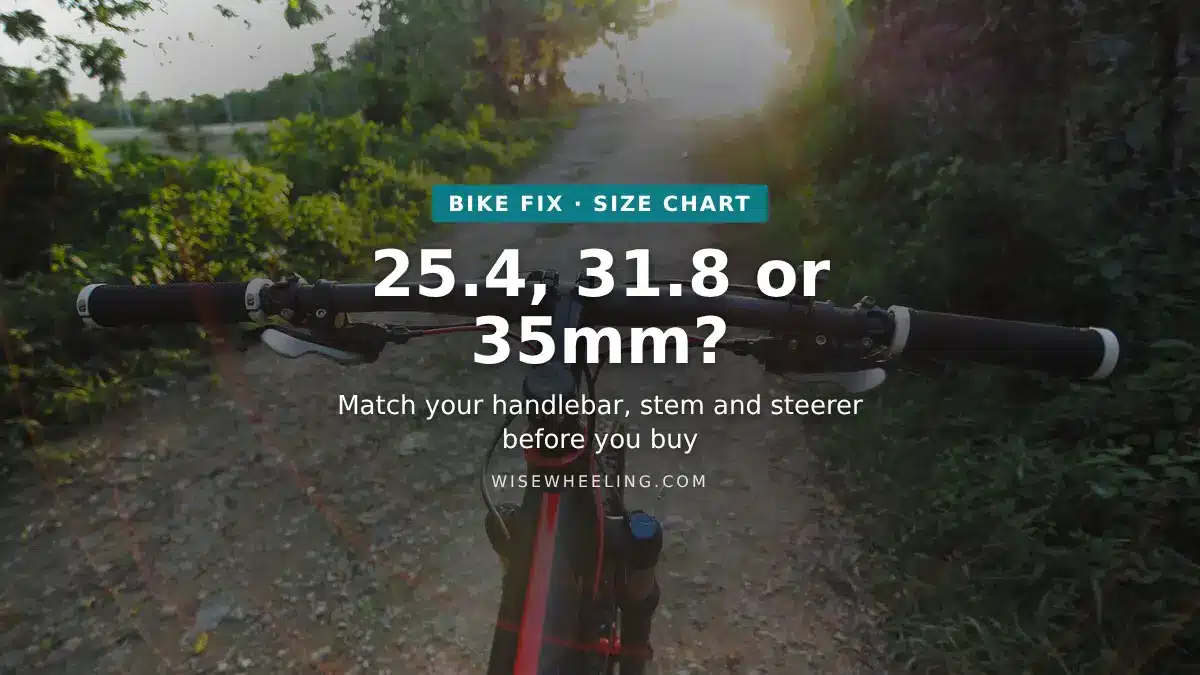
Most handlebars sold today clamp at 31.8 mm, newer trail and enduro mountain bike bars are often 35 mm, and older or budget flat bars are usually 25.4 mm. Older Italian-standard road bars are 26.0 mm, and BMX and old steel bars are 22.2 mm. The bar’s clamp diameter has to match the stem exactly, and the stem’s other clamp has to match your fork steerer, which on a modern threadless fork is usually 1-1/8 in (28.6 mm) where the stem clamps. Because 25.4, 25.8 and 26.0 mm are only fractions of a millimeter apart, Park Tool says to measure the bar with a metric caliper right where the stem clamps instead of guessing.
Handlebar clamp diameter chart
This chart lists every clamp size you’re likely to see on a US bike, from current standards to the obsolete ones that still show up on garage-sale road bikes and old 3-speeds. The circumference column is there so you can identify a bar with a strip of paper or a tape measure if you don’t own a caliper (see the tool below).
| Clamp diameter | Circumference | Grip / control area | Where you’ll find it | Status |
|---|---|---|---|---|
| 35.0 mm (1-3/8 in) | 110.0 mm (4.33 in) | 22.2 mm | Modern trail, enduro and downhill MTB bars; introduced by Easton in 2012 | Current |
| 31.8 mm (1-1/4 in, sometimes listed as 31.7) | 99.9 mm (3.93 in) | 22.2 mm flat / 23.8 mm drop | Most modern road, gravel, hybrid and MTB bars | Current |
| 26.0 mm | 81.7 mm (3.22 in) | 23.8 mm | Italian-standard drop bars, many pre-2010 road bikes | Legacy |
| 25.8 mm | 81.1 mm (3.19 in) | 23.8 mm | Some Italian drop bars made to fit either 25.4 or 26.0 stems | Legacy |
| 25.4 mm (1 in) | 79.8 mm (3.14 in) | 22.2 mm flat / 23.8 mm drop | ISO size: flat and riser bars on 1990s–2000s bikes, many budget bikes today, older drop bars | Current (mostly lower-end and retro) |
| 22.2 mm (7/8 in) | 69.7 mm (2.75 in) | 22.2 mm | BMX bars, old steel MTB bars, some kids’ bikes | Current (BMX) |
| 26.4 mm | 82.9 mm | 23.8 mm | Older Cinelli drop bars (Cinelli switched to 26.0 in 1998) | Obsolete |
| 27.0 mm | 84.8 mm | 23.8 mm | Titan drop bars | Obsolete |
| 23.8 mm (15/16 in) | 74.8 mm | 22.2 mm | Old British steel bars, older 3-speeds | Obsolete |
| 25.0 mm | 78.5 mm | 23.5 mm | Old French bars | Obsolete |
Two things in that chart trip people up. First, a 31.8 mm bar isn’t 31.8 mm everywhere: it tapers down to 22.2 mm at the grips on a flat bar or 23.8 mm at the levers on a drop bar, so your shifters, brake levers and grips don’t change when you move to an oversized bar. Second, “road size” is a misleading label. Sheldon Brown points out that 26.0 mm is the Italian standard and is “sometimes incorrectly called ‘road’ size”, while plenty of older drop bars are 25.4 mm.
Identify your bar and check a stem fit (tool)
Enter what you measured to find the matching standard, then check whether a stem you’re eyeing will fit both your bar and your fork.
1. What size is my handlebar?
2. Will this stem fit?
How the tool works: circumference is converted with diameter = circumference ÷ π (inches × 25.4 first). A caliper reading must land within 0.15 mm of a standard to count as a match; a tape or paper-strip reading gets ±0.35 mm because a 1 mm error in circumference is about 0.3 mm in diameter. Sizes come from the chart above; shim pairs listed as “sold” are ones we found as real products (Problem Solvers 25.4→26.0 via Harris Cyclery, Wheels Manufacturing 25.4→31.8 and 31.8→35.0, and 26.0→31.8 shims).
Steerer and quill stem sizes
A stem has two clamps, and the second one is the one people forget. The stem’s steerer clamp has to match the outside diameter of your fork’s steerer tube. Park Tool lists 1 in, 1-1/8 in, 1-1/4 in and 1-1/2 in as the common steerer sizes. Old threaded forks take a quill stem instead, and the quill is always smaller than the headset size it’s named after.
| Steerer size | Steerer OD | Threadless stem clamp | Quill stem diameter (threaded fork) | Typical use |
|---|---|---|---|---|
| 1 in | 25.4 mm | 25.4 mm | 22.2 mm (7/8 in) | Most threaded-headset road and touring bikes, vintage bikes |
| 1-1/8 in | 28.6 mm | 28.6 mm | 25.4 mm (1 in) | Modern threadless forks, and the top of most tapered 1-1/8 to 1-1/2 in forks; threaded 1-1/8 is a rarer, mostly 1990s size |
| 1-1/4 in | 31.8 mm | 31.8 mm | 28.6 mm | Tandems; Giant OverDrive 2 forks taper from 1-1/2 to 1-1/4 in at the stem |
| 1-1/2 in | 38.1 mm | 38.1 mm | n/a | Straight OnePointFive downhill and freeride forks |
Sheldon Brown’s rule is worth remembering: on a threaded fork, the stem’s shaft is 1/8 in smaller than the steerer. That’s why a “1 inch” headset takes a 7/8 in (22.2 mm) quill, and why people who measure the quill and order a 7/8 in headset get the wrong part. A few older bikes are exceptions: Harris Cyclery lists 21.15 mm (13/16 in) quills on older American bikes and BMX, and 22.0 mm quills on older French bikes.
Giant owners should check before buying a stem. A fork built to Giant’s OverDrive 2 standard is 1-1/4 in where the stem clamps, so a standard 1-1/8 in stem won’t fit it directly. If you’re raising your bars and the stem is the limit, our guide to raising bike handlebars covers spacers, flipping the stem and quill stems.
How to measure handlebar clamp diameter
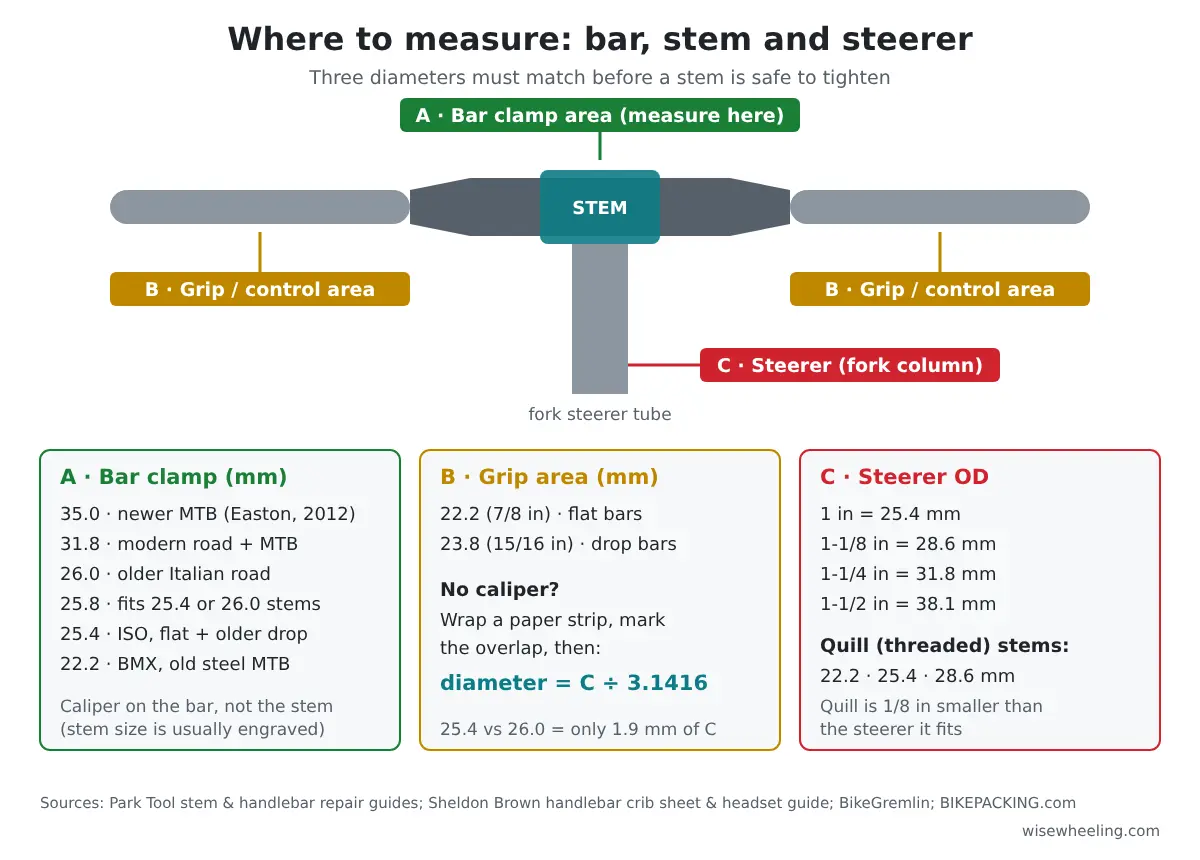
- Look for a marking first. Many bars have the clamp size printed near the center section, sometimes hidden under the stem, so you may have to loosen the faceplate and slide the bar a little to see it. Park Tool notes the stem’s size is “typically engraved or labeled,” but sometimes it isn’t, and that a stem’s clamp is hard to measure accurately.
- Measure the bar, not the stem. Close a caliper on the center section of the bar, right where the stem clamps. Take two readings 90 degrees apart and use the average. A Dasqua 6 in digital caliper or any caliper that reads to 0.01 mm is plenty.
- No caliper? Use circumference. Wrap a thin strip of paper around the center of the bar, mark where it overlaps, lay it flat and measure in millimeters. Divide by 3.1416, or put the number into the tool above.
- Measure the steerer the same way. On a threadless fork, measure the bare steerer above the headset or read the stem’s steerer clamp marking. On a threaded fork, measure the quill and add 1/8 in to get the headset size.
- Check the grip area if you’re moving controls. 22.2 mm means flat-bar grips and levers; 23.8 mm means road levers and drop-bar shifters.
Why the paper-strip method can’t tell 25.4 from 26.0
Here’s the math most guides skip. A 25.4 mm bar has a circumference of 79.8 mm, a 25.8 mm bar 81.1 mm, and a 26.0 mm bar 81.7 mm. That’s a 1.9 mm spread across three sizes, and a paper strip or soft tape is easily off by a millimeter. So circumference reliably separates 22.2, 25.4-ish, 31.8 and 35 mm bars (they’re 10 mm or more apart), but for the 25.4/25.8/26.0 group you need a caliper or the printed marking. Park Tool warns that some clamp diameters “are within fractions of a millimeter of each other and are not cross-compatible.”
Can you use a shim to fit a smaller bar?
Yes, but only in one direction. A shim is a thin split sleeve that makes a smaller bar fit a larger stem clamp, such as a 25.4 mm bar in a 31.8 mm stem. Nothing makes a bigger bar fit a smaller stem, and you should never spread, file or bend a clamp to try. Common pairs that are sold as shims:
- 25.4 to 31.8 mm, the most common case (an old flat bar in a modern stem): Wheels Manufacturing 25.4-31.8 handlebar shim.
- 31.8 to 35.0 mm, for running a 31.8 bar in a 35 mm MTB stem: Wheels Mfg 31.8 to 35.0 mm shim.
- 25.4 to 26.0 mm, for an ISO bar in an Italian-size stem: Problem Solvers 25.4 to 26.0 shim.
- 26.0 to 31.8 mm, for an old road bar in a modern stem.
Fit the shim properly. Surly’s handlebar instructions say to center the shims on the handlebar first, then center the bar in the stem, then fit the faceplate. Tighten in small, even steps to the stem maker’s torque (our stem bolt torque chart lists common values) and check that the faceplate gaps end up even. With carbon bars or carbon stems, read both makers’ instructions before shimming, because carbon parts often come with tighter rules on what can clamp them. Surly, for example, says its bars aren’t meant for carbon stems. If a bar still rotates after a correct install, work through our guide on handlebars slipping in the stem before you ride it.
Steerers can be shimmed too, again only from small to large. A 1 in threadless steerer takes a 1-1/8 in stem with a split shim like the OMNI Racer 1 in to 1-1/8 in stem shim (25.4 to 28.6 mm).
31.8 vs 35 mm: which should you buy?
If you’re only replacing one part, the answer is easy: match what you’re keeping. A new stem matches the bar you have, and a new bar matches the stem. The choice only matters when you’re buying both.
| Your situation | Pick | Why |
|---|---|---|
| Road, gravel, hybrid or commuter bike | 31.8 mm | The modern standard for drop and flat bars, with the widest choice of bars, stems and accessory mounts |
| Trail, enduro or downhill MTB, bike came with 35 mm | 35 mm | Easton developed 35 mm in 2012 for high-load riding as bars got wider; it’s now common on modern trail bikes |
| Bikepacking or lots of bar-mounted gear | 31.8 mm, or check mounts first | BIKEPACKING.com notes most accessory clamps (bells, GPS and light mounts) are sized for 22.2 and 31.8 mm, and readers report a lack of 35 mm options |
| Restoring a vintage road or 1990s mountain bike | Keep 25.4 or 26.0 | Original-size bars and stems are still made; shimming is an option if you want a modern stem |
| BMX | 22.2 mm bar | BMX bars are straight 22.2 mm tubing braced with a crossbar |
Width is a separate decision from clamp size. If you’re changing bars anyway, see how to measure handlebar width so the new bar fits your shoulders as well as your stem. The same “measure, don’t guess” approach applies to seatposts, which have even more sizes; our seatpost size chart covers them.
Tools for the job
- Digital caliper reading to 0.01 mm: Dasqua 6 in/150 mm digital caliper.
- Torque wrench covering roughly 2–15 Nm for stem and faceplate bolts: bike torque wrenches on Amazon.
- Correct-size hex keys for your stem bolts, plus a paper strip and ruler if you have no caliper.
Measuring takes a couple of minutes, and a bar or stem swap is a normal home-mechanic job. Have a shop do it if the bar or stem is carbon and you don’t own a torque wrench, if the stem size isn’t marked anywhere, or if the bar has crash damage. Park Tool’s advice: “Incompatible components can be a safety hazard, so always double-check with the manufacturer for specifications and compatibility information.”
FAQ
Are all handlebars 31.8 mm now?
No. 31.8 mm is the most common modern size, but many trail and enduro mountain bikes use 35 mm, many budget and retro bikes still use 25.4 mm, and BMX bars are 22.2 mm. Check the marking or measure before you buy.
Can I put a 26.0 mm bar in a 25.4 mm stem?
No. The bar is bigger than the clamp, and you should never spread or force a clamp to make it fit. The exception is a 25.8 mm bar, which was made to fit either 25.4 or 26.0 mm stems. The reverse (a 25.4 bar in a 26.0 stem) works with a 25.4-to-26.0 shim.
Is 31.7 mm the same as 31.8 mm?
Yes. Both are the 1-1/4 in oversized standard; some makers round the inch figure to 31.7 mm and others to 31.8 mm.
How do I tell what size stem my bike has?
Look for two numbers engraved or printed on the stem: the bar clamp (for example 31.8) and the steerer clamp (usually 1-1/8 in or 28.6 mm). If there’s no marking, measure the handlebar center and the fork steerer with a caliper, because the stem’s own clamp is hard to measure accurately.
Do I need new grips or brake levers with a 31.8 mm bar?
Usually not. Oversized bars taper to the normal 22.2 mm (flat bar) or 23.8 mm (drop bar) where grips, levers and shifters mount, the same as 25.4 mm bars of the same type.

Suryashankar Dasgupta founded Wise Wheeling. He has been cycling for more than 20 years, on geared and single-speed bikes, across many kinds of terrain. His guides cover bike repair, fit and gear, and each one is checked against manufacturer manuals, Park Tool and other primary sources before it’s published. Read how guides are made: https://wisewheeling.com/editorial-policy/