Back Wheel Stops Spinning Quickly, No Brake Rub? 4 Causes
When the back wheel stops spinning fast but the brake isn’t rubbing, the drag is almost always inside the wheel: hub bearings adjusted too tight or worn out, a dry or worn freehub, or a wheel that isn’t seated and clamped right in the frame. Less often, something outside the hub is still touching, such as the rotor, the caliper pistons or the tire.
You can sort out which one in about ten minutes with your hands. The finder below turns three quick hand tests into a likely cause, and the sections after it show the fix for each. Park Tool’s rule for hubs applies throughout: judge a hub by play and knocking, not by how smoothly it spins (Park Tool, hub overhaul and adjustment).
Rear wheel drag finder
Take the rear wheel out of the bike first. Hold it by the axle ends, then do the tests and pick the closest answer.
Rear wheel drag finder
The 4 causes, how to test each, and the fix
| Cause | Quick test | Fix | Source |
|---|---|---|---|
| 1. Bearings too tight or worn | Rock the axle out of the bike. No play means too tight. Gritty turning means dirty or worn. | Cup-and-cone: loosen the left locknut, back off the cone 1/32 turn, retighten. Worn surfaces: replace parts. | Park Tool |
| 2. Freehub dry, dirty or worn | Turn the cassette backward by hand. Rough, sticky or slipping is a fault. | Flush with solvent, dry, add liquid oil. Replace the freehub if it still slips or is rough. | Park Tool |
| 3. Wheel not seated or clamped right | Does it spin longer out of the frame than in it? | Seat the hub fully, close the quick release to resistance at 90°, or tighten the thru-axle. | Park Tool |
| 4. Something still touching | Spin the wheel in the frame and watch rotor, caliper, tire and stays. | Fix the contact. See the links in the cause 4 section. | Visual check |
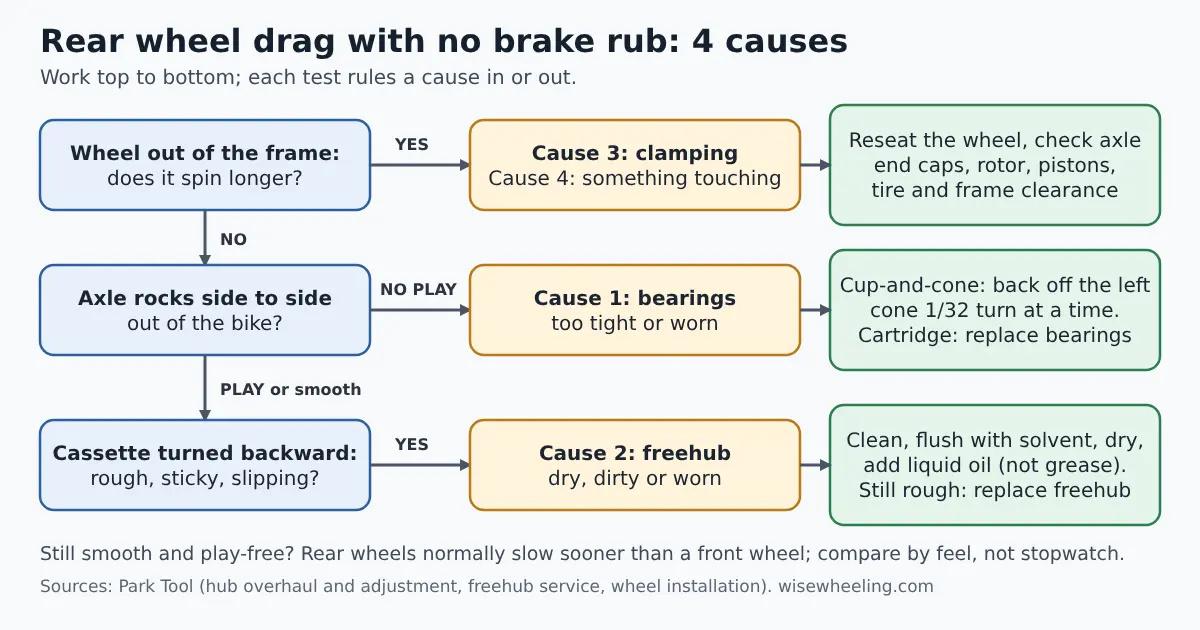
Start here: hub problem or installation problem?
Spin the wheel in the bike, then lift it out and spin it again by holding the axle ends. If it runs noticeably longer out of the frame, the hub is probably fine and the cause is in how the wheel sits or what touches it (causes 3 and 4). If it drags the same either way, the drag is in the hub (causes 1 and 2).
Cause 1: Bearings too tight or worn
Bearings are the usual suspect, and over-tightening is as likely as wear. Park Tool says it is hard to set a bearing by feeling for smoothness. Its rule is to use the loosest setting that has no knocking or play (Park Tool).
Cup-and-cone hubs: check and adjust
- Grab the wheel in the frame and pull it side to side. Then take it out and rock the axle by hand.
- Play out of the bike that disappears once the wheel is clamped in the frame is acceptable. If there is no play out of the bike, the adjustment is too tight. If play remains with the skewer closed, it is too loose.
- On a rear wheel the bearings are adjusted on the left side. Hold the cone with a cone wrench and loosen the locknut.
- Turn the cone in small steps. Park Tool suggests about 1/32 of a full turn at a time.
- Hold the cone, retighten the locknut, and test for play again. Repeat until the play is gone with the wheel clamped.
If you cannot find a setting that has no play and still turns reasonably smoothly, Park Tool says the internal bearing surfaces are probably worn out. Dull balls should be replaced, not reused (Park Tool). Hubs with sealed cartridge bearings have no cone to adjust, so follow the hub maker’s service instructions to replace the bearings.
Cause 2: Freehub dry, dirty or worn
The freehub is the part that lets you coast. Park Tool notes that the pawls may begin to slip and the bearings may become rough as it wears, and that most manufacturers call for liquid lubricant inside, because grease is typically not required there (Park Tool, freehub service).
- Where the freehub body comes off, flush it with solvent, dry it, lubricate it with oil, and reinstall it.
- Do not soak a freehub in solvent while it is on the hub. Park Tool says to wipe it with a damp rag instead, because solvent strips its internal lubrication (Park Tool). Drag that started right after a wheel wash or degreasing points here.
- Park Tool does not recommend dismantling the freehub completely. If cleaning and oil do not fix slipping, sticking or noise, the freehub is worn out and the whole unit is replaced.
Which freehub your wheel uses decides which replacement fits. Use our freehub body types chart before ordering one.
Cause 3: Wheel not seated or clamped right
A hub that spins freely out of the bike but drags in it is being squeezed or twisted by how it is held. Park Tool’s installation checklist: the hub fully seated in the dropouts, the quick release tightened until the lever meets resistance at 90° to the frame or fork, or the thru-axle turned clockwise until tight, and the wheel centered (Park Tool, wheel removal and installation). Park also says the skewer must be fully secure on disc brake bikes, so do not leave it loose to cure drag.
Park’s bearing rule allows a little play out of the bike because clamping takes it up. A hub set with no play out of the bike is therefore tighter still once the skewer is closed, which is why a hub that spins well on the bench can drag in the frame.
Cause 4: Something is still touching
Removing the pads rules out pad contact only. Check the rotor against the caliper body, a caliper piston that stays out, a tire touching the frame or a fender, and mud packed around the stays. Our guides cover those:
- How to fix a rubbing disc brake
- Disc brake that rubs only when riding
- Rear tire rubbing the frame under load
Is a quick stop normal for a rear wheel?
There is no published spin-time spec, so a stopwatch can’t tell you. A rear hub carries a freehub as well as bearings, so it usually spins down sooner than a front hub. Judge it by the tests above: no play when clamped, a smooth axle, a freehub that ticks evenly. If all pass, the wheel is fine. If the wheel does need tightening after a long time on the road, see how to tighten a loose rear hub.
Suryashankar Dasgupta founded Wise Wheeling. He has been cycling for more than 20 years, on geared and single-speed bikes, across many kinds of terrain. His guides cover bike repair, fit and gear, and each one is checked against manufacturer manuals, Park Tool and other primary sources before it’s published. Read how guides are made: https://wisewheeling.com/editorial-policy/