What Size Seatpost Do I Need? 27.2, 30.9 or 31.6 (+ Finder)
This post contains Amazon affiliate links. As an Amazon Associate I earn from qualifying purchases, at no extra cost to you.
The seatpost you need is the exact outside diameter of your old post, to 0.1 mm. That number is usually stamped near the bottom of the post, and the sizes you’ll see most are 27.2 mm on road, gravel and many hybrid bikes, 30.9 or 31.6 mm on mountain bikes, and 34.9 mm on some newer frames. If there’s no stamp, measure the post with a caliper, or average two or three readings of the seat tube’s inside diameter and subtract about 0.1 mm. A post that’s “close enough” will slip or damage the frame, so never round to the nearest whole millimeter.
Seatpost size finder: turn your measurement into a size
Enter what you measured. The finder matches it to the sizes riders actually run into, tells you how much post has to stay in the frame, and lists the dropper posts and shims that exist for that size.
How it works: post readings match within 0.06 mm; seat tube readings subtract the roughly 0.1 mm clearance Park Tool describes; circumference is divided by pi. The size list combines the sizes in Sheldon Brown’s seatpost list with current dropper and shim sizes. Dropper and shim data come from the makers’ pages linked in the tables below (checked October 2026).
Seatpost size chart: 27.2 vs 30.9 vs 31.6 vs 34.9
This is the table most size charts leave out: what each size actually lets you buy. A 27.2 mm frame has plenty of rigid posts to choose from but only a couple of droppers, while 30.9 and 31.6 mm open up nearly every dropper on the market.
| Post size | Where you usually find it | Min. insertion, 2.5x rule | Droppers made in this size (checked) | Shim options |
|---|---|---|---|---|
| 25.4 mm | Some older bikes (Sheldon Brown list) | 64 mm | None of the five we checked | Can’t shim a 27.2 post down into it (Redshift) |
| 26.0-27.0 mm (0.2 mm steps) | Older steel road and touring frames | 65-68 mm | None of the five we checked | Not listed by Redshift |
| 27.2 mm | Sheldon Brown calls it the de facto standard for quality bikes with 1-1/8 in seat tubes; common on road and gravel bikes | 68 mm | OneUp V3 (90, 120 mm drop); FOX Transfer SL (50, 70 mm) | 27.2 post fits 28.6, 29.8, 30.0, 30.4, 30.9, 31.6, 31.8 mm frames with a shim |
| 30.9 mm | Oversized; common on mountain bikes | 78 mm | OneUp V3, FOX Transfer, FOX Transfer SL (75, 100 mm), RockShox Reverb AXS, PNW Loam Gen 2 | Takes a 27.2 post with a 27.2-30.9 shim |
| 31.6 mm | Oversized; common on mountain bikes | 79 mm | OneUp V3, FOX Transfer, FOX Transfer SL (75-150 mm), RockShox Reverb AXS, PNW Loam Gen 2 | Takes a 27.2 post with a 27.2-31.6 shim |
| 34.9 mm | Some newer mountain bike frames | 88 mm | OneUp V3 (120-240 mm), FOX Transfer, RockShox Reverb AXS, PNW Loam Gen 2 | Takes a 31.6 post with a 31.6-34.9 shim |
Two things stand out. First, 27.2 mm is the size with the fewest dropper choices, so a gravel rider who wants a long drop often ends up looking at frames, not posts. Second, Park Tool’s dropper sizing guide calls 30.9 and 31.6 mm the two most common dropper sizes, and every long-travel dropper we checked comes in both.
How to measure seatpost diameter (and which methods to trust)
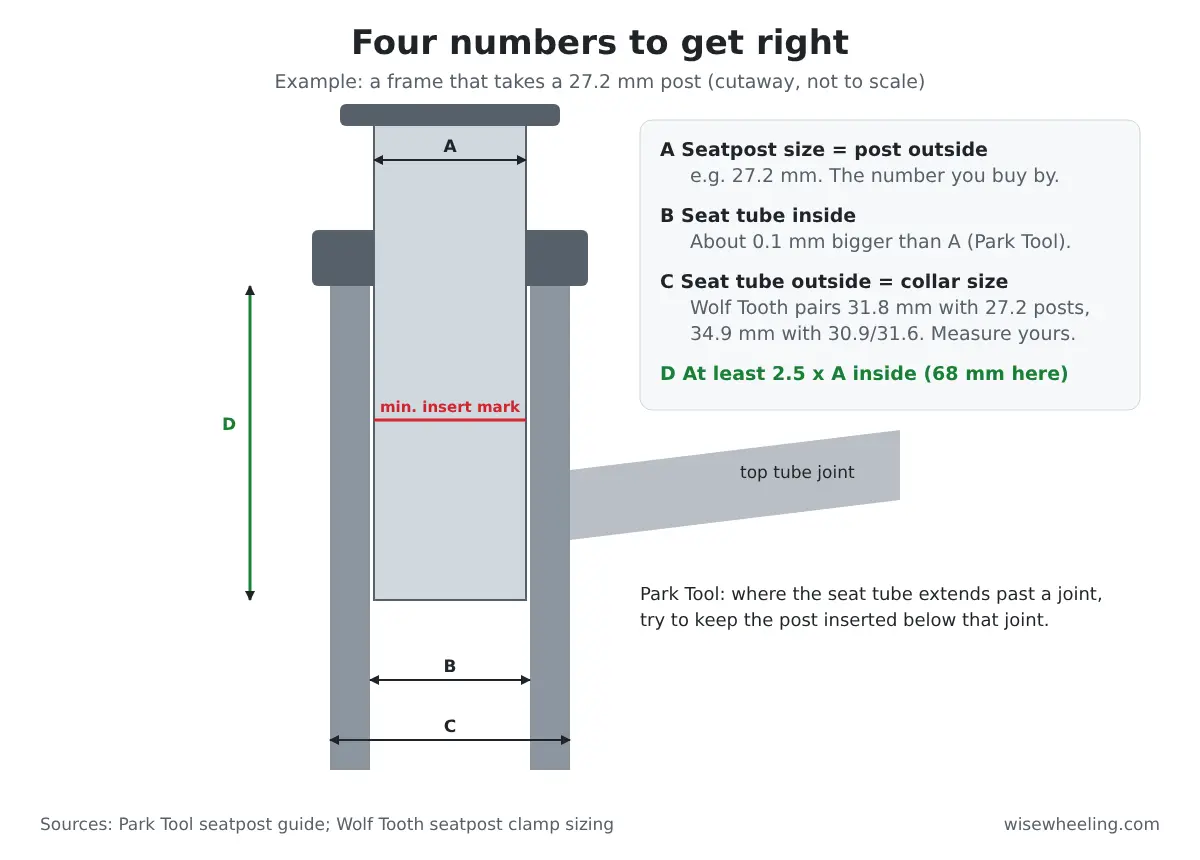
Seatpost standards sit very close together. Park Tool points out that some are within 1 mm of each other and that a post is typically only about 0.1 mm smaller than the seat tube it slides into. That’s why the method matters as much as the number.
- Read the stamp. Pull the post (mark the height first with tape) and look near the bottom. Both Park Tool and Sheldon Brown say the diameter is usually printed there.
- Measure the post with a caliper. Close the jaws squarely on a clean, round section, take two or three readings rotated around the post, and round to the nearest 0.1 mm. Park Tool’s own example reads 30.87 mm and calls it 30.9. Any digital caliper that reads to 0.01 mm works, such as the NEIKO 01407A digital caliper (check the current price on Amazon).
- No post? Measure the seat tube. Use the caliper’s inside jaws, take two or three readings at different positions and average them (Park Tool’s method). Subtract about 0.1 mm to get the post size.
- No caliper? Use the frame spec. Park Tool notes that bike makers’ websites often list the seatpost or seat tube diameter. Search your exact model and year.
Sheldon Brown also mentions closing an adjustable wrench until it just slips over the post and measuring the jaw gap. It’s a workable shop trick, but the gap reading is only as good as your ruler, so confirm with the stamp or spec before you buy.
Why the tape-measure trick fails
Several guides suggest wrapping a tape around the post and dividing by pi. The math is right, but the precision isn’t there. Diameter equals circumference divided by 3.14, so a tape that’s off by just 1 mm puts you off by about 0.3 mm. A 27.2 mm post has a circumference of about 85.5 mm, while 27.0 mm is about 84.8 mm. That’s less than one millimeter of tape, which is closer than most people can read a cloth tape wrapped around a tube. Use the tape only to tell a 27.2 from a 31.6, never to decide between 27.0 and 27.2 or 30.8 and 30.9.
Which seatpost fits your bike? The 5-step check
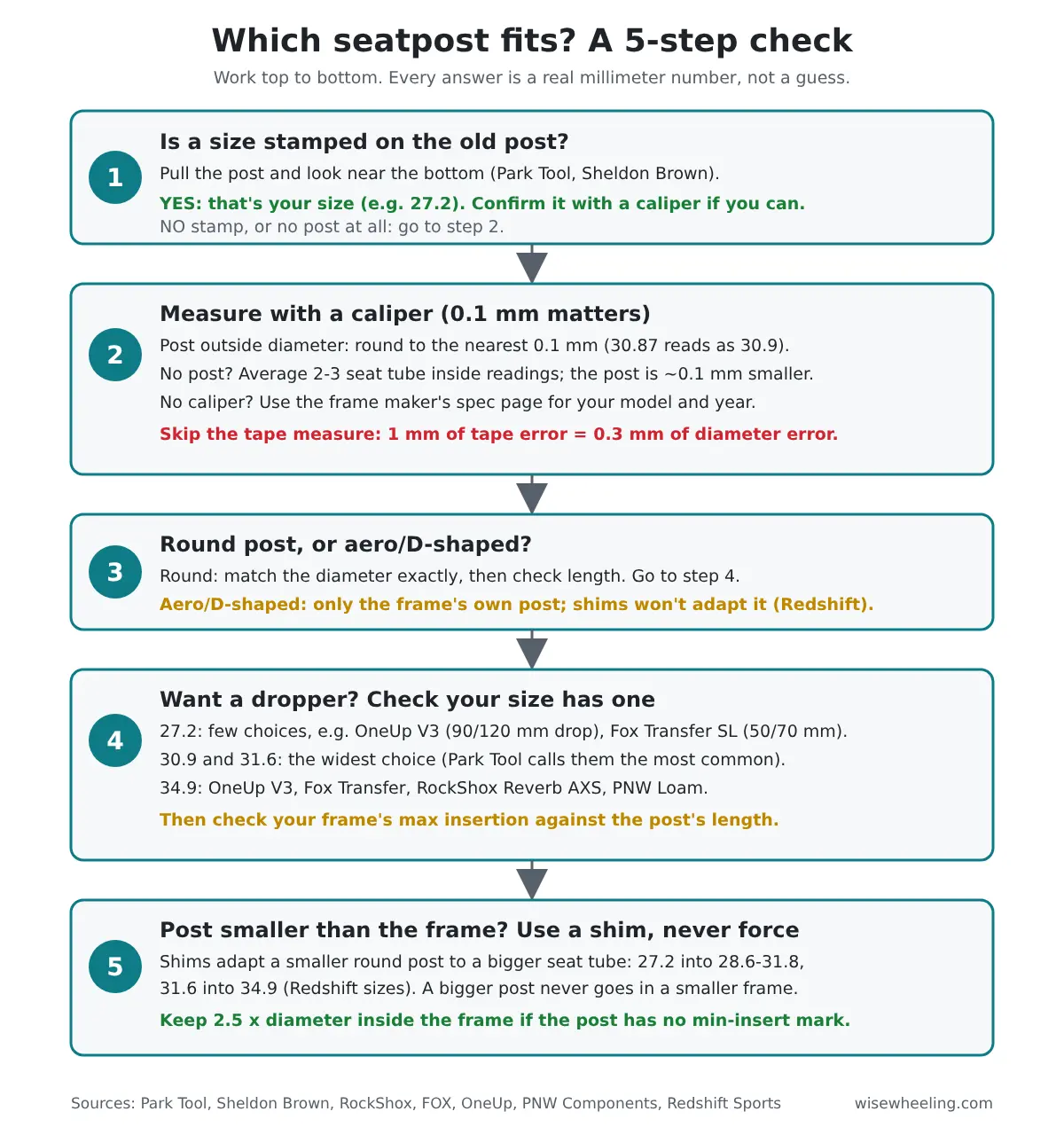
Diameter is only the first check. A mechanic swapping a post also looks at the shape (round or aero), the length you need versus how deep the frame lets the post go, and whether a shim makes more sense than a frame-specific part. The flowchart above runs those checks in the order that saves you a return.
Older steel bikes: why 27.0 and 26.8 trip people up
If you’re fixing up a bike from the 1970s through the ’90s, don’t assume 27.2. We tallied the reader-supplied list on Sheldon Brown’s seatpost page. Of the roughly 275 bikes with a size listed, about one in three uses 27.2 mm, and 27.0, 26.8 and 26.6 mm together account for roughly 40%. Only one entry lists 30.9 mm, which tells you the list skews toward older frames. Sheldon Brown warns the list is unverified and that frames can be reamed or vary, so treat it as a hint and measure.
The 0.2 mm steps are the trap. A 27.0 mm post in a 27.2 mm frame feels like it fits, then slips or creaks no matter how hard you crank the bolt. If your post keeps sinking, our guide to a seatpost that keeps slipping even when tight walks through the other causes.
Can you use a smaller seatpost with a shim?
Yes, as long as the post is round and smaller than the frame. A shim is a thin sleeve that fills the gap. Redshift Sports sells shims that adapt a 27.2 mm post to seat tubes of 28.6, 29.8, 30.0, 30.4, 30.9, 31.6 and 31.8 mm, and a 31.6 mm post to a 34.9 mm seat tube. Redshift also spells out the limits: shims don’t work with oval or aero posts, and you can’t shim a larger post into a smaller frame, such as a 27.2 mm post into a 25.4 mm seat tube.
A shim is how you’d run a 27.2 mm suspension or dropper post on a bike with a bigger seat tube, or to use a 31.6 mm dropper in a 34.9 mm frame when the length you need only comes in 31.6. If you go that route, look for a Redshift seatpost shim in the exact from-to sizes you measured.
Dropper posts: diameter is only half the fit

A dropper has to match your diameter and fit between two limits: it needs enough post inside the frame to be safe, and the frame has to let it go deep enough for your saddle height. Park Tool defines maximum insertion as how far a post goes in before something stops it. Measure it by sliding a rigid post in until it hits a bend, bolt or pivot, marking it at the collar, and measuring. The makers publish their own minimums, and they’re longer than the generic 2.5x rule:
| Dropper | Drop | Minimum frame insertion |
|---|---|---|
| RockShox Reverb AXS B1/B2 (30.9, 31.6, 34.9) | 100-175 mm | 80 mm |
| RockShox Reverb AXS B1/B2 | 200 / 225 / 250 mm | 110 / 120 / 160 mm |
| PNW Loam Gen 2 (30.9, 31.6, 34.9) | 125 / 150 / 175 / 200 / 225 mm | 90 / 120 / 120 / 150 / 190 mm |
| FOX Transfer SL (27.2, 30.9, 31.6) | 50-150 mm | 80 mm |
RockShox’s advice for riders between two lengths is worth repeating: pick the shorter travel. A dropper that’s too long can’t go low enough for your saddle height, and you can’t fix that with adjustment. Get your saddle height right first (our seat height guide uses the inseam x 0.883 method), then measure from the collar to the saddle rails and compare it with the maker’s chart.
Mistakes that get the wrong seatpost ordered
- Buying the collar by the post size. The seatpost clamp wraps the outside of the seat tube, so it’s a different number. Wolf Tooth sizes its clamps by seat tube: 31.8 mm for frames that take a 27.2 mm post and 34.9 mm for 30.9 and 31.6 mm posts, and says its clamps fit within plus or minus 0.5 mm of the listed size.
- Confusing 31.6 and 31.8. 31.6 mm is a post size; 31.8 mm is usually a seat tube outside size (and a handlebar clamp size). Write down which one you measured.
- Calling 30.8 “close enough” to 30.9. Both exist. Measure with a caliper.
- Ignoring the minimum insertion mark. Park Tool says to look for a min-insert or max-height mark, and with no mark keep at least 2.5 times the diameter in the frame (68 mm for a 27.2 post). Where the seat tube extends past the top tube joint, try to keep the post below that joint.
- Greasing a carbon post. Park Tool suggests grease or anti-seize for metal posts in metal frames, while a carbon post in a carbon frame can usually go in dry unless the maker says otherwise. For a post that slips, Park Tool recommends its SAC-2 assembly compound, a gritty paste (Park Tool SAC-2 on Amazon).
- Over-tightening to stop a slip. Use the torque printed on the collar or frame, which Park Tool treats as a recommendation since the collar maker rarely makes the post. FOX’s Transfer troubleshooting tells riders not to go above 5 N·m (44 in-lb). A small low-range bike torque wrench takes the guesswork out; our stem bolt torque guide covers the same habit for the cockpit.
Seatpost size FAQ
Can I put a 27.2 seatpost in a 30.9 or 31.6 frame?
Yes, with the matching shim (27.2-to-30.9 or 27.2-to-31.6) and a round post. Without a shim it will slip and can damage the frame.
Can I use a 31.6 post in a 30.9 frame?
No. A bigger post never goes into a smaller seat tube. Don’t sand, ream or force it; buy the correct size.
How do I find my seatpost size without removing it?
Look up your bike’s spec page; Park Tool notes that makers often list the seatpost or seat tube diameter. The stamp on the post is usually hidden inside the frame, so you’ll have to pull the post to read it. Mark the height with tape first so you can put it back exactly, or recheck it with our loose bike seat guide.
Is a slightly smaller seatpost OK if I tighten it more?
No. Seatpost sizes are only 0.2 mm apart in places, and a post is supposed to be only about 0.1 mm smaller than the seat tube. Extra torque on an undersized post squeezes the frame and still lets the post move.
What is the most common seatpost size?
27.2 mm is the de facto standard on road, gravel and many hybrid bikes. On mountain bikes, 30.9 and 31.6 mm are the most common, with 34.9 mm on some newer frames.
When to let a shop measure it
Take the bike in if the post is stuck, the seat tube is carbon and you see cracks near the collar, the frame is a vintage or custom build with no spec online, or your readings fall between two sizes. A shop with a sizing rod set can confirm the number in a minute, which is cheaper than buying the wrong post twice.

Suryashankar Dasgupta founded Wise Wheeling. He has been cycling for more than 20 years, on geared and single-speed bikes, across many kinds of terrain. His guides cover bike repair, fit and gear, and each one is checked against manufacturer manuals, Park Tool and other primary sources before it’s published. Read how guides are made: https://wisewheeling.com/editorial-policy/