Bike Chain Length: How Many Links? Calculator + Maker Rules
This post contains Amazon affiliate links. As an Amazon Associate I earn from qualifying purchases, at no extra cost to you.
There is no single link count that fits every bike. Wrap the chain around your biggest chainring and biggest cog (skip the derailleur), mark where the ends overlap, then add links: 2 per Park Tool for cogs up to 36T, 4 to 7 per Shimano for MTB drivetrains, and 2 to 4 per SRAM for Eagle AXS. Then prove it on the bike with a big-big and small-small check. The calculator below gives you a starting number so you buy the right chain.
Bike chain length calculator (starting link count)
How it works: the calculator finds the length of a closed loop of chain around your biggest chainring and biggest cog, using the standard open-belt geometry formula: links = 4 × chainstay (in) + (chainring teeth + cog teeth) ÷ 2 + (chainring − cog)² ÷ (8π² × chainstay in). That is plain chain geometry, not a maker spec. It rounds up to the overlap point, adds the links your maker specifies, and rounds up to an even number because a standard chain is built from inner and outer link pairs. Treat the answer as good to about ±2 links: dropout position, chain pitch wear and real-world routing all move it. It is a shopping and cut-long guide, never a replacement for the on-bike check below.
What Park Tool, Shimano and SRAM each tell you to add
Every maker starts from the same place, the biggest ring and biggest cog with the chain bypassing the derailleur, but they count the extra links differently. Here are their published instructions side by side. Use the row for your drivetrain, not an average of them.
| Source and drivetrain | Reference position | Links to add | Notes |
|---|---|---|---|
| Park Tool (rear cogs 36T or smaller) | Closest joinable rivet, big-big, derailleur bypassed | +2 links (two rivets, 1 inch) | No formula given; check small-small for self-contact |
| Park Tool (1x with 42T+ rear cog) | Shortest joinable rivet, big-big | +4 links (four rivets, 2 inches) | Full suspension: disconnect the shock and bottom out the linkage |
| Sheldon Brown (general rule) | Shortest chain that connects, big-big | +1 complete link (an inner plus an outer, so 2 links) | SRAM 1x needs two extra complete links (4 links) |
| Shimano MTB, hardtail, connecting pin | Zero position (ends overlap), big-big | +5 or 6 links | Choice depends on whether the overlap ends on matching or different links |
| Shimano MTB, hardtail, QUICK-LINK | Zero position, big-big | +4 or 5 links | Same |
| Shimano MTB, full suspension, connecting pin | Zero position, big-big | +6 or 7 links | Same |
| Shimano MTB, full suspension, QUICK-LINK | Zero position, big-big | +5 or 6 links | Same |
| SRAM Eagle AXS, hardtail | Where the chain starts to overlap, big-big | +2 inner and +2 outer links (4 links) | Derailleur bypassed |
| SRAM Eagle AXS, full suspension | Same, with the shock compressed to the point where the axle is farthest from the bottom bracket | +1 inner and +1 outer link (2 links) | Deflate or remove the shock if needed |
| SRAM RED XPLR page | No wrap method | Look up a chart using chainring size and chainstay length | Use the chart in the manual or the Full Mount Chain Length Guide |
Why the numbers disagree (and which to trust)
They are not measuring from identical reference points. Park Tool says to find the closest rivet where the ends can join and add two rivets. Shimano sets a zero position where the ends overlap, then adds 4 to 7 links. SRAM adds pairs at the point the chain starts to overlap. Shimano itself says it cannot give one standard value, because the right number depends on the bike type, the connector, and whether the overlap ends on matching or different links. So: follow your drivetrain maker if it has a rule, use Park Tool for a generic derailleur bike, and let the on-bike check below settle any doubt.
Two details most guides skip. First, newer SRAM systems such as RED XPLR do not use the wrap method at all; SRAM points you to a chart that needs your chainring size and chainstay length, so if you ride one, use that chart. Second, full-suspension bikes are measured with the suspension at the point of maximum chain growth. SRAM says to compress the shock to where the rear axle is farthest from the bottom bracket, while Park Tool says to bottom out the linkage; on some frames those are not the same point, so check your frame maker’s note.
How to size and install the chain, step by step
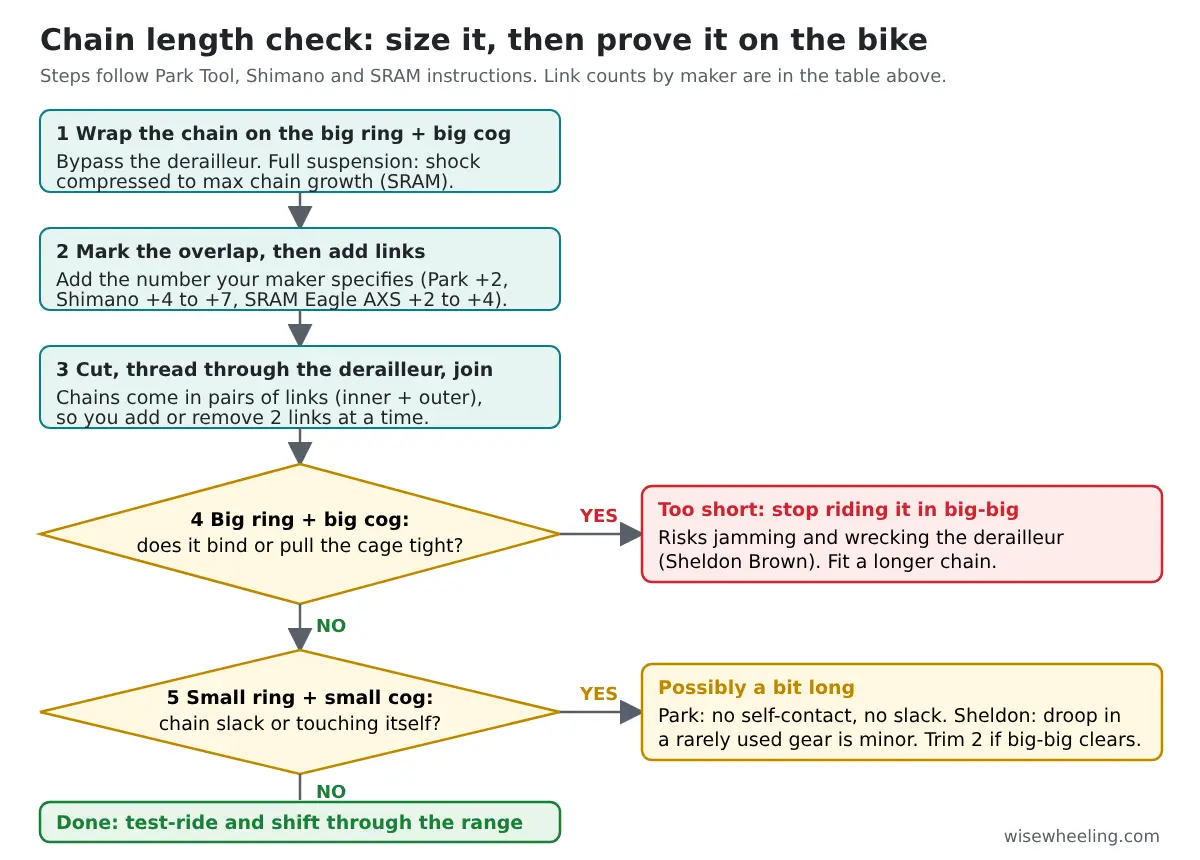
- Shift the chain to the biggest chainring and biggest cog. On a full-suspension bike, set the shock to the maker’s maximum chain growth position first.
- Wrap the new chain around the ring and cog without routing it through the derailleur. Find where the two ends can join, which is your zero position (Park Tool, Sheldon Brown).
- Add the links from the table for your drivetrain. Remember that a standard chain is built in inner and outer pairs, so you add or remove two links at a time.
- Cut the chain with a chain tool (a chain breaker tool on Amazon; check the current price). Thread it through both derailleur pulleys, with the printed side facing out, and join it with a connecting pin or a new quick link (match the quick link to your chain speed).
- Run the checks in the next section before you ride. Cut long first. You can always remove two links, but you cannot add them back.
Check it on the bike: too short vs too long
| What you see | Likely cause | What to do |
|---|---|---|
| Chain binds, or the derailleur cage is yanked forward, in big ring + big cog | Chain too short | Stop using that gear combination. A too-short chain risks jamming and ruining the derailleur (Sheldon Brown). Install a longer chain. |
| Chain touches itself, or has visible slack, in small ring + small cog | Chain a bit long, or the gear range is beyond the derailleur’s capacity | Park Tool wants no self-contact and no slack there. If big-big still clears with two fewer links, shorten it. Otherwise accept some droop in a gear you rarely use (Sheldon Brown). |
| Tight only at one point in suspension travel (full-suspension bikes) | Sized at the wrong point of travel | Re-size with the shock at maximum chain growth (SRAM). |
Do the big-big check by turning the cranks by hand to confirm the chain reaches big-big without binding (Sheldon Brown), not by hammering into that gear under load on a freshly cut chain.
Chain length questions riders ask
Can I just copy the link count from my old chain?
Only if the old chain was the right length to begin with. Shimano notes that a worn chain has loose links, and says to count the old chain only if you know it was originally the correct length. Otherwise size from scratch. A worn chain may also be a sign it is time to replace it; see our guide on how often to replace a bike chain, and a chain wear checker makes that check easy.
What happens if a chain is too long?
It hangs slack in the small-small combinations. Sheldon Brown says that is not a serious problem when those gears are outside the derailleur’s recommended range and you will not use them. Park Tool wants no slack and no self-contact in small-small. Once the length is right, our rear derailleur indexing guide covers fine-tuning the shifting.
What happens if a chain is too short?
Sheldon Brown warns it can jam and ruin the rear derailleur if you shift into the big-big combination, and says never to run a chain that is too short except in an emergency.
Why can I only add or remove two links at a time?
Standard chains alternate inner and outer links, so a clean join needs matching pairs. That is why the calculator rounds to even numbers and why Sheldon Brown talks in “complete links”.
Is a 1x drivetrain different?
Yes. Park Tool says 1x drivetrains with big cogs (42T and larger) need a longer chain than narrow-range setups: four rivets (two inches) past the shortest joinable rivet. SRAM Eagle AXS hardtails add two inner and two outer links. Shimano gives its own numbers by bike type and connector.
When to take it to a shop
If your drivetrain is a SRAM chart-based system, the frame has an unusual suspension layout, or you cannot get both the big-big and small-small checks to pass, a shop can size it in minutes. Shimano itself recommends a dealer if you are unsure. If the chain is now correct but it still skips or jams, start with our chain skipping diagnosis, chain suck on the chainring, or a chain that falls behind the cassette. For roadside fixes, a multi-tool with a chain tool helps; see our multi-tool roundup. Switching to a different cassette too? Confirm it fits your hub first with our freehub body types chart.
Sources
- Park Tool: chain length and sizing (big-big plus two rivets; 1x 42T+ adds four rivets; full suspension).
- Sheldon Brown: derailer adjustment (large/large method, SRAM 1x extra links, too-short and too-long consequences).
- Shimano: how to determine chain length (zero position and link counts by bike type and connector).
- SRAM: sizing a chain for Eagle AXS (hardtail and full-suspension rules). SRAM RED XPLR page: chart-based sizing.

Suryashankar Dasgupta founded Wise Wheeling. He has been cycling for more than 20 years, on geared and single-speed bikes, across many kinds of terrain. His guides cover bike repair, fit and gear, and each one is checked against manufacturer manuals, Park Tool and other primary sources before it’s published. Read how guides are made: https://wisewheeling.com/editorial-policy/