Is the Giant Contend a Gravel Bike? What It Can Handle
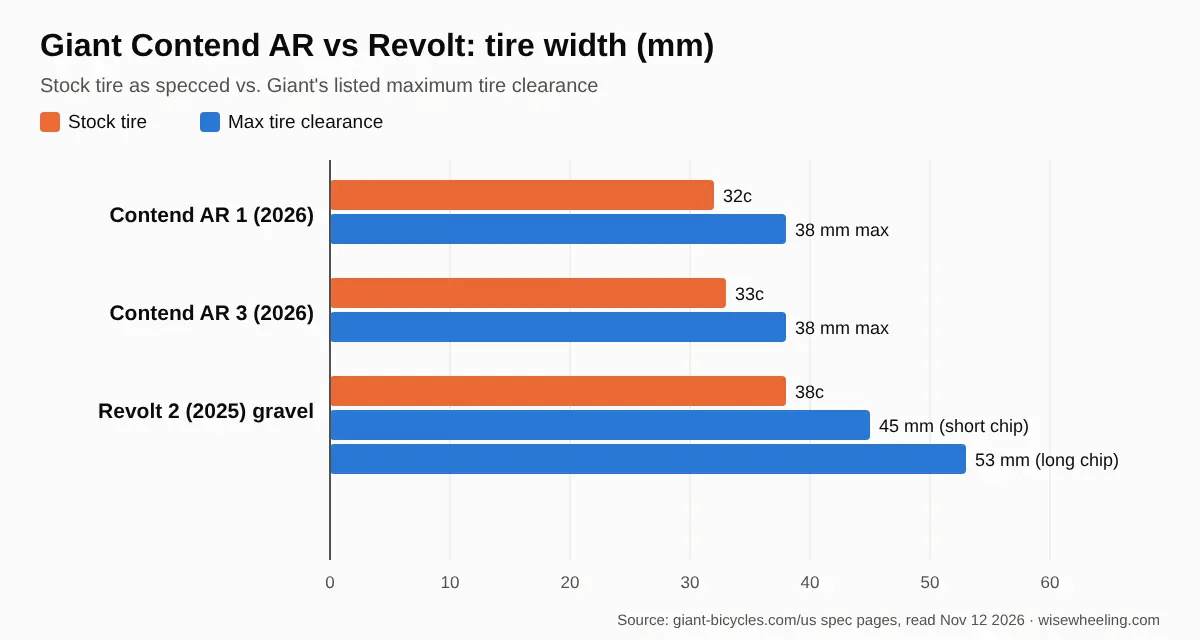
No. Giant sells the Contend AR as an all-rounder road bike, and its gravel bike is the Revolt. That said, the current Contend AR takes tires up to 38 mm and comes with 32 to 33 mm tires, disc brakes and fender mounts, so it handles smooth dirt roads, packed gravel paths and broken pavement well. On loose, rocky gravel or long rough descents, a true gravel bike with room for 45 mm-plus tires is the better tool.
Contend AR vs. Revolt: the specs that decide it
All figures come from Giant’s US spec pages for the Contend AR 1, Contend AR 3 and Revolt 2 (read November 2026). Giant notes that specs can change without notice.
| Spec | Contend AR 1 (2026) | Contend AR 3 (2026) | Revolt 2 (2025) |
|---|---|---|---|
| Giant’s category | All-rounder road | All-rounder road | Gravel |
| Max tire clearance | 38 mm | 38 mm | 45 mm (short flip-chip), 53 mm (long) |
| Stock tires | Giant Gavia Fondo 2, tubeless, 700x32c (34 mm on Giant’s rims) | CST Sprint, 700x33c | Giant CrossCut AT 2, 700x38c, tubeless |
| Gearing | Shimano 105 12-speed, 34/50 crank, 11-36 cassette | Shimano CUES, 34/50 crank, 11-36 cassette | Shimano Sora 2×9, 32/48 crank, 11-34 cassette |
| Brakes | Shimano 105 hydraulic disc, 160 mm rotors | Tektro MD-C550 mechanical disc, 160 mm rotors | Tektro MD-C550 mechanical disc, 160 mm rotors |
| Head tube angle (by size) | 71.8-72.5° | 71.8-72.5° | 70.0-72.0° |
| Trail | 56.4-61.3 mm | 56.4-61.3 mm | About 68-82 mm, by size and flip-chip setting |
| Chainstay | 422 mm | 422 mm | 430-440 mm, by flip-chip setting |
| Extras | Fender mount, tubeless-ready, D-Fuse seatpost and handlebar | Fender mount | Flip-chip dropout, tubeless-ready |
Both Contend AR models share the same frame and fork description (ALUXX-grade aluminum frame, composite fork, 12 mm thru-axles) and the same geometry; they differ in parts.
What those numbers mean on gravel
- Tire room is the big one. 38 mm is the ceiling on the Contend AR. The Revolt ships with 38 mm tires and still has room for 45 mm, or 53 mm with the flip-chip in its long setting. Wider tires run at lower pressure for more grip and comfort on loose surfaces. Our guide to choosing tire width explains the trade-off.
- Steering is quicker on the Contend. Its steeper head angle and lower trail suit pavement. The Revolt’s slacker head angle and extra trail generally make it steadier when the front wheel gets knocked around on rough ground.
- Low gears are almost identical. The Contend AR’s easiest gear is 34 x 36 (a 0.94 ratio) and the Revolt 2’s is 32 x 34 (also 0.94), so climbing gears are not a reason to choose one over the other.
- Brakes: the AR 1 has hydraulic discs; the AR 3 and Revolt 2 use mechanical discs. All three have disc brakes and 160 mm rotors.
Which bike fits your riding
| Your riding | Better pick | Why |
|---|---|---|
| Mostly pavement, some rough roads and smooth dirt | Contend AR | Road-bike steering with room for 32-38 mm tires |
| Packed gravel rail-trails and fire roads, dry weather | Either | A Contend AR on 35-38 mm tires copes; a Revolt is more comfortable |
| Loose, chunky or rocky gravel; long rough descents | Revolt | 45 mm-plus tire room and steadier steering |
| Mud and wet gravel | Revolt | More clearance around the tire leaves space for mud |
| Commuting with fenders | Contend AR | Fender mount and road gearing |
For more on surfaces, see what terrain a gravel bike can handle. If you are comparing brands, the Specialized Diverge is a dedicated gravel bike in the same way as the Revolt.
Older Contend models
If you are looking at a used bike, check which Contend it is. Giant’s archive page for the 2020 Contend 1 lists 700×28 tires and frame and fork clearance for tires up to 32c. That model is a road bike for pavement and the occasional smooth path. The 2020 Contend AR 2 already had disc brakes, 12 mm thru-axles and tire clearance up to 38c, much like today’s AR.
Setting up a Contend AR for gravel
- Fit the widest tire that leaves clearance on your frame, up to Giant’s 38 mm limit. Check the actual mounted width, because it depends on the rim. Giant lists the AR 1’s 32c tires as 34 mm on its rims.
- Pick a tread with small knobs on the shoulders if your gravel is loose; a file tread rolls faster on hardpack.
- Go tubeless if your wheels are tubeless-ready (Giant lists the AR 1 as tubeless-prepared) so you can run lower pressure with fewer pinch flats.
- Lower your pressure from your road setting. Our tire pressure chart and calculator gives a starting point by weight and tire width.
Frame and tire clearance are fixed, though. If you find yourself wanting tires wider than 38 mm, that is the sign you need a gravel bike, not more parts.
FAQ
What does AR stand for on the Giant Contend?
Giant’s spec pages don’t spell it out, but its US site files the Contend AR under “All-Rounder” bikes.
Can you put 40 mm tires on a Giant Contend AR?
Giant lists 38 mm as the maximum, so 40 mm tires are outside its spec. A tire that rubs on the frame or fork can damage it.
Is the Contend AR good for gravel races?
On smooth, fast courses it can work on 35-38 mm tires. On rough or loose courses, most of the field will be on wider tires than the Contend AR can fit.

Suryashankar Dasgupta founded Wise Wheeling. He has been cycling for more than 20 years, on geared and single-speed bikes, across many kinds of terrain. His guides cover bike repair, fit and gear, and each one is checked against manufacturer manuals, Park Tool and other primary sources before it’s published. Read how guides are made: https://wisewheeling.com/editorial-policy/