Bike Tire Pressure Chart by Weight: Road & Gravel + Calculator
This post contains Amazon affiliate links. As an Amazon Associate I earn from qualifying purchases, at no extra cost to you.
For a 165 lb rider on 28 mm road tires, the published charts land between about 70 and 93 psi: Schwalbe says roughly 70 psi front and 77 psi rear, Canyon says 79 psi, and Michelin’s Power Cup chart says 93 psi. Heavier riders and narrower tires need more air, wider tires need less, and on a hookless rim a 25–29 mm tire is capped at 72 psi no matter what any chart says. Plug your own weight and tire width into the calculator below to see all three makers’ numbers and the hookless limit side by side.
Tire pressure calculator: your weight, three makers’ charts
Tire pressure by weight: what each maker’s chart says
How it works: the tool converts your weight to kilograms, finds your band in each maker’s published table (Michelin: under 50 kg up to over 100 kg in 10 kg steps; Schwalbe Pro One TLE: 55–85 kg; Canyon: 50 kg and under up to 96 kg and over), and converts bar to psi (1 bar = 14.5038 psi). Hookless limits come from Schwalbe’s table for its TLE/TLR tires. Nothing is interpolated or invented: if a maker doesn’t publish a value for your width or weight, the tool says so.
Bike tire pressure chart by weight (28, 32 and 40 mm)
Here are the same published numbers at common US rider weights. Every value is taken straight from the maker’s table for that weight band and rounded to the nearest psi.
| Rider weight | 28 mm Michelin Power Cup | 28 mm Schwalbe Pro One (front / rear) | 28 mm Canyon | 32 mm Michelin Dynamic | 32 mm Canyon | 40 mm Michelin gravel |
|---|---|---|---|---|---|---|
| 120 lb | 87 | not published | 64 | 73 | 58 | 38 |
| 140 lb | 90 | 61 / 67 | 69 | 76 | 64 | 41 |
| 160 lb | 93 | 70 / 77 | 74 | 78 | 69 | 44 |
| 180 lb | 96 | 84 / 87 | 84 | 81 | 78 | 46 |
| 200 lb | 99 | not published | 89 | 84 | 84 | 49 |
| 220 lb | 99 | not published | 94 | 84 | 89 | 49 |
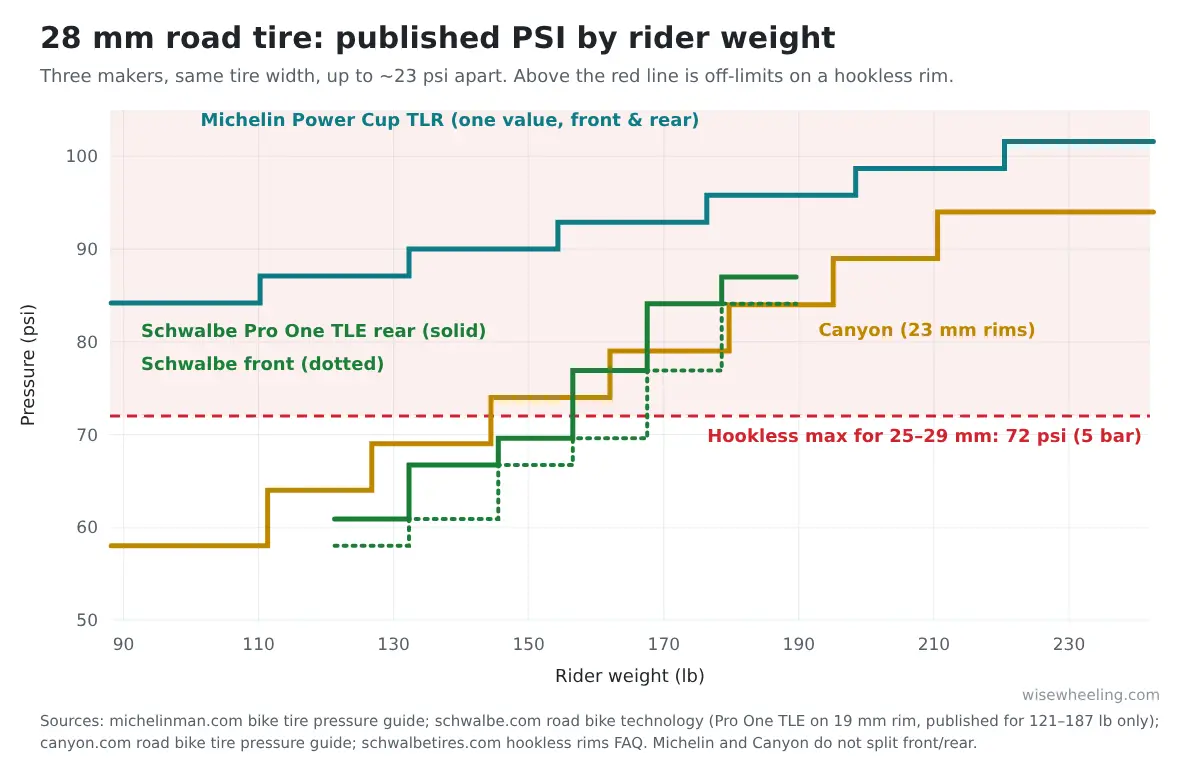
Two things jump out. First, the 28 mm column alone runs from 61 to 99 psi depending on whose chart you read. Second, every Michelin Power Cup value for a 28 mm tire, even for a rider under 110 lb, sits above the 72 psi hookless ceiling. That chart was written for hooked rims, and you can’t follow it on a hookless wheel.
Why tire pressure charts disagree by 20+ psi
If two charts can’t agree within 20 psi, it’s fair to ask whether any of them is right. They’re all right for their own setup. Schwalbe’s tire pressure FAQ puts it plainly: there’s no general pressure recommendation for a specific bike or tire, because the right pressure depends mainly on the load (rider plus luggage) and on whether you care more about low rolling resistance or comfort. Here’s what changes from chart to chart:
- The tire casing. Michelin publishes separate tables per product line. For a 28 mm tire, its Dynamic Classic/Sport line starts at 69.6 psi and its Power Cup line starts at 84.2 psi for the same lightest rider. That’s a 15 psi gap inside one brand, from the tire model alone (Michelin).
- The rim width. Schwalbe’s table assumes a 19 mm inner-width rim; Canyon’s assumes 23 mm. Schwalbe notes that the same tire can measure about 1 mm wider or narrower depending on the rim it’s mounted on (Schwalbe), and its fit table shows the same tire measuring wider on wider rims. That’s why Canyon’s numbers for a 28 mm tire on a 23 mm rim can’t be copied straight onto a narrow older rim.
- Front and rear. Schwalbe gives the front 0.2–0.6 bar (3–9 psi) less than the rear. Canyon gives a single value but says to run the front lower than the rear because the rear carries more weight (Canyon). Michelin gives one value for both.
- What “weight” means. All three tables are keyed to rider weight. Schwalbe says luggage counts too, and Canyon says bikepacking or commuting loads should push your pressure up. If you ride with a loaded pack or panniers, use rider plus gear.
- Plain errors. Michelin’s PSI table for the Power Cup TLR 30 mm at 61–70 kg reads 72.5 psi, but its own bar table lists 5.2 bar, which is 75.4 psi and fits the 2.9 psi steps on either side. The calculator uses 75.4 psi. Typos like this are a good reason to cross-check more than one source.
Hookless rims: the pressure ceiling that overrides every chart
Hookless (TSS, tubeless straight side) rims have a hard pressure limit that depends on tire width. Schwalbe publishes these maximums for its TLE/TLR tubeless tires on hookless rims, and ENVE quotes the same ETRTO figures of 5 bar (72.5 psi) for 25–29 mm and 4.5 bar (65 psi) for 30–34 mm tires. Schwalbe also says hookless rims may only be used with tubeless-ready tires, whether or not you run a tube.
| Tire width | Max pressure on a hookless rim |
|---|---|
| 18–24 mm | 5.5 bar / 80 psi |
| 25–29 mm | 5 bar / 72 psi |
| 30–34 mm | 4.5 bar / 65 psi |
| 35–39 mm | 4 bar / 58 psi |
| 40–44 mm | 3.5 bar / 51 psi |
| 45–54 mm | 3 bar / 44 psi |
| 55–64 mm | 2.5 bar / 36 psi |
Look at the chart above with that table in mind. On 28 mm tires, Schwalbe’s own rear pressure passes 72 psi from 71 kg (about 157 lb), and Canyon passes it from 66 kg (about 145 lb). Canyon says it outright: on hookless rims like most modern Zipp wheelsets, never exceed 5 bar (Canyon). If your weight puts you above the ceiling, stay at or under the limit and consider a wider tire. Schwalbe’s rule of thumb is that narrower tires and heavier loads need more air, so going wider is how you get the support back without breaking the limit.
The safety margin is thinner than many riders assume. According to ENVE, the ISO 4210 blow-off test only requires a tire to hold 110% of its max pressure for five minutes. Schwalbe says it tests its own tires at 1.6 times the max for 60 minutes, but still tells riders to stick to the stated tire and rim pressure. Not sure what rim you have? Check the wheel maker’s spec page or manual for “hookless” or “TSS” before you pump past 65–72 psi.
How to set your tire pressure in 5 steps
- Read your limits first. Find the min and max pressure on the tire sidewall and the max on the rim (or in the wheel’s manual). Schwalbe says never go above or below the tire’s printed range. If the rim is hookless, apply the width limit from the table above.
- Pick a starting number. Enter your weight (plus any regular load) and tire width in the calculator. If your exact tire model is listed by its maker, use that. If not, start in the middle of the published range rather than at either end.
- Split front and rear. Run the front a few psi lower than the rear. Schwalbe’s table uses a 3–9 psi gap on road tires.
- Adjust for the road. Michelin says to adjust its tables slightly for your riding and especially the surface. Canyon says rough roads favor lower pressure, because a tire that’s too hard can’t soak up the vibration. Go up in small steps if the tire squirms in corners or you get pinch flats. Go down if the bike feels harsh and skips over chatter.
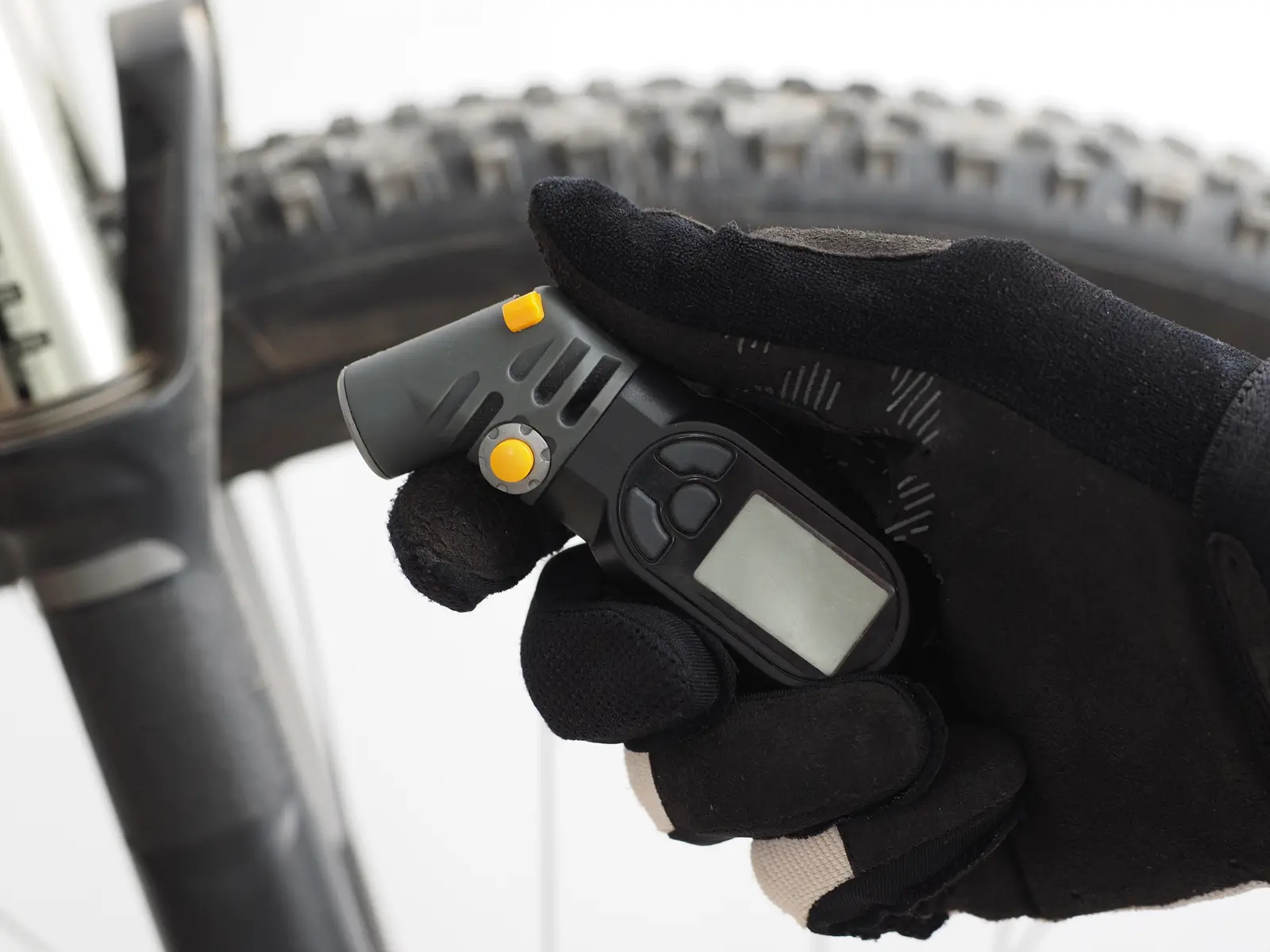
- Measure the same way every time. Use a floor pump with a gauge or a separate digital tire pressure gauge and check before every ride. If your tubeless tire is going soft overnight, see why tubeless tires lose air overnight.
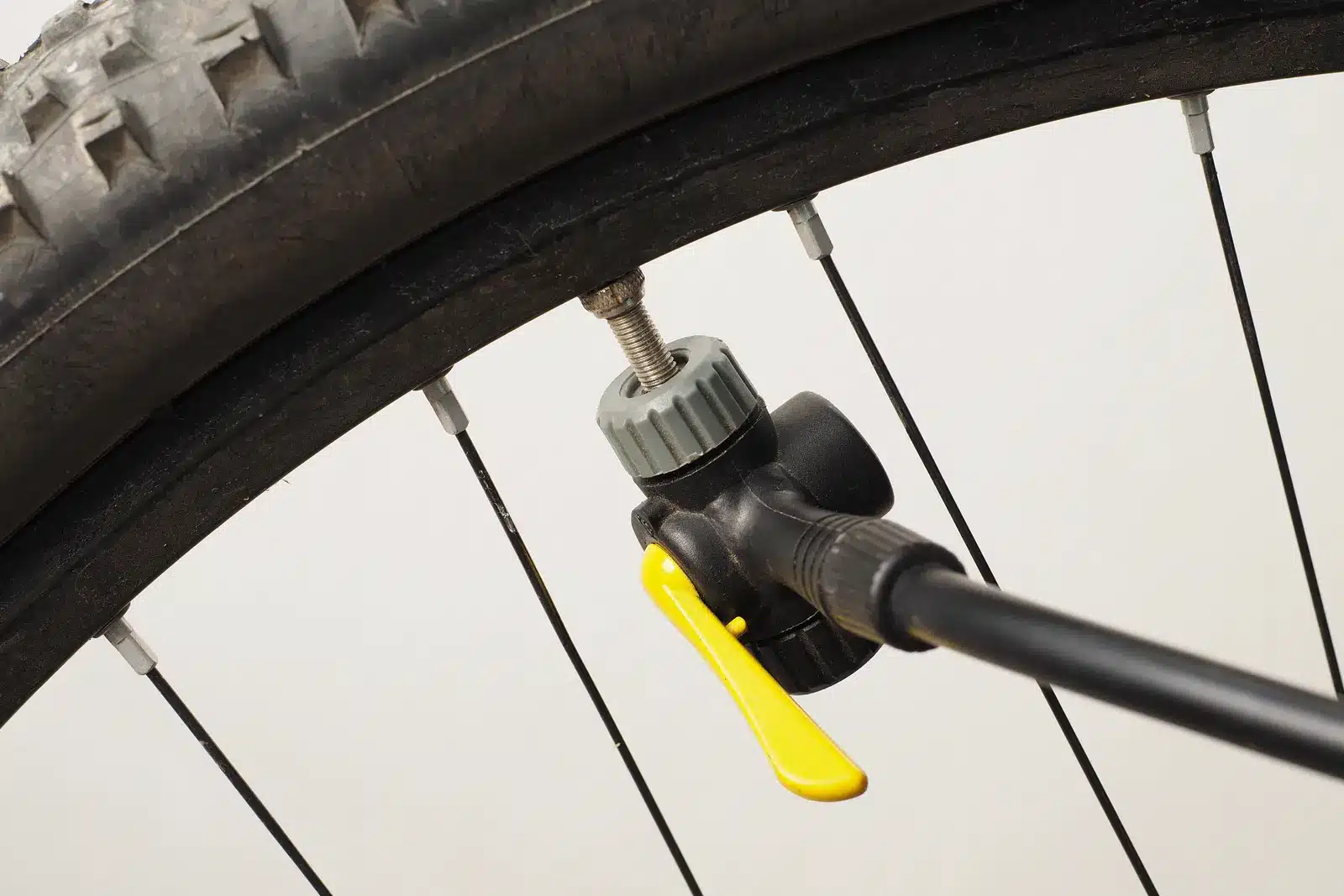
Pump giving you trouble with skinny valves? Here’s how to inflate a Presta valve with a regular pump, and what to look for in a floor pump if it’s time for a better gauge.
Gravel tire pressure by weight (35, 40 and 47 mm)
Wider tires need far less air. Michelin publishes one gravel/cyclocross table covering its whole gravel range. At 160 lb (the 71–80 kg band) it lists 49.3 psi for 35 mm, 43.5 psi for 40 mm and 34.8 psi for 47 mm. At 200 lb (91–100 kg) those climb to 55.1, 49.3 and 40.6 psi. The hookless limits for these widths (58, 51 and 44 psi) sit above most of Michelin’s gravel numbers, with one exception: on 40 mm tires, Michelin’s 52.2 psi value for riders over 100 kg (220 lb) is above the 51 psi hookless limit for 40–44 mm.
| Rider weight (Michelin band) | 35 mm | 40 mm | 47 mm |
|---|---|---|---|
| Under 110 lb (<50 kg) | 41 | 35 | 26 |
| 112–132 lb (51–60 kg) | 44 | 38 | 29 |
| 134–154 lb (61–70 kg) | 46 | 41 | 32 |
| 157–176 lb (71–80 kg) | 49 | 44 | 35 |
| 179–198 lb (81–90 kg) | 52 | 46 | 38 |
| 201–220 lb (91–100 kg) | 55 | 49 | 41 |
| Over 220 lb (>100 kg) | 58 | 52 | 44 |
Choosing between widths in the first place? Our guide to choosing bike tire width by rim, frame and surface covers clearance and rim-width fit, and the bike tire size chart explains the ETRTO numbers (like 28-622) printed on the sidewall.
What most tire pressure charts leave out
- Your tire model matters as much as your weight. Two 28 mm Michelin tires are 15 psi apart for the same rider. If your tire’s maker publishes a table for that model, it beats any generic chart.
- A chart number can be illegal on your rim. Hooked-rim tables happily recommend 80–100 psi for 28 mm tires. On hookless, 72 psi is the ceiling.
- Weight bands cover a lot of ground. Michelin’s bands are 10 kg (22 lb) wide. If you’re near the top of a band, the next band’s value may suit you better.
- Tables stop at some weight. Schwalbe’s road table only covers 55–85 kg (121–187 lb). Above that, use the tire’s maker if it publishes higher bands, never exceed the printed max, and think about going wider instead of harder.
Tire pressure FAQ
Should I pump my tires to the max PSI on the sidewall?
No. The sidewall shows the allowed range, not a target. Schwalbe says higher pressure lowers rolling resistance, wear and puncture risk, while lower pressure adds comfort and grip, and that you should never go outside the printed min and max. All three charts here recommend pressures well under typical road-tire maximums for most riders.
Is 100 psi too much for a road bike?
On a modern 28 mm tire it’s more than any of these charts give a rider under 220 lb (Michelin’s Power Cup chart reaches 98.7 psi at 91–100 kg and 101.6 psi only above 100 kg). On a hookless rim it’s not allowed at all: 25–29 mm tires max out at 72 psi. Older 23–25 mm tires on narrow hooked rims do run higher. Canyon notes that riders on those need more pressure than its 28 mm table shows, so check the tire’s own range.
Should the front tire have less pressure than the rear?
Yes, slightly. Schwalbe’s table puts the front 3–9 psi below the rear on road tires, and Canyon advises running the front lower because the rear carries more of your weight. Add front pressure if you carry heavy front bags.
Do I use my weight or my weight plus the bike?
The three charts here are keyed to rider weight. Schwalbe says the load is mostly rider plus luggage, with the bike’s weight playing a minor role. So add backpacks, panniers or bikepacking bags to your weight, but don’t add the bike.
Does a tubeless setup change the right pressure?
The tables used here don’t give separate tubeless numbers (Schwalbe’s is for a tubeless-easy tire). The bigger tubeless change is the rim: on a hookless rim the width-based maximums above apply. If you’re converting, also check which tubeless valve and rim tape width you need.
Sources
- Michelin: Bike tire pressure guide (road, MTB, gravel/cyclocross tables by rider weight and tire width).
- Schwalbe: Road bike technology page (Pro One TLE pressure table on 19 mm rim; rim/tire width notes).
- Schwalbe’s tire pressure FAQ: What is the right air pressure for my tire?
- Schwalbe’s hookless limits: maximum pressures for TLE/TLR tires on straight-side/hookless rims; test procedure.
- Canyon: Road bike tire pressure guide (28/32 mm on 23 mm rims; hookless 5 bar note; front vs rear).
- ENVE: Hookless rim technology 101 (ETRTO 72.5/65 psi limits; ISO 4210 110% test).
Suryashankar Dasgupta founded Wise Wheeling. He has been cycling for more than 20 years, on geared and single-speed bikes, across many kinds of terrain. His guides cover bike repair, fit and gear, and each one is checked against manufacturer manuals, Park Tool and other primary sources before it’s published. Read how guides are made: https://wisewheeling.com/editorial-policy/