What Headset Do I Need? SHIS Size Chart + Finder
This post contains Amazon affiliate links. As an Amazon Associate I earn from qualifying purchases, at no extra cost to you.
A headset is sized by four things: the type and bore size at the top of the head tube, the same at the bottom, the steerer diameter, and the fork’s crown race. Written as a SHIS code, a common tapered setup reads ZS44/28.6 | ZS56/40. To find yours, pull the fork and check whether the bearing sits in a pressed cup (EC or ZS) or drops straight into the frame (IS). Then measure the bare bore, or the bearing’s outside diameter on IS frames, with calipers and match it to the chart below. The trap to watch for is IS41 vs IS42: those bearings are only 0.8 mm apart, and they don’t swap.
Headset finder: turn your measurements into a SHIS code
Fill in the top, the bottom and the fork. The finder matches each reading to the bore and bearing sizes in Park Tool’s SHIS tables (allowing 0.3 mm for measuring error), builds the full code, and flags combinations that won’t work, like a tapered fork in a straight 44 mm lower.
How it works: bore ranges and bearing sizes come from Park Tool’s Standardized Headset Identification System tables (repeated in the chart below). Steerer codes are 25.4, 28.6, 31.8 and 38.1 mm; threaded steerers add the thread count. If a reading matches two codes, it tells you, because the type (cup or no cup) decides it.
Step 1: Is your headset EC, ZS or IS?
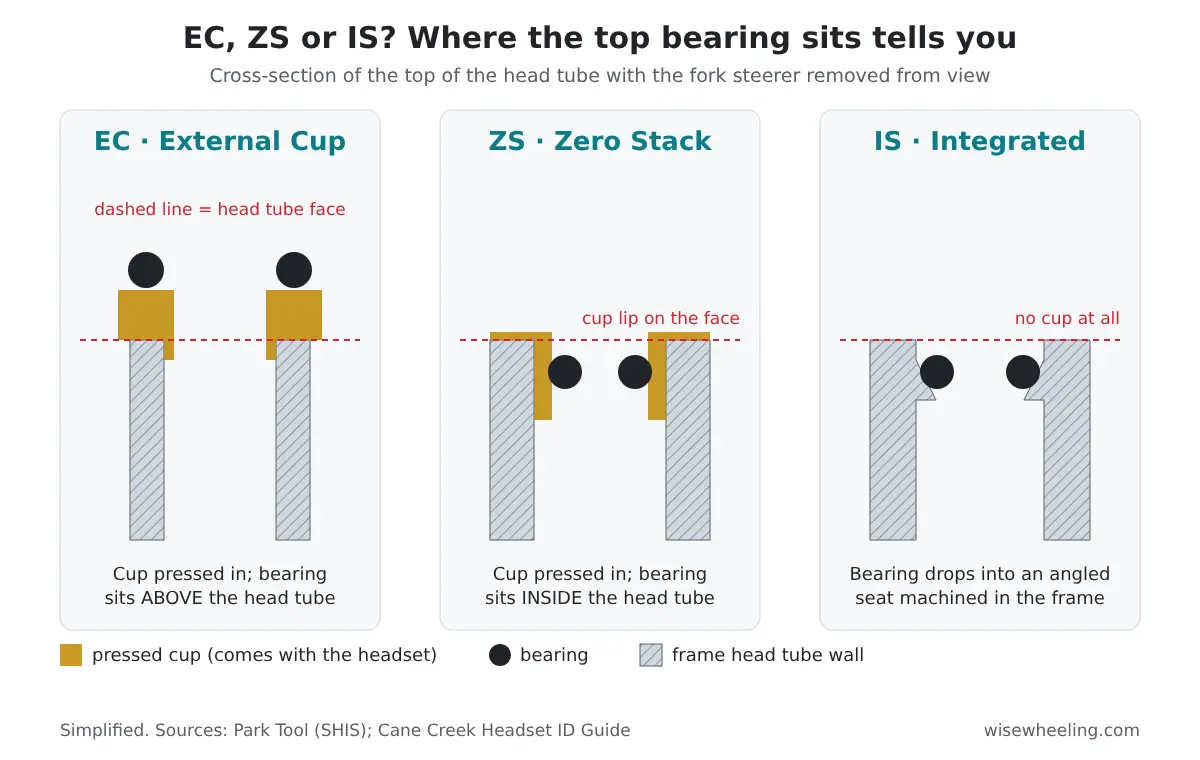
The two letters at the front of every headset code describe how the bearing is held. You can usually tell by looking, before you measure anything:
- EC (external cup): the classic pressed headset. The cups press into the head tube, but the bearings sit outside it, so you see a stack of cup and bearing above the top tube junction and below the bottom of the head tube. Used with both threaded and threadless forks.
- ZS (zero stack, also called internal or semi-integrated): a removable cup presses in and its thin lip rests on the head tube face, but the bearing sits flush with or inside the head tube. The head tube has a large outside diameter. FSA calls this Orbit Z; others call it InSet, ZeroStack or “hidden cup.”
- IS (integrated): there’s no cup. The cartridge bearing has an angled outer edge that rests on a matching angle machined into the frame, and it lifts out by hand. A replacement IS headset comes with only the two bearings, spacers, top cap and crown race.
Those descriptions follow Park Tool’s headset standards guide and the Cane Creek headset identification guide. One thing that trips people up: the top and bottom don’t have to be the same type. Park’s own tables list mixed setups like ZS on top with EC on the bottom, so check each end separately.
Step 2: How to measure for a replacement headset
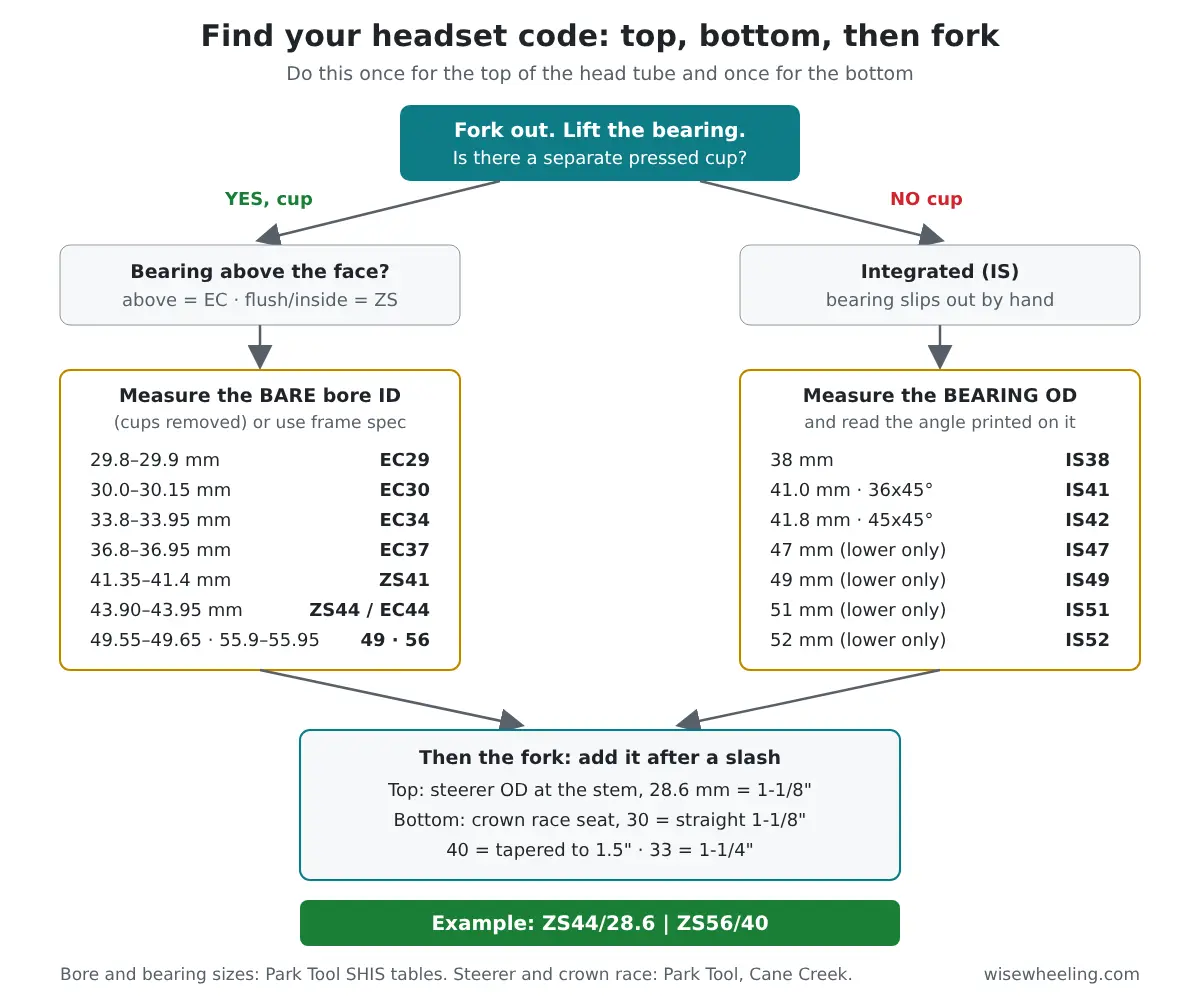
- Look up the spec first. Many frame makers list the SHIS code on the product page or in the manual. If you find it, you’re done measuring. Cane Creek’s guide gives this as the first option, before calipers.
- Get the fork out. Remove the stem and top cap, then drop the fork. Lift the top bearing out and look at what’s under it: a pressed cup or a bare, machined seat.
- EC or ZS: measure the bare bore. SHIS codes for cup headsets are based on the inside diameter of the head tube with no cup in it. Cane Creek’s support team says to measure the bare head tube, top and bottom, “with a good set of calipers.” That means the old cups have to come out first (a headset cup remover does it cleanly) unless the frame spec already told you.
- IS: measure the bearing. Integrated bearings slip out by hand, so measure the old bearing’s outside diameter with digital calipers and read the angles printed on it (for example 36×45 or 45×45). That’s faster and easier than measuring an angled seat inside the frame.
- Measure the fork. At the top, measure the steerer’s outside diameter where the stem clamps: 28.6 mm is the common 1-1/8 inch. At the bottom, the crown race size is 30 for a straight 1-1/8 inch fork and 40 for a fork that tapers to 1.5 inch.
- Put it together. Upper code, slash, steerer size, then a vertical line, then the lower code, slash, crown race. Example: ZS44/28.6 | ZS56/40.
SHIS bore numbers are codes, not exact measurements. Park Tool’s example: a 1-inch JIS head tube actually measures 29.8 mm, but its code is EC29. So don’t expect your calipers to read a round number; match the reading to the ranges below.
Headset size chart: every SHIS bore size
This chart pulls Park Tool’s three SHIS tables (EC, ZS and IS) into one place, with the fit type from Park’s headset standards summary. For EC and ZS, match your bare bore reading. For IS, match the bearing’s outside diameter.
| SHIS code | Type | Old name | Cup or bearing OD | Bare bore ID | Fit |
|---|---|---|---|---|---|
| EC29 | External cup | 1″ JIS pressed cup | 30 mm | 29.8–29.9 mm | Press |
| EC30 | External cup | 1″ Pro/Euro pressed cup | 30.2 mm | 30.0–30.15 mm | Press |
| EC33 | External cup | 1″ BMX (old) | 32.8 mm | 32.6–32.7 mm | Press |
| EC34 | External cup | 1-1/8″ pressed cup | 34 mm | 33.8–33.95 mm | Press |
| EC37 | External cup | 1-1/4″ pressed cup | 37 mm | 36.8–36.95 mm | Press |
| EC44 | External cup | External cup in a 44 head tube | 44.1 mm | 43.90–43.95 mm | Press |
| EC49 | External cup | 1.5″ pressed cup | 49.7 mm | 49.55–49.6 mm | Press |
| EC56 | External cup | 1.5″ pressed cup (lower) | 56 mm | 55.9–55.95 mm | Press |
| ZS41 | Zero stack | 1″ semi-integrated | 41.5 mm | 41.35–41.4 mm | Press |
| ZS44 | Zero stack | 1-1/8″ semi-integrated | 44.1 mm | 43.90–43.95 mm | Press |
| ZS49 | Zero stack | 1-1/2″ semi-integrated | 49.7 mm | 49.57–49.65 mm | Press |
| ZS55 | Zero stack | 1-1/2″ semi-integrated (rare) | 55 mm | 54.90–54.95 mm | Press |
| ZS56 | Zero stack | 1-1/2″ semi-integrated | 56 mm | 55.90–55.95 mm | Press |
| IS38 | Integrated | 1″ IS (Cane Creek) | 38 mm bearing | 38.15–38.25 mm | Slip |
| IS41 | Integrated | 1-1/8″ IS (Cane Creek) | 41 mm bearing | 41.10–41.20 mm | Slip |
| IS42 | Integrated | 1-1/8″ Campagnolo Hiddenset type | 41.8 mm bearing | 41.95–42.05 mm | Slip |
| IS47 | Integrated | 1-1/4″ lower only | 47 mm bearing | 47.05–47.1 mm | Slip |
| IS49 | Integrated | 1-3/8″ lower only | 49 mm bearing | 49.1–49.2 mm | Slip |
| IS51 | Integrated | 1-1/2″ lower only | 51 mm bearing | 51.1–51.15 mm | Slip |
| IS52 | Integrated | 1-1/2″ lower only | 52 mm bearing | 52.1–52.15 mm | Slip |
Notice that 44 mm shows up three times: EC44, ZS44, and an obsolete 44 mm integrated standard with 36×36 bearings that Park lists without a current code. Calipers can’t tell those apart, because the difference is whether a cup is pressed in and where the bearing sits. Same story at 49 and 56 mm, where EC and ZS share a bore. That’s why Step 1 comes before the calipers. Cane Creek also notes that newer frames have started using a 62 mm bore, which isn’t in Park’s tables yet; for those, go by the frame maker’s spec.
Fork side: steerer and crown race sizes
The number after the slash describes the fork. On the upper half it’s the steerer’s outside diameter (the only SHIS number with a decimal). On the lower half it’s the crown race size. Cane Creek says almost every modern fork has a 28.6 mm (1-1/8 inch) steerer at the top, and most modern single-crown mountain bike forks taper to 1.5 inch with a 40 mm crown race.
| What you have | SHIS code | Measures |
|---|---|---|
| 1″ threadless steerer | 25.4 | 25.4 mm OD |
| 1-1/8″ threadless steerer | 28.6 | 28.6 mm OD |
| 1-1/4″ threadless steerer | 31.8 | 31.8 mm OD |
| 1-1/2″ threadless steerer | 38.1 | 38.1 mm OD |
| 1″ threaded (BSC) | 25.4-24 TPI | 25.4 mm, 24 threads per inch |
| 1-1/8″ threaded | 28.6-26 TPI | 28.6 mm, 26 threads per inch |
| 1-1/4″ threaded | 31.8-26 TPI | 31.8 mm, 26 threads per inch |
| Crown race, 1″ JIS | 27 | Fork seat 27.1 mm, race ID 27 mm |
| Crown race, 1″ Pro/Euro | 26 | Fork seat 26.5 mm, race ID 26.4 mm |
| Crown race, 1-1/8″ | 30 | Fork seat 30.1 mm, race ID 30 mm |
| Crown race, 1-1/4″ | 33 | Fork seat 33.1 mm, race ID 33 mm |
| Crown race, 1-1/2″ (tapered) | 40 | Fork seat 39.8 mm, race ID 39.7 mm |
| 1-3/8″ integrated race | none | Race is machined into the fork |
IS41 vs IS42: the 0.8 mm mistake
This one is easy to get wrong on road and gravel bikes, because both are “1-1/8 inch integrated” and the bearings look nearly identical in a photo. They’re two different standards with different bearing sizes and contact angles.
| IS41 | IS42 | |
|---|---|---|
| Also called | “Cane Creek” IS | Campagnolo Hiddenset type, “Italian” |
| Bearing OD | 41 mm | 41.8 mm |
| Contact angle | 36 x 45 degrees | 45 x 45 degrees |
| Bare bore ID | 41.10–41.20 mm | 41.95–42.05 mm |
| Usual upper code | IS41/28.6 | IS42/28.6 |
Run the numbers and you can see why they don’t swap. A 41.8 mm IS42 bearing is bigger than the largest IS41 bore (41.20 mm), so it won’t drop in. A 41 mm IS41 bearing in an IS42 frame (bore up to 42.05 mm) has nearly a millimeter of room to move around. Park Tool notes that IS bearings may be marked with their angles, like “36-45,” where the first number is the inner contact and the second is the frame contact. So check the old bearing in two ways: measure its OD (41.0 or 41.8) and read the marking.
The headset combinations you’ll actually see
The Cane Creek identification guide lists five common top and bottom bore pairings. Here they are written as full SHIS codes using Park Tool’s tables, which makes them easy to search for when you shop.
| Top / bottom bore | Typical full code | Fork | What it is |
|---|---|---|---|
| 34 / 34 mm | EC34/28.6 | EC34/30 | Straight 1-1/8″ | Conventional external-cup threadless |
| 44 / 44 mm | ZS44/28.6 | ZS44/30 | Straight 1-1/8″ | Common zero-stack setup |
| 44 / 56 mm | ZS44/28.6 | ZS56/40 | Tapered 1-1/8″ to 1.5″ | Park calls it a common tapered configuration |
| 41 / 52 mm | IS41/28.6 | IS52/40 | Tapered 1-1/8″ to 1.5″ | Integrated, Cane Creek type upper |
| 42 / 52 mm | IS42/28.6 | IS52/40 | Tapered 1-1/8″ to 1.5″ | Integrated, Campagnolo type upper |
Once you have the code, search it exactly as written. Typing ZS44/28.6 ZS56/40 headset into a store’s search box gets you far closer than “1-1/8 tapered headset,” which can mean any of the last three rows.
Older bikes: threaded headsets and the JIS vs Pro trap
If your bike has a quill stem and a big locknut on top of the head tube, it has a threaded EC headset. Most are 1 inch, and there are two 1-inch standards that look the same but don’t share parts. Park lists the JIS version as EC29/25.4-24tpi | EC29/27 and the Pro/Euro version as EC30/25.4-24tpi | EC30/26. The cups differ by 0.2 mm (30.0 vs 30.2 mm OD), and the crown races differ by 0.6 mm (27 vs 26.4 mm ID), so a JIS crown race won’t stay put on a Pro fork seat, and a Pro race is too small to press onto a JIS fork seat properly. Measure the fork’s crown race seat before ordering: about 27.1 mm means JIS, about 26.5 mm means Pro.
Two things the code doesn’t tell you: stack height and cup depth
Stack height. Some makers add an “H” number to the code, which is how much steerer the headset takes up. On a threadless fork that’s already cut to length, a headset with a taller top cover or a thicker upper stack changes how much steerer is left for the stem and spacers. Compare the old and new stack heights before you install. If your bar ends up lower or higher than you want, our guide to raising bike handlebars with spacers or a stem flip covers the options.
ZS cup depth. Park Tool points out that how deep a ZS cup goes into the head tube varies by brand. If the frame was designed for a shallow cup, a deeper one won’t fit properly, even with the right bore code. When you replace a ZS headset, compare the depth of the old cup with the new one before you press it in.
Tools, and when to let a shop do it
For an IS headset, the swap is mostly just bearings: they slip out and in by hand. EC and ZS cups need a cup remover to come out and a headset press to go in square. A new crown race has to be seated fully on the fork, which takes a crown race setter. If the bore measures oversize, out of round, or the faces are damaged, the fix is reaming and facing with dedicated cutters, which is shop work. Carbon frames and forks deserve extra caution here: if you’re not sure, have a shop press the cups.
After the new headset is in, set the preload and tighten the stem to its spec; our stem bolt torque chart has the numbers by brand. If the front end still knocks under braking, work through why the front end knocks even when the headset feels tight. Matching other standards on the same bike? See what bottom bracket you have and which thru axle you need.
Headset sizing FAQ
Is 1-1/8 inch the same as 28.6 mm?
Yes. 1-1/8 inch works out to 28.575 mm, and SHIS writes it as 28.6. It’s the steerer size at the top of nearly every modern fork, straight or tapered.
Are ZS44 and IS44 the same thing?
No. ZS44 uses a pressed cup in a 43.90–43.95 mm bore. The old 44 mm integrated standard used 36×36 bearings sitting directly in the frame, and Park Tool lists it as obsolete. Look for a cup: if there is one, it’s ZS (or EC if the bearing sits above the face).
Can I put a tapered fork in a straight head tube?
Only if the lower headset can take a 40 mm crown race. On a 49 mm head tube, Park lists ZS49/40 and EC49/40 lowers for tapered forks. On a 44 mm head tube, a ZS44 lower is made for a 30 mm race; Cane Creek’s guide shows an external EC44/40 lower as one way to fit a tapered fork. An external lower cup puts the bearing below the head tube, which adds stack height, so check with the frame and fork makers first.
Do I need a new crown race with a new headset?
Most complete headsets include one, and Park Tool notes a replacement IS headset comes with the crown race. It has to match your fork’s seat (26, 27, 30, 33 or 40), and the lower code after the slash tells you which. Forks with a 1-3/8 inch integrated race have the race machined in, so there’s nothing to replace.
Why doesn’t my caliper reading match the code number?
Because the bore number is a code, not a measurement. A ZS44 bore measures 43.90–43.95 mm and an EC29 bore measures 29.8–29.9 mm. Match your reading to the ranges in the chart, or let the finder above do it.

Suryashankar Dasgupta founded Wise Wheeling. He has been cycling for more than 20 years, on geared and single-speed bikes, across many kinds of terrain. His guides cover bike repair, fit and gear, and each one is checked against manufacturer manuals, Park Tool and other primary sources before it’s published. Read how guides are made: https://wisewheeling.com/editorial-policy/