What Bottom Bracket Do I Have? Shell Size Chart + Finder
This post contains Amazon affiliate links. As an Amazon Associate I earn from qualifying purchases, at no extra cost to you.
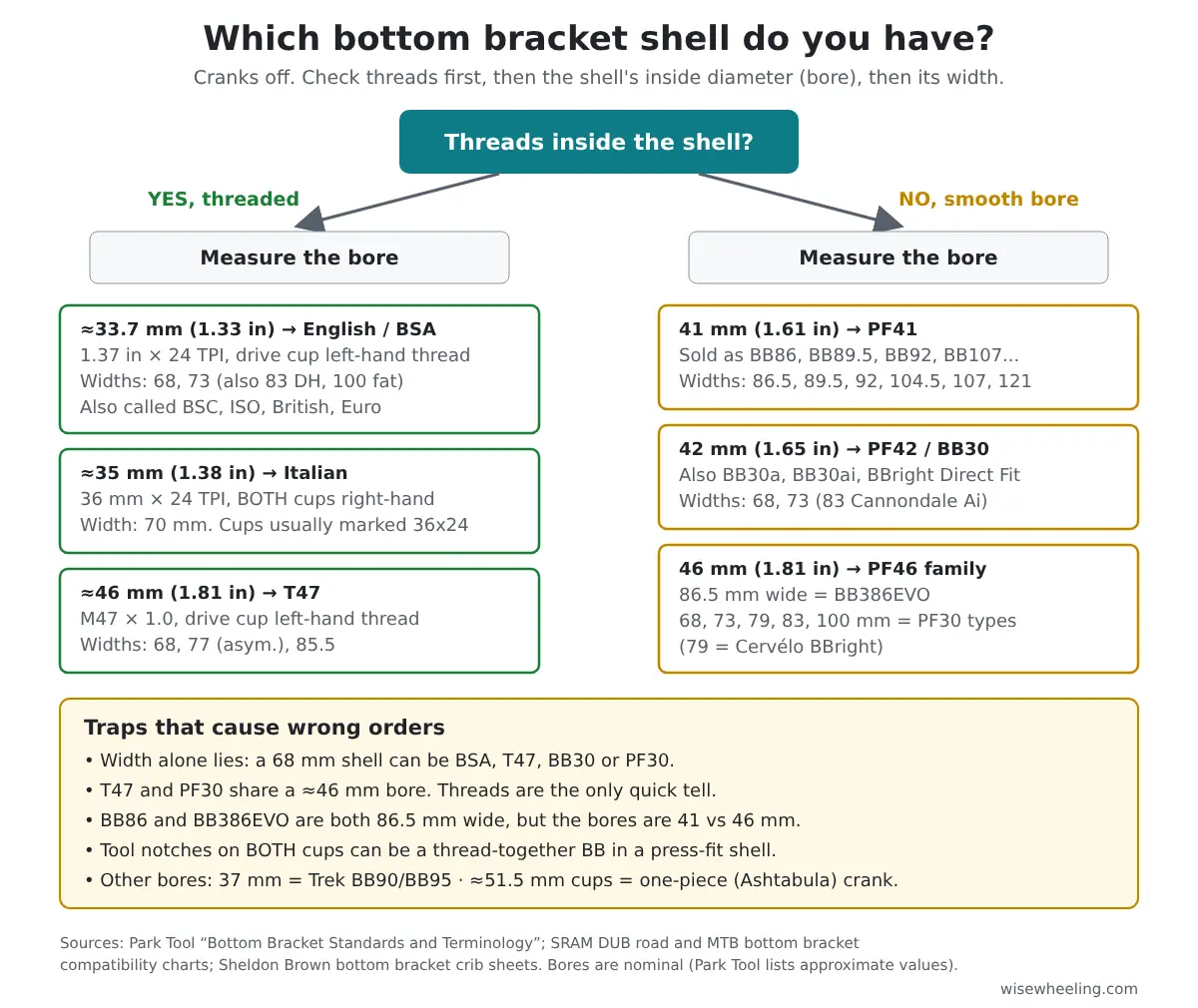
You find out what bottom bracket you have by taking the cranks off and checking three things on the frame: whether the shell is threaded, its inside diameter (the bore), and its width. The bore names the standard. A threaded shell of about 33.7 mm is English (BSA), about 35 mm is Italian and about 46 mm is T47; a smooth bore of 41 mm is PF41 (BB86/BB92), 42 mm is BB30 and 46 mm is PF30 or BB386EVO. The width then picks the exact version, and your crank’s spindle (24 mm, 28.99 mm SRAM DUB or 30 mm) decides which bearings go inside.
Put your caliper readings into the finder below. It accepts millimeters or inches, so a standard US 6-inch caliper is all you need.
Bottom bracket finder: enter your shell measurements
How the finder works: it compares your bore with the nominal shell diameters published by Park Tool, then checks your width against the shell widths SRAM lists in its road and MTB DUB bottom bracket charts. It allows about half a millimeter either side of each nominal bore and 1 mm on width to absorb caliper error.
Bottom bracket size chart: bore, threads and shell widths
This chart puts the three numbers you can measure side by side. Park Tool sorts press-fit standards by bore because the bore is the only part of the system that stays consistent; the trade names (BB86, BB92, PF30, BB386EVO) mix up spindle sizes and shell widths. The widths below come from SRAM’s DUB charts, which list a bottom bracket for each shell SRAM supports.
| Standard (also sold as) | Threads / fit | Shell bore | Shell widths (mm) |
|---|---|---|---|
| English (BSA, BSC, ISO, British, Euro) | Threaded, 1.37 in x 24 TPI; drive cup left-hand | ≈33.7 mm (1.33 in) | 68, 73, 83 (DH), 100 (fat) |
| Italian | Threaded, 36 mm x 24 TPI; both cups right-hand | ≈35 mm (1.38 in) | 70 |
| T47 | Threaded, M47 x 1.0; drive cup left-hand | ≈46 mm (1.81 in) | 68, 77 (asymmetric), 85.5 |
| PF41 (BB86, BB89.5, BB92, BB104.5, BB107, BB121, Shimano Press-Fit) | Press fit | 41 mm (1.61 in) | 86.5, 89.5, 92, 104.5, 107, 121 |
| PF42 (BB30, BB30a, BB30ai, BBright Direct Fit) | Press fit | 42 mm (1.65 in) | 68, 73, 83 (Cannondale Ai); 79 (BBright Direct Fit) |
| PF46 (PF30, PF30a, PF30ai, BBright Press Fit) | Press fit, bearings in plastic or alloy cups | 46 mm (1.81 in) | 68, 73, 79 (Cervélo BBright), 83, 100 (fat) |
| BB386EVO | Press fit | 46 mm (1.81 in) | 86.5 |
| Trek BB90 / BB95 | Bearings press into seats in the frame | 37 mm bearing OD (1.46 in) | 90.5 per SRAM; 90/95 nominal |
| One-piece crank (American, Ashtabula) | Pressed-in cups | ≈51.5 mm cups (2.03 in) | 68 (2.68 in) |
Older and rarer shells you may still meet: French and Swiss (both M35 x 1.0, about 34 mm bore; French has a right-hand drive cup, Swiss a left-hand one), the old Raleigh 1.37 in x 26 TPI thread, and ISIS Overdrive (M48 x 1.5, about 46.5 mm, now mostly on exercise equipment). Park Tool notes that not every Italian, French or Swiss-made bike uses its “national” thread, so measure instead of guessing from the decal. Sheldon Brown’s threaded crib sheet explains what happens when you try to mix them: Italian shells are too big for English cups, and a Raleigh 26 TPI shell will bind an English cup after a few turns.
How to measure your bottom bracket shell
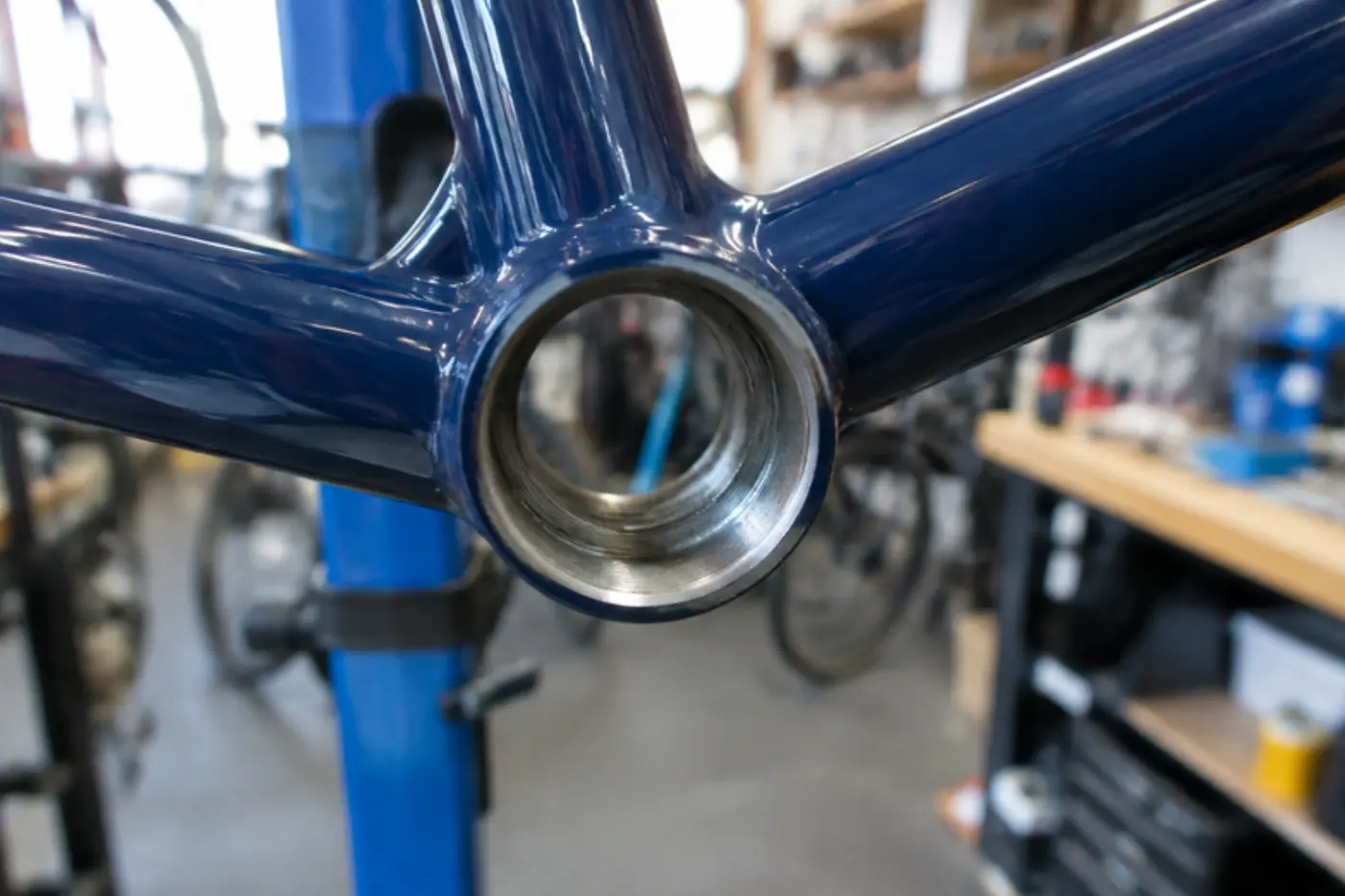
- Look before you pull anything. A press-fit bottom bracket shows no tool fittings from the outside. Threaded cups have notches, splines, pin holes or wrench flats (Park Tool). Also check the cups for a printed name; SRAM notes that some bottom brackets have it printed right on them.
- Check the frame maker’s spec. SRAM recommends confirming the standard on the frame manufacturer’s website. If it says something specific like “BB86” or “T47 85.5”, you mostly just need to confirm it.
- Take the cranks off. Most two-piece cranks come off with hex keys; old square-taper cranks need a puller (or see our guide to removing a crank without a puller).
- Measure the shell width with the caliper’s outside jaws across the two machined end faces of the shell. Measure the frame, not the cups, and take two or three readings.
- Measure the bore with the inside jaws, at the open edge of the bare shell. With press-fit cups still in place you can’t get this number, so use the printed markings or the frame spec, or have the cups pulled.
- Look at the threads. Shine a light into the shell. Fine threads all the way around mean a threaded standard. If both old cups had tool notches but the shell is smooth, it was a thread-together bottom bracket in a press-fit frame (Park Tool calls these “thread-thru”).
- Measure the spindle. Measure your crank’s spindle diameter, or the bearing’s inside diameter. That tells you the bearing size to order (next section).
A NEIKO 01407A 6-inch digital caliper (or any caliper that reads to 0.01 mm or 0.001 in) is plenty. A tape measure won’t separate a 41 mm bore from a 42 mm one, and that 1 mm is the whole difference between a BB86 and a BB30 part.
Bottom bracket identification flowchart
Which crank spindle fits which bottom bracket?
The frame standard and the crank spindle are two separate choices. Park Tool groups spindles into three sizes, and most press-fit shells can take bearings for more than one of them. That’s why the same SRAM or Shimano crank can go in very different frames: you buy the bottom bracket that bridges the two.
| Spindle diameter | Example cranks | Shells that take bearings for it |
|---|---|---|
| 24 mm (incl. 22/24 mm stepped) | Shimano two-piece (Hollowtech II), SRAM GXP (22/24) | English threaded with external cups; PF41, PF42 and PF46 with 24 mm bearings; Trek BB90 (24 mm spindle) |
| 28.99 mm | SRAM DUB | SRAM lists DUB bottom brackets for English, Italian, T47, BB30, PF30, PF41 (86.5 to 121 mm) and BB386EVO shells |
| 30 mm | BB30-type cranks, Race Face Cinch 30 mm | PF42 (BB30), PF46 (PF30) and PF41 with 30 mm bearings |
Two more details to copy from SRAM’s chart before you order: DUB cranks come in different spindle lengths (Road, Road-Wide, MTB, MTB Wide, Super Boost+, DH, Fat), and the bottom bracket ships with spacers that change by shell width. So “DUB BSA 68” is not the whole part number; match the crank type etched on the spindle too.
Which tool removes your bottom bracket?
Once you know the standard, the cups tell you the tool. Park Tool’s method: count the notches or splines, then measure the outside diameter of the cup with your caliper. Within about a millimeter is close enough. Here are the fittings you’ll see most on US shop bikes.
| Cup fitting | Cup OD | Typical bottom bracket | Park Tool tool |
|---|---|---|---|
| 16 external notches | 44–45 mm | Shimano Hollowtech II, SRAM GXP, Chris King ThreadFit 24, Race Face, Praxis | BBT-69.4, BBT-169, BBT-19.2 or Park Tool BBT-9 |
| 16 external notches | 41–42 mm | Shimano XT MT800, Ultegra BBR60 | BBT-59.3 |
| 16 external notches | 39–40 mm | Shimano XTR BB93, Dura-Ace R9100 | BBT-49.3 or BBT-29 |
| 24 external notches | 45–47 mm | SRAM DUB threaded | Park Tool BBT-79.3 or BBT-179 |
| 12 external notches | 45–47 mm | Race Face Cinch, Rotor 30 | Park Tool BBT-79.3 or BBT-179 |
| 12 external notches | 50–53 mm | Chris King ThreadFit, Rotor | BBT-47-12 or BBT-147-12 |
| 16 external notches | 52–54 mm | Enduro, SRAM, CeramicSpeed | BBT-47-16 |
| 20 internal splines | 31.5 mm ID | Square-taper and Octalink cartridge BBs | BBT-22 or BBT-32 |
| No fittings (press fit) | — | PF41, PF42, PF46, BB386EVO | Removal tool sized to the bearing ID; 30 mm bearings use the Park Tool BBT-30.4 |
Direction matters too. On English and T47 shells the drive-side (right) cup is left-hand thread, so it loosens clockwise; the non-drive cup loosens counterclockwise. On an Italian shell both cups are right-hand thread and both loosen counterclockwise (Park Tool). If a drive-side cup won’t budge, check you aren’t tightening it.
Mistakes that get riders the wrong bottom bracket
- Ordering by width alone. In SRAM’s road chart a 68 mm shell can be English, T47, BB30 or PF30. Width only narrows it down after you know threads and bore.
- Mixing up BB86 and BB386EVO. Both shells are 86.5 mm wide. BB86 has a 41 mm bore and BB386EVO has a 46 mm bore, so the cups can’t swap.
- Calling a T47 frame “PF30”. Both bores sit around 46 mm. T47 has threads; PF30 is smooth. A quick look with a flashlight saves a return.
- Treating BB30 and PF30 as the same thing. BB30 is a 42 mm bore and PF30 is a 46 mm bore with the bearings carried in cups. Same “30”, different frames.
- Assuming a threaded frame because the cups have notches. Thread-together bottom brackets screw into each other inside a smooth press-fit shell. The frame is still press fit.
- Trusting the country on the down tube. Park Tool notes that not all Italian-made bikes use Italian threading (the same goes for French and Swiss).
What to write down before you order
- Threaded or smooth shell (and, for threaded, which way the drive cup unscrewed)
- Bore in mm, from your caliper or the frame spec
- Shell width in mm, face to face
- Crank brand, model and spindle diameter (24, 22/24, 28.99 or 30 mm), plus the spindle type etched on SRAM DUB cranks
- For a threaded BB: the cup tool you need, from the table above
With those five lines, any shop counter or online fitment chart can give you one correct part number instead of a guess.
DIY or bike shop?
A threaded bottom bracket is a reasonable home job if you have the matching cup tool and a torque wrench; tighten to the figure printed in the bottom bracket’s instructions. Press-fit bearings need a removal tool sized to the bearing and a bearing press to go back in straight, and a crooked press into a carbon shell is an expensive mistake. Park Tool’s own advice when compatibility is unclear is to check with the bike maker, the component maker or a shop, and that’s sound for odd frames like Trek BB90 or an asymmetric T47 77. If your frame creaks and you suspect the BB, our creak-under-load guide walks through the other usual suspects first, and if you’re also changing the cassette, check your freehub body for the same kind of fit trap at the back wheel. Headsets use the same kind of bore codes, explained in what headset do I need.
Bottom bracket FAQ
Is BSA the same as English threaded?
Yes. BSA, BSC, BC, ISO, British and “Euro” (the BMX term) all mean the same 1.37 in x 24 TPI thread with a left-hand drive-side cup, according to Park Tool. Any bottom bracket labeled with one of those names fits the others, as long as the shell width matches.
Is BB86 the same as BB92?
They share the same 41 mm bore (Park Tool groups them as PF41), but the shells are different widths: SRAM lists 86.5 mm for road and 89.5 or 92 mm for mountain bikes. Buy the bottom bracket made for your width so the bearings and spacers line up.
What is the difference between BB30 and PF30?
BB30 (PF42) is a 42 mm bore; PF30 (PF46) is a 46 mm bore whose bearings sit in a plastic or aluminum adapter pressed into the shell. Both were named for the 30 mm spindle they launched with, but their parts aren’t interchangeable (Park Tool, Sheldon Brown).
Will a SRAM DUB crank fit my frame?
Probably. SRAM’s DUB charts list a bottom bracket for English (68, 73, 83, 100), Italian 70, T47 (68, 77, 85.5), BB30, PF30, PF41 widths from 86.5 to 121 and BB386EVO shells. The exception in its road chart is Trek BB90, where SRAM has no DUB option and points you to a GXP crank. Check the road or MTB chart for the exact part.
Can I convert a press-fit frame to a threaded bottom bracket?
You can’t add threads to the frame, but a thread-together (thread-thru) bottom bracket installs into a smooth press-fit shell and has cups that screw into each other inside it, per Park Tool. Make sure one is made for your exact bore and width.
Sources
- Park Tool: Bottom Bracket Standards and Terminology
- Park Tool: Bottom Bracket Identification
- Park Tool: Bottom Bracket Tool Selection, Threaded and Thread-Together
- Park Tool: Bottom Bracket Tool Selection, Press Fit
- SRAM: DUB Choose a Road Bottom Bracket (PDF) and DUB MTB Bottom Bracket Compatibility Chart (PDF)
- Sheldon Brown: Threaded and Unthreaded Bottom Bracket Crib Sheets

Suryashankar Dasgupta founded Wise Wheeling. He has been cycling for more than 20 years, on geared and single-speed bikes, across many kinds of terrain. His guides cover bike repair, fit and gear, and each one is checked against manufacturer manuals, Park Tool and other primary sources before it’s published. Read how guides are made: https://wisewheeling.com/editorial-policy/