How to Remove a Bike Quick Link (and Whether You Can Reuse It)
This post contains Amazon affiliate links. As an Amazon Associate I earn from qualifying purchases, at no extra cost to you.
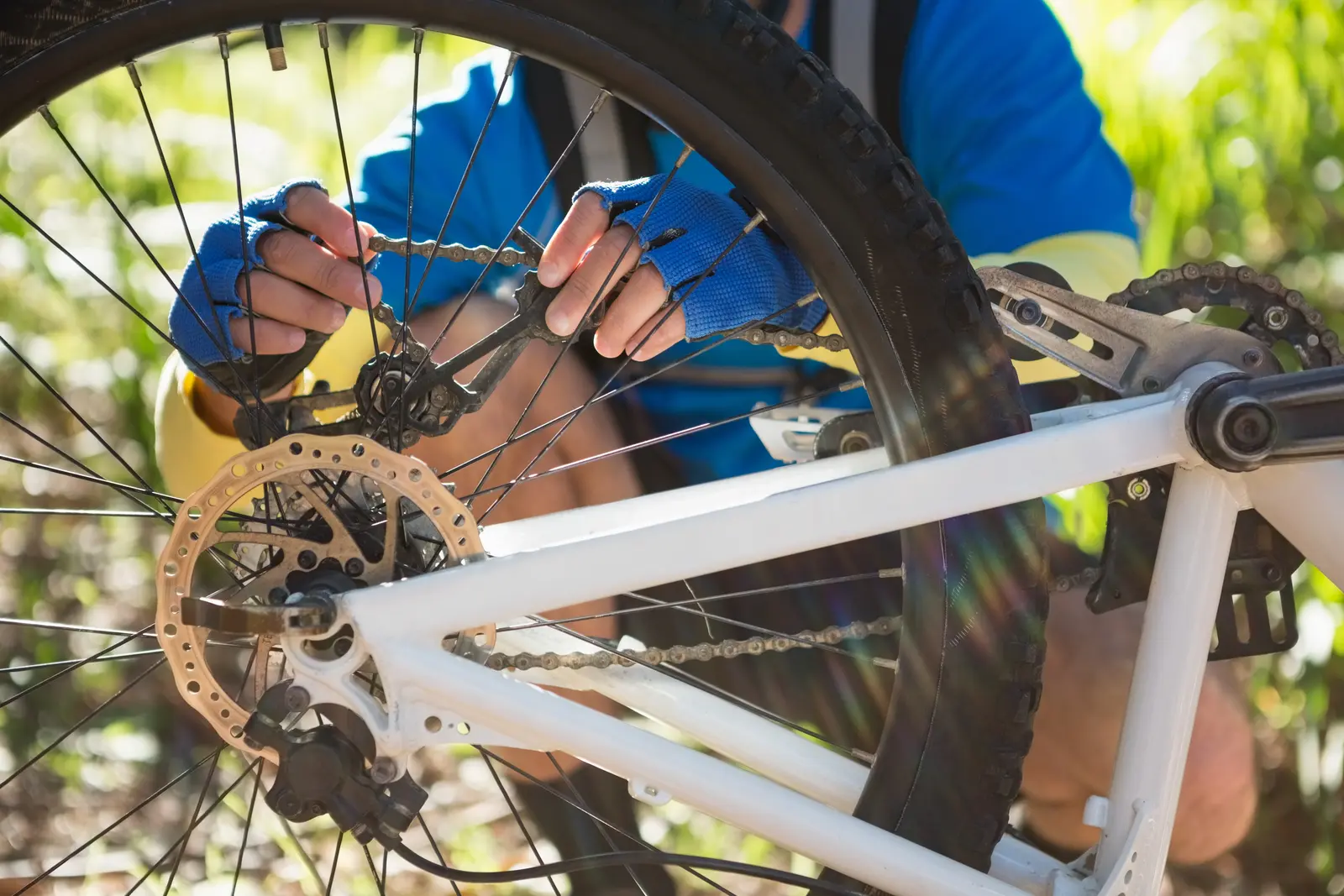
Shift to the smallest rear cog so the chain goes slack. Then turn the cranks backward until the quick link sits on the lower run of chain, between the cassette and the chainring. Hook master link pliers into the rollers on either side of the link and squeeze, and the two halves slide together and come apart. Before you put it back on, check the chart below: SRAM 12-speed PowerLocks and Shimano QUICK-LINKs are single use. KMC “R” links and old SRAM 8/9-speed PowerLinks can go back on.
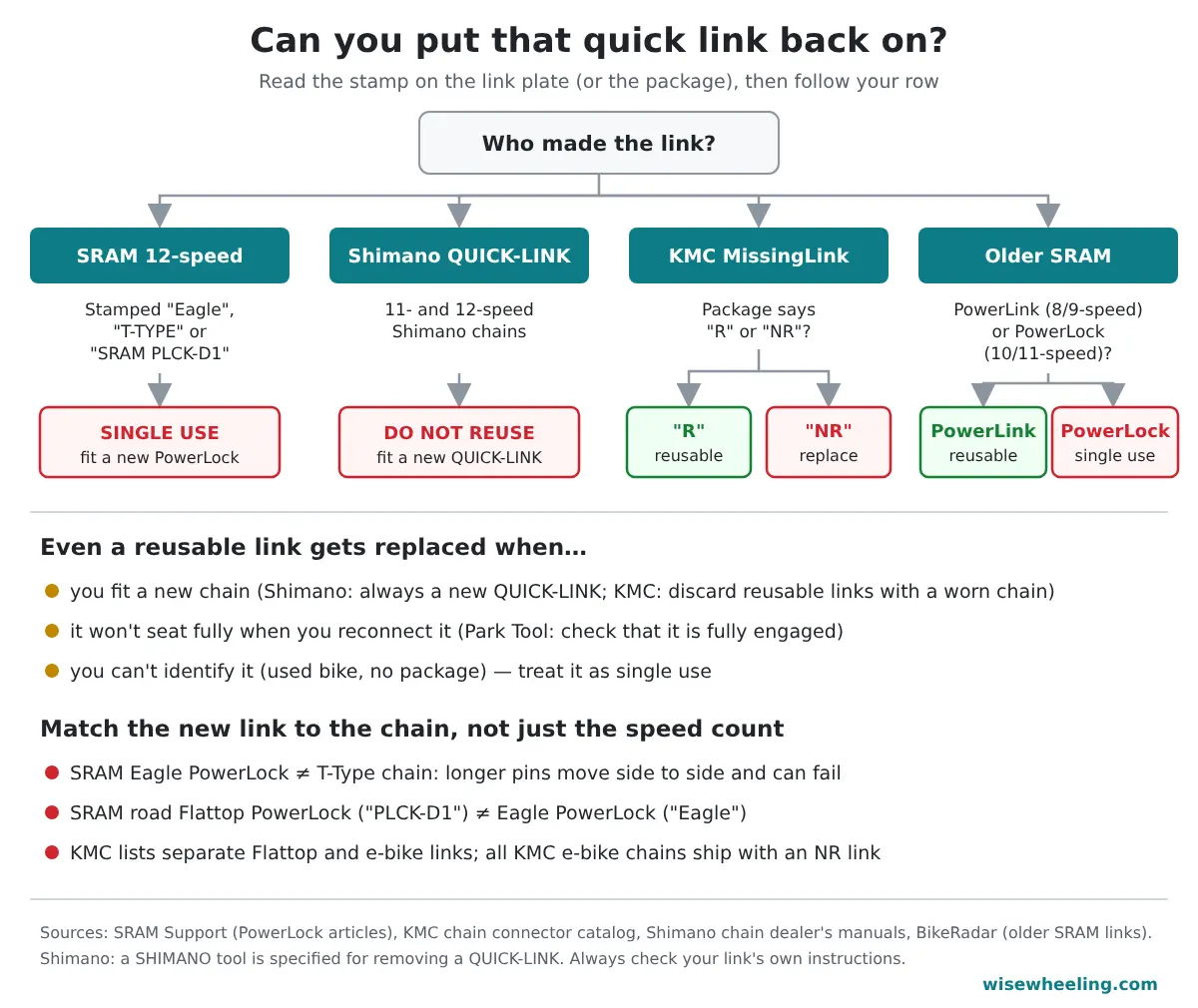
Can you reuse your quick link? Chart by brand
This is the question most removal guides skip, and the answer depends on who made the link, not on how clean it looks. We compiled this table from each maker’s own support pages and manuals. Where a maker doesn’t publish an answer for a link, we’ve left it out rather than guess.
| Link (how to spot it) | Reusable? | Removal tool | What the maker says |
|---|---|---|---|
| SRAM Eagle PowerLock (stamped “Eagle”) | No, single use | Chain link pliers | “Designed for single use only… Install a new PowerLock each time a chain is installed.” (SRAM) |
| SRAM Eagle Transmission T-Type PowerLock (stamped “T-TYPE”) | No, fit a new one | Chain link pliers | Use only T-Type PowerLocks on T-Type chains. An Eagle PowerLock’s longer pins move side to side and can fail (SRAM). |
| SRAM road Flattop 12-speed PowerLock (stamped “SRAM PLCK-D1”) | No, single use | Chain link pliers | “Reusing a PowerLock may result in a broken chain that could result in a crash.” (SRAM) |
| SRAM 10- and 11-speed PowerLock | No, single use | Chain link pliers | SRAM designs PowerLocks to be used once (reported by BikeRadar). |
| SRAM 8- and 9-speed PowerLink | Yes | Pliers or by hand | PowerLinks can be reused (BikeRadar). |
| Shimano QUICK-LINK (11- and 12-speed Shimano chains) | No | Shimano tool (TL-CN10) | Don’t reuse a removed QUICK-LINK; a reused link can loosen and come apart. Always fit a new one with a new chain (Shimano dealer’s manual). |
| KMC MissingLink “R” (7/8R, 9R, 10R, 11R) | Yes | Pliers or by hand | “Can be opened and closed as many times as you want.” Throw it out when the chain is worn (KMC). |
| KMC MissingLink “NR” (all 12-speed, Flattop, e-bike and some 9–11-speed links) | No | Pliers | “A non-reusable one has to be replaced once opened.” Every KMC e-bike chain ships with an NR link (KMC). |
Don’t know which link is on your bike? Read the outer plate. SRAM stamps its 12-speed links so you can tell them apart: “Eagle” for Eagle, “T-TYPE” for Eagle Transmission and “SRAM PLCK-D1” for road Flattop chains (SRAM). For KMC, the R or NR rating is printed on the package. If you bought the bike used and there’s no package, assume the link is single use and buy a new one that matches the chain.
Quick link checker: can this link go back on?
The checker uses the same maker statements as the table above (SRAM Support, Shimano dealer’s manual, KMC catalog, BikeRadar for older SRAM links). If your link’s own instructions say something different, follow the instructions.
How to remove a quick link with pliers, step by step
You’ll need master link pliers, a rag and, for a Shimano chain, Shimano’s own tool. That’s it. Plan on a couple of minutes once you’ve found the link.
- Get slack in the chain. Shift to the smallest rear cog (and the small chainring on a 2x bike). A chain under derailleur tension pulls the link closed while you squeeze.
- Find the link. Quick links have their own pair of side plates, sometimes a different color from the rest of the chain (Park Tool). Wipe the chain with a rag so you can see them, and read any stamp on the plate (see the chart above).
- Move it to the lower run. Pedal backward until the link sits on the bottom stretch of chain, between the cassette and the chainring. That’s where Park Tool says to position it before you open it.
- Squeeze. Seat the plier tips in the rollers on either side of the link and squeeze the handles. The two halves slide toward each other and the link drops apart. On a Shimano chain, use a Shimano tool. Shimano’s manuals say its own tool is required to remove a QUICK-LINK, and the TL-CN10 pliers are made for this.
- Catch the chain. Hold both ends so the chain doesn’t drop onto the floor or slide out of the derailleur. If you’re keeping a reusable link, put both halves somewhere you won’t lose them.
Which pliers to buy
For SRAM and KMC links, a pair of dedicated master link pliers like the Park Tool MLP-1.2 Master Link Pliers does the job. It’s the tool Park Tool names for both removing and installing links. For Shimano QUICK-LINKs, follow Shimano’s instruction and use the Shimano TL-CN10 quick link pliers. Check the current price on Amazon. A few multi-tools also have a quick link opener built in, and our roadside multi-tool guide covers what to look for.
How to remove a quick link without pliers
Which option you have depends on the link and on whether you’re keeping the chain.
- Replacing a worn chain anyway? Skip the link. Park Tool’s advice: ignore the master link and break the chain with a chain tool a few links away from it. The old chain is going in the recycling, so it doesn’t matter where you cut it.
- Loose reusable links (KMC R, SRAM 8/9-speed PowerLink) may open by hand. With the chain slack, push the rollers on each side of the link toward each other while you pinch the plates. A stiff 11- or 12-speed link usually won’t move this way, so don’t count on it.
- Don’t pry it open. SRAM says its Eagle PowerLock can only be removed with chain link pliers, and Shimano specifies its own tool. Screwdrivers and ordinary pliers can bend link plates. On a single-use link that’s fine, since it’s going in the trash, but don’t let a slipping tool gouge the chain, chainring or frame.
- No tool on the trail? Carry a spare link that matches your chain and a multi-tool with a chain breaker. That gets you home from a broken chain whether or not the old link opens.
Quick link won’t come off? Check these four things
| What you see | Likely reason | Fix |
|---|---|---|
| Pliers squeeze but nothing moves | Chain is under tension from the derailleur | Shift to the smallest cog, or lift the chain off the chainring onto the bottom bracket shell to make it fully slack, then squeeze again. |
| Link moves a little, then jams | Grit packed into the link | Degrease and scrub the link, dry it, then retry. |
| Pliers slip off | Tips aren’t seated in the rollers right next to the link | Put one tip in the roller on each side of the quick link, not further along the chain. |
| Can’t find any link with different plates | The chain may not have a quick link. Some chains are joined with a connecting pin. | Break the chain with a chain tool. Join it again with a new connecting pin or a new quick link that matches the chain. |
If you’re taking the chain off because it keeps dropping or skipping, the link usually isn’t the culprit. Work through why a chain keeps falling off or the three causes of chain slip before buying parts.
How to put a quick link back on
- Use the right link. A reusable link goes back on only if it’s the same chain. Anything else gets a new link that matches the chain’s brand, speed and type. Don’t assume links interchange just because the speed count matches. SRAM’s Eagle, T-Type and road Flattop PowerLocks are all different parts (SRAM).
- Check for arrows. Some links are marked with the direction of travel. Park Tool says to look for these before you connect it.
- Hook both halves in on the chain’s upper run. Drop each pin through the opposite end of the chain and bring the halves together.
- Seat it. Either close it with the master link pliers (engage them and pull outward), or hold the rear brake and push firmly on a pedal so chain tension snaps it shut. Both methods come from Park Tool.
- Inspect it. Make sure the link is fully engaged at both pins, then backpedal and shift through the gears. If the link won’t seat fully, replace it.
Fitting a whole new chain? Get the length right first with our chain length calculator. It uses Shimano’s and SRAM’s own sizing rules, which differ for quick-link and connecting-pin chains. And if you’re not sure the old chain is done, read how often to replace a bike chain. A worn chain is also the moment to retire a reusable link, according to KMC.
Spare links worth keeping in your kit
Buy spares that match your chain exactly: SRAM Eagle PowerLock 12-speed for Eagle chains, Shimano SM-CN910-12 Quick-Link for Shimano 12-speed, or a KMC MissingLink in your chain’s speed. KMC sells R and NR versions, so read the label. These links come in many speed and finish variants, so the links above open an Amazon search. Check the speed rating on the listing before you order.
Quick link FAQ
Can you reuse a SRAM PowerLock?
Not the 12-speed ones. SRAM’s support pages say Eagle PowerLocks are single use and must not be reused, and that Flattop road PowerLocks need to be recycled once removed. Older 8- and 9-speed SRAM PowerLinks are the reusable exception.
Can you reuse a Shimano quick link?
No. Shimano’s chain dealer’s manuals say not to reuse a QUICK-LINK after removing it, because it can loosen and detach. Always fit a new one when you install a new chain.
Do quick links go on a certain direction?
Some do. Park Tool says to check the link for arrows that show the direction of travel and to install it that way. If there are no arrows, follow the link’s own instructions.
How do I know if my chain has a quick link?
Clean the chain and look for one link with different outer plates, sometimes a different color or with a stamp such as “Eagle” or “T-TYPE”. If every link looks the same, the chain was probably joined with a connecting pin, and you’ll need a chain tool to split it.
Can I use a KMC link on a SRAM or Shimano chain?
KMC sells its MissingLinks by chain speed and type (standard, Flattop, e-bike), and lists one 7/8-speed link as “SRAM only.” So check that the KMC link you buy is listed for your chain’s speed and type. SRAM itself says to use only matching PowerLocks on its Flattop and T-Type chains, so on those chains, stick with SRAM’s own link.
Sources
- Park Tool: Chain Replacement, Derailleur Bikes
- SRAM Support: Can I use the SRAM Eagle PowerLock multiple times?
- SRAM Support: Can I reuse the Flattop PowerLock?
- SRAM Support: Eagle PowerLock on an Eagle Transmission chain
- KMC: Chain connectors (MissingLink R and NR)
- Shimano: Chain dealer’s manual (QUICK-LINK)
- BikeRadar: Mastering master links

Suryashankar Dasgupta founded Wise Wheeling. He has been cycling for more than 20 years, on geared and single-speed bikes, across many kinds of terrain. His guides cover bike repair, fit and gear, and each one is checked against manufacturer manuals, Park Tool and other primary sources before it’s published. Read how guides are made: https://wisewheeling.com/editorial-policy/