Starting a Motorized Bicycle With a Drill: Risks and Better Ways
This post contains Amazon affiliate links. As an Amazon Associate I earn from qualifying purchases, at no extra cost to you.
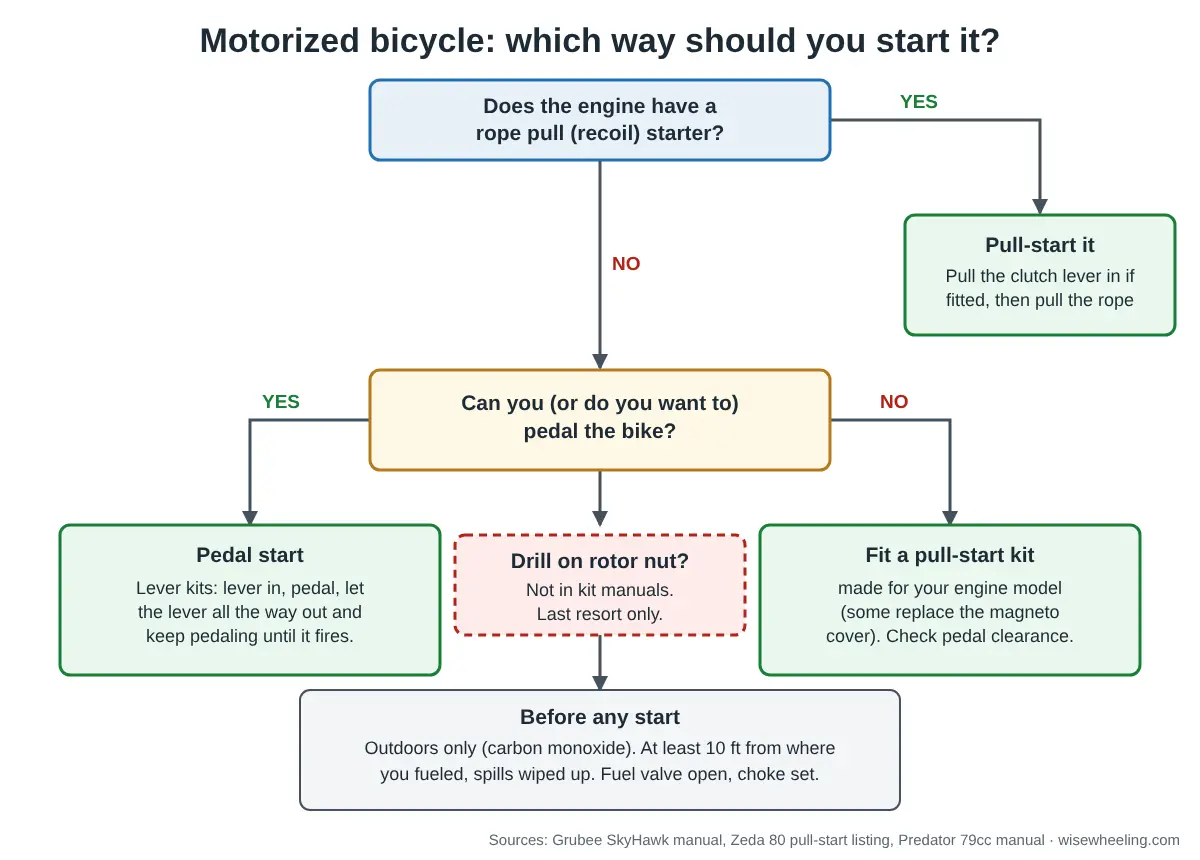
Some riders spin a bicycle engine kit over with a cordless drill and a socket on the nut that holds the magneto rotor, but no kit manual we checked describes that method, and the parts were not designed to be driven that way. The starting methods kit makers do document are pedal starting (lever-clutch engines) and rope pulling (engines with a recoil starter). If you want to stop pedaling, a pull-start kit made for your engine is the supported way to get there.
Drill start vs. the documented ways to start
| Method | Who documents it | What you need | Main catch |
|---|---|---|---|
| Pedal start | Grubee manual (lever-clutch models) | A working clutch cable with about 1/16 inch of free play; a stand helps | You have to pedal, ideally downhill for the first start |
| Rope pull | Grubee manual (GGG-2 centrifugal-clutch engines); pull-start kit makers | An engine or conversion kit with a recoil starter | Some kits make the engine wider, which can affect pedal clearance |
| Drill on the rotor nut | No kit manual we found | A drill, a socket that fits the nut, the magneto cover off | The nut, socket and drill take loads they were not built for; a stall or catch twists the drill hard |
How the drill method works, and why it is risky
On a typical two-stroke bicycle engine, the ignition comes from a magneto: a permanent-magnet rotor spins with the engine past a coil and sends voltage to the CDI, which fires the plug. The Grubee SkyHawk manual also notes that ignition timing is not adjustable because the rotor’s position is fixed. The drill method puts a socket on the nut that holds that rotor and uses the drill to turn the engine over fast enough for the engine to fire.
That is where the problems start:
- The nut is a fastener, not a drive point. Its job is to clamp the rotor that sets your ignition timing. Whether the drill turns it in the tightening or loosening direction depends on which way your engine spins, and the kit manuals we checked do not cover it. A rotor nut that backs off or rounds over is a bigger repair than a hard start.
- Drills kick when they stall. DeWalt’s DCD771 drill manual warns that a drill “may stall if overloaded causing a sudden twist” and says to grip it firmly. An engine coming up against compression is exactly that kind of load.
- The engine can outrun the drill. Once it fires, the engine spins on its own. If the socket is still on the nut, the drill is suddenly being driven instead of driving.
- The magneto is exposed. With the cover off, the spinning rotor and its wiring sit right where your hands are. Harbor Freight’s Predator 79cc manual also tells people with pacemakers to take care near an engine’s magneto or recoil starter.
If you try it anyway: a safety checklist
We are not giving a step-by-step drill procedure, because no manufacturer publishes one we could check. If you still decide to try it, these rules come straight from the engine and tool manuals:
- Work outdoors only. The Predator manual warns that engine exhaust contains carbon monoxide, a poison you cannot see or smell, and says never to run an engine in a home or garage, even with the doors and windows open.
- Move the bike at least 10 feet from where you fueled it, wipe up any spilled fuel and put the tank cap back on (Grubee).
- Put the bike on a stand. On a lever-clutch kit, pull the clutch lever in and lock it in its catch so the engine is disconnected from the rear wheel (Grubee).
- Set up the engine as for any start: fuel valve open and choke lever on (Grubee).
- Brace the drill with both hands and expect it to twist (DeWalt).
- If the drill stalls, release the trigger right away. DeWalt says not to pulse the trigger on and off to restart a stalled drill because that can damage it.
- The moment the engine fires, release the trigger and pull the drill clear.
- Refit the magneto cover before you ride.
Better option: fit a pull start
If pedal starting is hard for you, or you are building a bike without pedals, a recoil starter is what the kit makers sell for that job.
- Bolt-on pull start. For example, the Zeda 80 pull start replaces the engine’s magneto cover. You pull in the clutch and pull the rope. The seller says it fits only the Zeda 80 and adds about 1.75 inches to the engine’s width, which may affect pedal clearance.
- Centrifugal-clutch conversion. Grubee’s manual describes a kit that converts a friction-clutch engine to its GGG-2 setup so it can be pedal started or rope pulled. Grubee notes that the wider GGG-2 needs a one-piece or three-piece wide crank so the pedals clear the engine, and that the crank is not always included.
Buy the kit made for your exact engine model. A generic 2-stroke bicycle engine pull start kit search will show several types, so check the listing against your engine’s make and size before you order. For pedal starts in place, a rear wheel bike stand lifts the drive wheel off the ground.
When the engine will not start by pedaling either
People often reach for a drill because the engine won’t fire by pedaling. Check these first, all from the Grubee manual:
| Check | What it should be |
|---|---|
| Clutch cable | About 1/16 inch of free play at the engine clutch arm with the lever released. Too loose or too tight and the engine will not start. |
| Ignition wiring | All bullet connectors tight; the kill switch has no unwanted ground. |
| Magneto ground | Good ground to the engine, not insulated by varnish on the mounting face. |
| Fuel mix | 2-stroke gas/oil mix at the ratio in your manual (Grubee gives a richer mix for break-in, then 40:1). |
| Idle after it starts | About 1,400 rpm, plus or minus 100, set with the idle screw. |
For the full pedal and pull-cord procedures, see how to start a motorized bicycle without pedaling. If you are still choosing a kit, how to install a motor on a bicycle compares kit types. If a pull-start conversion means changing your cranks, how to remove bike pedals shows which way each side turns. Rules for engine-assisted bikes vary by state; whether you can ride a motorized bicycle without a license covers the legal side.
FAQ
Can a drill damage a motorized bicycle engine?
It can. The drill drives the nut that holds the magneto rotor, and that rotor’s position sets the ignition timing. A loosened or rounded nut, or a slipping socket, can damage parts that a normal pedal or rope start never touches.
Do I need to remove the pedals to use a drill or pull start?
Not for a drill. The kit manuals keep the pedals as part of the starting procedure. Some pull-start setups make the engine wider, so check pedal clearance and crank fit instead of removing the pedals.
Why does my kit only show pedal starting?
Lever-clutch engines like Grubee’s have no starter of their own. Releasing the clutch lever while you pedal connects the rear wheel to the engine through the chain, and that is what turns it over.
Sources
- Grubee SkyHawk engine manual: magneto, clutch adjustment, fueling safety, starting procedures, GGG-2 conversion (read 2026-11-12).
- Bicycle-engines.com, Zeda 80 pull start listing (read 2026-11-12).
- DeWalt DCD771 drill/driver instruction manual: stall and trigger warnings (read 2026-11-12).
- Harbor Freight Predator 79cc (item 69733) owner’s manual: carbon monoxide and magneto warnings (read 2026-11-12).

Suryashankar Dasgupta founded Wise Wheeling. He has been cycling for more than 20 years, on geared and single-speed bikes, across many kinds of terrain. His guides cover bike repair, fit and gear, and each one is checked against manufacturer manuals, Park Tool and other primary sources before it’s published. Read how guides are made: https://wisewheeling.com/editorial-policy/