Rear Derailleur Capacity: Will Your Bigger Cassette Work?
This post contains Amazon affiliate links. As an Amazon Associate I earn from qualifying purchases, at no extra cost to you.
A rear derailleur can handle a bigger cassette only if your new gearing stays inside three numbers on its spec sheet: the largest cog it is rated for, its total capacity, and (on a 2x or 3x crank) its maximum front difference. Total capacity is simply (big chainring − small chainring) + (largest cog − smallest cog). Find the model number printed on your derailleur, run it through the calculator below, and you will know before you spend money on a cassette.
One warning up front: the cage letters alone do not give you a number. In Shimano’s current spec sheet, an 11-speed 105 RD-R7000-GS is rated 39T, while a 12-speed Deore XT RD-M8100-GS is rated 35T.
Which derailleur do you have?
| What you see | How to spot it | What it tells you |
|---|---|---|
| -SS (short cage), e.g. RD-R7000-SS | Suffix after the model number printed on the derailleur body; shortest cage of the family | Shimano’s 105, Ultegra, Sora and Claris SS models are rated 35–37T, with a largest cog of 30–32T |
| -GS (medium cage), e.g. RD-R7000-GS | Same marking, longer cage than SS | Anywhere from 32T to 43T depending on the family: 39T on 11-speed 105/Ultegra, 35–36T on 12-speed XTR/XT (built for 45T cogs) |
| -SGS (long cage), e.g. RD-M6100-SGS | Longest cage of the family | 39T to 47T. The 12-speed MTB SGS models are rated 41T for a 51T cog but are 1x only |
| No suffix, e.g. RD-R7100, RD-R8150, RD-RX820 | Only one cage length exists for that model | Read the model’s own row in the chart below |
| SRAM model name (e.g. Rival eTap AXS, GX Eagle) | Model name on the derailleur; some AXS road models come in different max-cog versions | SRAM publishes capacity per model on its support pages (see the SRAM table below) |
Rear derailleur capacity calculator
Enter your crank and cassette, pick your Shimano derailleur (or type in the specs for any brand), and the calculator runs all four checks from the manufacturer data.
Rear derailleur capacity calculator
How it works: capacity needed = (big ring − small ring) + (largest cog − smallest cog), the formula SRAM and BikeRadar both publish. Model limits come from Shimano’s Specifications document; leave the small chainring blank for a 1x.
The 3 numbers every derailleur spec gives you
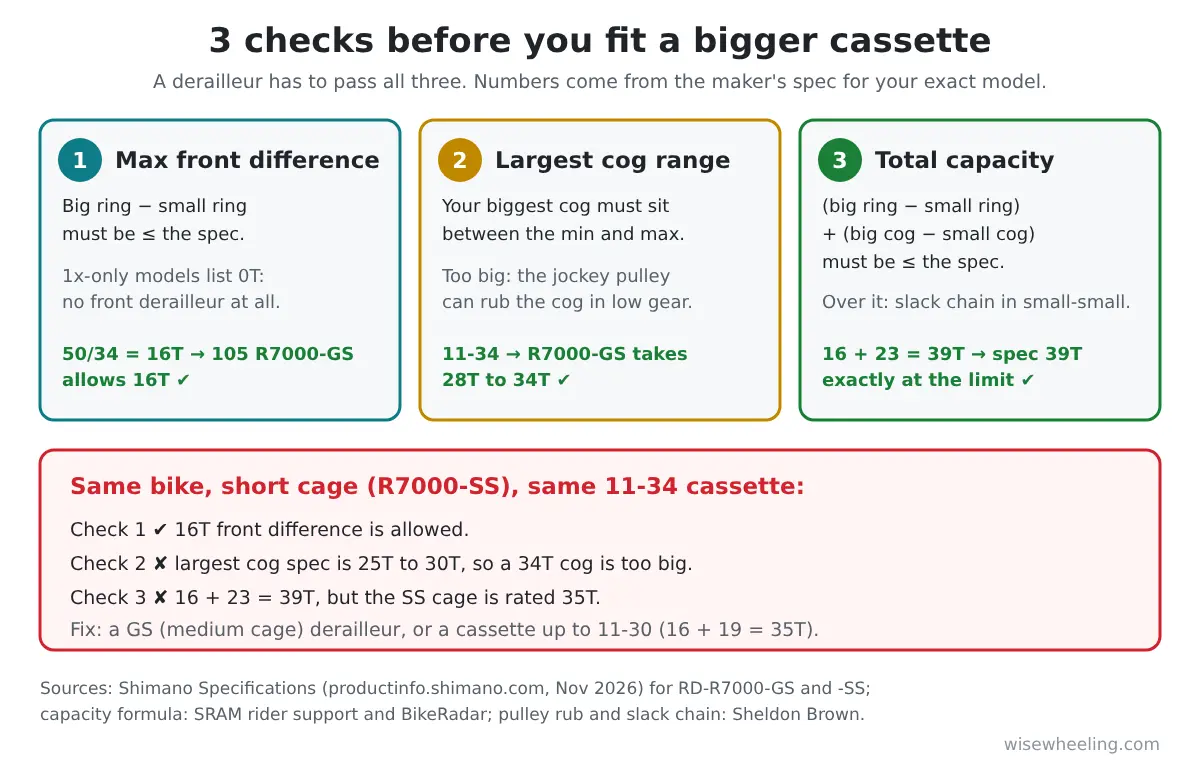
1. Largest cog (max low sprocket)
This is the biggest cog the derailleur can reach. Go over it and, as Sheldon Brown’s glossary puts it, the jockey pulley may rub against the sprocket in the lowest gear. Shimano also lists a minimum largest cog for each model. The 12-speed Deore RD-M6100-SGS, for example, is listed at 51T for both minimum and maximum, and Shimano makes separate GS models for 45T cassettes.
2. Total capacity (chain wrap)
Total capacity is how much chain slack the cage can take up between your biggest and smallest gear combinations. SRAM’s support page states the formula as [large chainring − small chainring] + [largest cog − smallest cog]. A 50/34 crank with an 11-34 cassette needs 16 + 23 = 39T. A 1x with a 10-51 needs 0 + 41 = 41T.
Park Tool’s chain sizing guide sizes the chain on the largest ring and largest cog, and says that in the smallest combination there should be no slack and the chain should not contact itself. If your gearing exceeds the derailleur’s capacity, you can’t meet both rules at once: a chain long enough for big-big hangs slack in small-small.
3. Max front difference (2x and 3x only)
This is the biggest chainring gap the derailleur is designed for. Shimano lists 16T for its 11- and 12-speed 2x road derailleurs (enough for a 50/34 or 46/30 crank) and 17T for 11- and 12-speed 2x GRX. Many modern MTB and gravel 1x derailleurs show 0T or “–”, meaning no front derailleur at all, even when their total capacity looks huge.
Shimano rear derailleur capacity chart (40 current models)
Find your model number (it’s printed on the derailleur, usually on the body or outer cage plate) and read across. “1x only” means Shimano lists 0T or no front difference. A range like 28T–34T means the largest cog must fall between those sizes.
| Model | Speeds | Max front difference | Total capacity | Largest cog | Smallest cog |
|---|---|---|---|---|---|
| Mountain bike, 12-speed | |||||
| XTR RD-M9100-SGS | 12 | 1x only | 41T | 51T | 10T |
| Deore XT RD-M8100-SGS | 12 | 1x only | 41T | 51T | 10T |
| Deore XT RD-M8100-GS | 12 | 1x only | 35T | 45T | 10T |
| Deore XT RD-M8120-SGS | 12 | 10T | 45T | 45T | 10T |
| SLX RD-M7100-SGS | 12 | 1x only | 41T | 51T | 10T |
| Deore RD-M6100-SGS | 12 | 1x only | 41T | 51T | 10T |
| Mountain bike, 11/10/9-speed | |||||
| Deore XT RD-M8130-SGS | 11 | 1x only | 39T | 50T | 11T |
| Deore RD-M5100-SGS | 11 | 1x only | 40T | 51T | 11T |
| Deore RD-M6000-GS | 10 | 10T | 41T | 42T | 11T |
| Deore RD-M6000-SGS | 10 | 22T | 43T | 32T–36T | 11T |
| Alivio RD-M3100-SGS | 9 | 22T | 45T | 32T–36T | 11T–12T |
| Altus RD-M370-SGS | 9 | 22T | 45T | 28T–34T | 11T |
| Gravel (GRX) | |||||
| GRX RD-RX822-GS | 12 | 1x only | 35T | 45T | 10T |
| GRX RD-RX822-SGS | 12 | 1x only | 41T | 51T | 10T |
| GRX RD-RX820 | 12 | 17T | 42T | 34T–36T | 11T |
| GRX RD-RX825 (Di2) | 12 | 17T | 40T | 34T–36T | 11T |
| GRX RD-RX810 | 11 | 17T | 40T | 30T–34T | 11T |
| GRX RD-RX812 | 11 | 1x only | 31T | 40T–42T | 11T |
| GRX RD-RX815 (Di2) | 11 | 17T | 38T | 30T–34T | 11T |
| GRX RD-RX400 | 10 | 16T | 41T | 32T–36T | 11T |
| Road | |||||
| Dura-Ace RD-R9250 (Di2) | 12 | 16T | 37T | 30T–34T | 11T |
| Ultegra RD-R8150 (Di2) | 12 | 16T | 39T | 30T–34T | 11T |
| 105 RD-R7150 (Di2) | 12 | 16T | 41T | 34T–36T | 11T |
| 105 RD-R7100 | 12 | 16T | 41T | 34T–36T | 11T |
| Ultegra RD-R8000-SS | 11 | 16T | 35T | 25T–30T | 11T–14T |
| Ultegra RD-R8000-GS | 11 | 16T | 39T | 28T–34T | 11T–12T |
| 105 RD-R7000-SS | 11 | 16T | 35T | 25T–30T | 11T–14T |
| 105 RD-R7000-GS | 11 | 16T | 39T | 28T–34T | 11T–12T |
| Tiagra RD-R4000 | 11 | 16T | 41T | 36T | 11T |
| Sora RD-R3000-SS | 9 | 16T | 37T | 25T–32T | 11T–14T |
| Sora RD-R3000-GS | 9 | 20T | 43T | 28T–34T | 11T–14T |
| Claris RD-R2000-SS | 8 | 16T | 37T | 25T–32T | 11T–13T |
| Claris RD-R2000-GS | 8 | 20T | 43T | 28T–34T | 11T–13T |
| Hybrid, trekking and entry-level | |||||
| CUES RD-U8000 | 11 | 1x only | 39T | 50T | 11T |
| CUES RD-U6000 | 11/10 | 1x only | 39T | 48T–50T | 11T |
| CUES RD-U6040 | 11 | 16T | 41T | 36T | 11T |
| CUES RD-U4000 | 9 | 1x only | 35T | 41T–46T | 11T |
| CUES RD-U4020 | 9 | 16T | 41T | 36T | 11T |
| Essa RD-U2000 | 8 | 1x only | 34T | 45T | 11T |
| Tourney RD-TY300-SGS | 7/6 | 20T | 43T | 28T–34T | 11T–14T |
SRAM: what SRAM publishes
| Derailleur | Total capacity | Largest cog | Source |
|---|---|---|---|
| Rival eTap AXS | 39T | Not stated on that page | SRAM support |
| RED or Force eTap AXS (standard version) | 36T | Not stated on that page | SRAM support |
| RED eTap AXS 36T Max | 39T | 36T (per model name) | SRAM support |
| GX Eagle (RD-GX-1-B2), 1x | Cassette spread only (1x) | 52T | SRAM model page |
What happens if you go over capacity?
- Too big a cog: the upper (jockey) pulley can rub the largest cog in low gear (Sheldon Brown). Treat the largest-cog figure as a hard limit.
- Too much total capacity: with the chain sized for big ring/big cog, the chain goes slack or touches itself in small ring/small cog, which Park Tool’s guide says shouldn’t happen.
- How much slack is in the ratings? BikeRadar notes that quoted capacities tend to be conservative, and Sheldon Brown says riders who avoid small-ring/small-cog combinations can exceed them. BikeRadar also points out that Shimano wouldn’t condone it. If you go a tooth or two over capacity, size the chain for big-big and stay out of small-small. Don’t do that with the largest-cog limit.
What most guides get wrong
- “GS = 39T, SS = 35T.” That holds for Shimano 11-speed road (105 R7000, Ultegra R8000). It is wrong for a 12-speed XT RD-M8100-GS (35T) or a Claris GS (43T). Always read the model’s own spec.
- Treating capacity and largest cog as the same thing. The 105 RD-R7000-SS is rated 35T of capacity but only a 30T largest cog. An 11-32 on a 1x needs just 21T of capacity, yet it’s still out of spec for that derailleur.
- Assuming a long cage means it works on any crank. Shimano’s 12-speed MTB SGS derailleurs (XTR M9100, XT M8100, SLX M7100, Deore M6100) are 1x only. For 2×12 MTB, Shimano makes the XT RD-M8120-SGS: 10T front difference, 45T capacity, 45T largest cog.
Your setup doesn’t pass? Fix it in this order
- Pick a cassette that fits your current derailleur. Usually the cheapest fix. On a 105 R7000-GS with a 50/34, an 11-34 is the limit (39T exactly).
- Swap to the right cage or model. Use the chart to find one rated for your gearing. Examples: Shimano 105 RD-R7000-GS for 11-speed road up to 34T, Shimano Deore RD-M6100-SGS for 1×12 with a 51T cog, or Shimano GRX RD-RX822-SGS for 1×12 gravel with a 51T cog. Check the current price on Amazon, and confirm shifter compatibility in Shimano’s compatibility charts first.
- Check the freehub. A wider cassette may need a different freehub body, especially 10T-start cassettes. See freehub body types, then swap the cassette.
- Re-size the chain. A bigger largest cog almost always needs a longer chain. Use our chain length calculator and check it in big-big and small-small.
- Set B-tension and indexing. Set the B-screw gap to the maker’s spec for the new largest cog, then index the rear derailleur.
Not sure the bigger cassette is even worth it? Compare your low gear before and after with the gear ratio calculator.
FAQ
Can a Shimano 105 R7000 handle an 11-34 cassette?
The GS (medium cage) version can: Shimano lists a 28T–34T largest cog and 39T capacity, and a 50/34 with 11-34 needs exactly 39T. The SS (short cage) version can’t. Its largest cog is listed at 25T–30T and its capacity at 35T.
Will a 12-speed Deore M6100-SGS work with a 10-45 cassette?
Not per Shimano’s spec. It lists 51T as both the minimum and maximum largest cog for RD-M6100-SGS. For 45T cassettes, Shimano makes GS models such as the XT RD-M8100-GS (35T capacity, 45T largest cog).
How do I calculate capacity for a 1x drivetrain?
With one chainring the front difference is zero, so capacity needed equals the cassette spread: largest cog minus smallest cog. A 10-51 needs 41T, an 11-42 needs 31T, and a 10-45 needs 35T.
Is the total capacity rating conservative?
Usually a little. BikeRadar and Sheldon Brown both say so, and going slightly over mostly costs you a slack chain in small-small. The largest-cog limit is different: exceed it and the pulley can rub the cog, so stay within that number.
Sources
- Shimano: Specifications (PDF, productinfo.shimano.com)
- SRAM: total drivetrain tooth capacity (formula)
- BikeRadar: complete guide to rear derailleurs
- Sheldon Brown: glossary, “Capacity”
- Park Tool: chain length sizing

Suryashankar Dasgupta founded Wise Wheeling. He has been cycling for more than 20 years, on geared and single-speed bikes, across many kinds of terrain. His guides cover bike repair, fit and gear, and each one is checked against manufacturer manuals, Park Tool and other primary sources before it’s published. Read how guides are made: https://wisewheeling.com/editorial-policy/