New Bike Tires Feel Slower? 6 Causes and How to Check
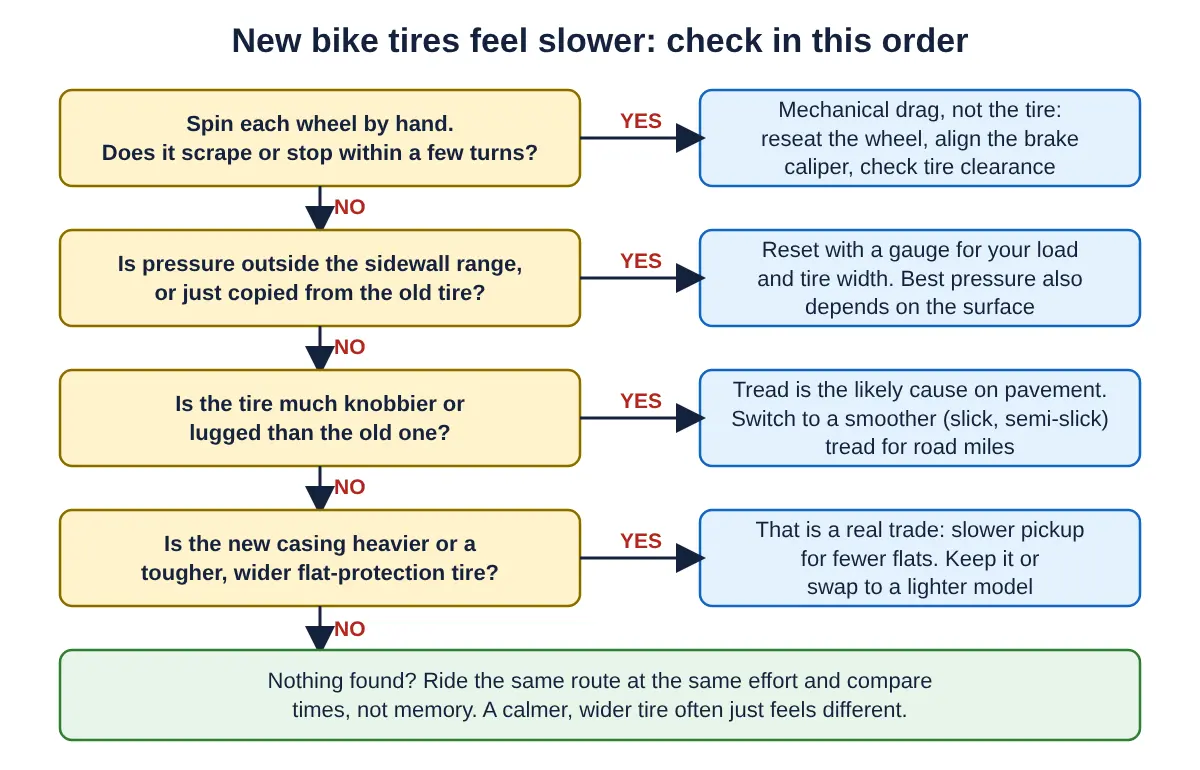
New tires can make a bike feel slower for two very different reasons: the tires really do roll slower, or something was disturbed when the wheel came off. Spin each wheel by hand first. If one scrapes or stops much sooner than the other, you have brake rub or a crooked wheel, not a slow tire. If both spin freely, the cause is the tire itself: tougher tread, a different pressure, or a different casing.
Six causes of a slower feel, and how to check each
| What you notice | Likely cause | How to check | Fix |
|---|---|---|---|
| Scraping, or the wheel stops quickly when spun | Brake pad or rotor rub, wheel not fully seated | Lift the wheel, spin it, sight the gap between rotor and pads | Reseat the wheel, realign the caliper |
| Rubbing noise at the frame, fork or fender | New tire is wider or taller than the old one | Spin slowly and look for shiny or scuffed spots | Add clearance or fit a narrower tire |
| Hum or drag on pavement, fine on dirt | Knobbier tread than before | Compare the tread to the old tire | Smoother tread for road miles |
| Bouncy and harsh, or mushy and draggy | Pressure copied from the old tire or outside the sidewall range | Check with a gauge against the sidewall range | Reset for your weight and tire width |
| Slower pickup but smooth when rolling | Different casing or rubber compound | Compare the maker’s spec for the two tires | Keep it for the durability, or swap |
| Tire hops or wobbles as the wheel spins | Bead not seated evenly | Look at the molded line just above the rim | Deflate, reseat, and re-inflate |
The 5-minute check before you blame the tires
- Lift one end of the bike and spin the wheel. Do the same with the other wheel and compare. Listen for scraping.
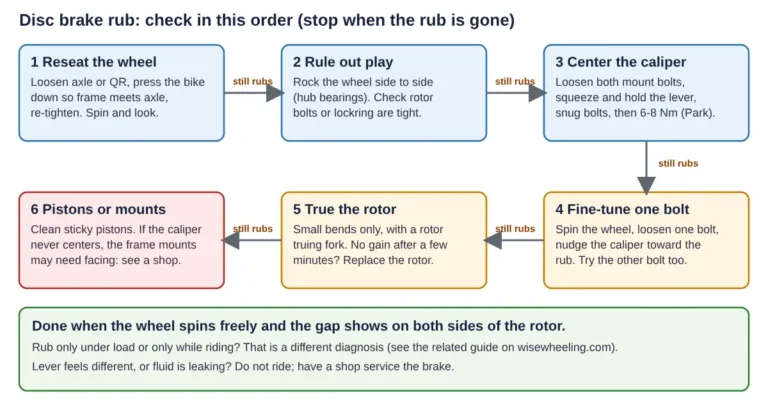
- On disc brakes, backlight the caliper and sight the gaps between the rotor and the pads. Park Tool notes that rub can come from a misaligned caliper or from an improperly seated wheel. Press down on the bike so the frame and axle are in contact, then check the wheel again. Our guides to disc brake rub that only shows up while riding and adjusting rim and disc brakes cover the fix.
- Look for contact between tire and frame, fork, fender or brake hardware, especially if the new tire is wider.
- Look at the molded line just above the rim on both sides. Park Tool says it should run consistently above the rim, and if it bulges you should deflate immediately and reseat the tire (see Tire and Tube Removal and Installation). If the bump only appears after fitting a tube, see why a tire can have a bump after changing a tube.
- Set pressure with a gauge. Details below.
Pressure: higher is not always faster
The old tire’s pressure is not a safe guess for the new one. Schwalbe says there is no general pressure for a bike or tire: the right pressure depends largely on the load on the tire, narrower tires and heavier loads need more, and you should stay inside the minimum and maximum printed on the sidewall. It also says a permanently low pressure often leads to premature tire wear.
Surface matters too. According to Schwalbe’s rolling resistance page, on smooth surfaces higher pressure lowers rolling resistance, while on hard gravel roads and soft forest tracks the reverse holds: lower pressure rolls better. So a tire pumped to the maximum can feel slower and harsher on rough pavement, and a soft tire can feel slow on a smooth bike path.
When the tire really is slower
Schwalbe lists tire construction, tread and other factors as the things that affect rolling resistance. Two of them are easy to judge yourself. Smooth treads generally roll better than coarse ones, and tall lugs with wide gaps usually hurt rolling resistance. The more flexible the rubber compound, the less energy is lost through deformation (both from the rolling resistance page). A gravel or mountain tire on a paved commute will feel slower than the slick road tire it replaced for exactly this reason.
Width is less obvious. Schwalbe’s tire size page says wide tires, properly inflated, do not necessarily suffer from higher rolling resistance, and that they are generally run at lower pressures. A wider tire that feels calmer and slower is often not slower on the clock. Time the same route at the same effort before and after if you want a real answer. If you are unsure what width suits your bike, start with how to choose tire width and the tire size chart.
Keep the tires or swap them?
| Your riding | Better choice |
|---|---|
| Mostly pavement or bike paths | Smooth or semi-slick tread; pressure toward the upper part of the sidewall range for your load |
| Rough pavement or mixed surfaces | Same tread, but try lower pressure inside the printed range |
| Hard gravel roads or forest tracks | Tread with some grip; lower pressure rolls better there, per Schwalbe |
| Commuting where a flat costs you the morning | Keep the tougher tire and accept the slower feel |
FAQ
Can a wider tire be faster?
It can be. Schwalbe says wide tires do not necessarily have higher rolling resistance when properly inflated, and they run at lower pressures. The feel changes before the speed does.
Is higher pressure always faster?
No. On very smooth surfaces higher pressure lowers rolling resistance, but on rough gravel and forest tracks lower pressure does. Never go outside the range printed on the sidewall.
How do I tell brake rub from a slow tire?
Spin the wheel with the bike lifted. Scraping, or a wheel that stops much sooner than the other one, points to rub or a poorly seated wheel. A freely spinning wheel points to the tire or the pressure.
Suryashankar Dasgupta founded Wise Wheeling. He has been cycling for more than 20 years, on geared and single-speed bikes, across many kinds of terrain. His guides cover bike repair, fit and gear, and each one is checked against manufacturer manuals, Park Tool and other primary sources before it’s published. Read how guides are made: https://wisewheeling.com/editorial-policy/