Which Disc Brake Adapter Do I Need? Rotor Chart + Finder
This post contains Amazon affiliate links. As an Amazon Associate I earn from qualifying purchases, at no extra cost to you.
The adapter you need depends on two numbers: the rotor size your fork or frame mount was built for (its “native” size) and the rotor you want to run. On post mounts, subtract one from the other: a 160 mm mount going to a 180 mm rotor needs a +20 mm adapter (Shimano SM-MA-F180P/P2 or SRAM 20 P-1), and 180 to 203 mm needs a +23 mm one (Shimano SM-MA-F203P/PM). IS mounts and flat mounts follow their own charts, so pick your mount type in the finder below and it returns the exact Shimano or SRAM part.
Disc brake adapter finder (Shimano and SRAM)
How it works: the finder looks up your native mount size and target rotor in Shimano’s mount adapter chart (C-195) or the SRAM Caliper Mounting Specifications (Rev V, 2025). A blank result in those charts means the maker doesn’t list that combination, so the finder doesn’t offer it. SRAM results are for offset-tab calipers (Maven, Motive, Code 2017+, Level, G2, Guide, DB); older inline-tab CPS calipers like Juicy or BB7 use a different chart. Flat mount is covered in its own table below.
Post mount adapter chart: Shimano vs SRAM part numbers
Most mountain bikes, and plenty of older gravel and hybrid bikes, use post mounts. Here are both brands’ official answers side by side, so you can see which parts do the same job:
| Native post mount | Rotor you want | Step | Shimano part | SRAM part (offset-tab caliper) |
|---|---|---|---|---|
| 140 mm | 160 mm | +20 | SM-MA-F180P/P2, SM-MA90-F180P/P, MA-P0020-N1 | 20 S spacers or 20 P-1 |
| 140 mm | 180 mm | +40 | Not listed | 40 P |
| 160 mm | 180 mm | +20 | SM-MA-F180P/P2, SM-MA90-F180P/P, MA-P0020-N1 | 20 S spacers or 20 P-1 |
| 160 mm | 200 mm | +40 | SM-MA-F220P/PM, MA-P0040-N1 | 40 P |
| 160 mm | 203 mm | +43 | SM-MA-F203P/P | Not listed |
| 180 mm | 200 mm | +20 | SM-MA-F220P/PL2, MA-P0020-N2 | 20 S spacers or 20 P-2 |
| 180 mm | 203 mm | +23 | SM-MA-F203P/PM, SM-MA90-F203P/PM | Not listed |
| 180 mm | 220 mm | +40 | SM-MA-F220P/PM, MA-P0040-N1 | 40 P |
| 200 mm | 203 mm | +3 | SM-MA-F203P/PL2 | 3S spacers |
| 200 mm | 220 mm | +20 | SM-MA-F220P/PL2, MA-P0020-N2 | 20 S spacers or 20 P-2 |
| 203 mm | 220 mm | +17 | SM-MA-F220P/PL | 17 P |
Two catches the part names hide:
- Shimano names an adapter after the rotor it gives on a 160 mm mount. Shimano’s own note on chart C-193 says the rotor size in the model number assumes a 160 mm post mount. That’s why the “F180” adapter gives you 160 mm on a 140 mm mount, and why “F220P/PM” is the part for a 200 mm rotor on a 160 mm mount. Shop by the native-size row, not by the number printed on the adapter.
- SRAM Maven needs the new brackets. SRAM says Maven needs the 20 P-1 (160/180 mm rotors) or 20 P-2 (200/220 mm rotors) bracket for a 20 mm jump and isn’t compatible with the old 20P. Its mounting PDF also says the 30 P doesn’t work with Maven.
If you’re shopping: the Shimano SM-MA-F180P/P2 is the common +20 mm adapter for Shimano calipers. For 180 to 203 mm there’s the Shimano SM-MA-F203P/PM, and for 160 to 203 mm the Shimano SM-MA-F203P/P. SRAM riders want the SRAM 20 P-1 post bracket or the SRAM 40 P post bracket. Check the current price on Amazon, and match the part number exactly. Lookalike “universal” adapters often get the step wrong.
Step 1: Identify your brake mount type
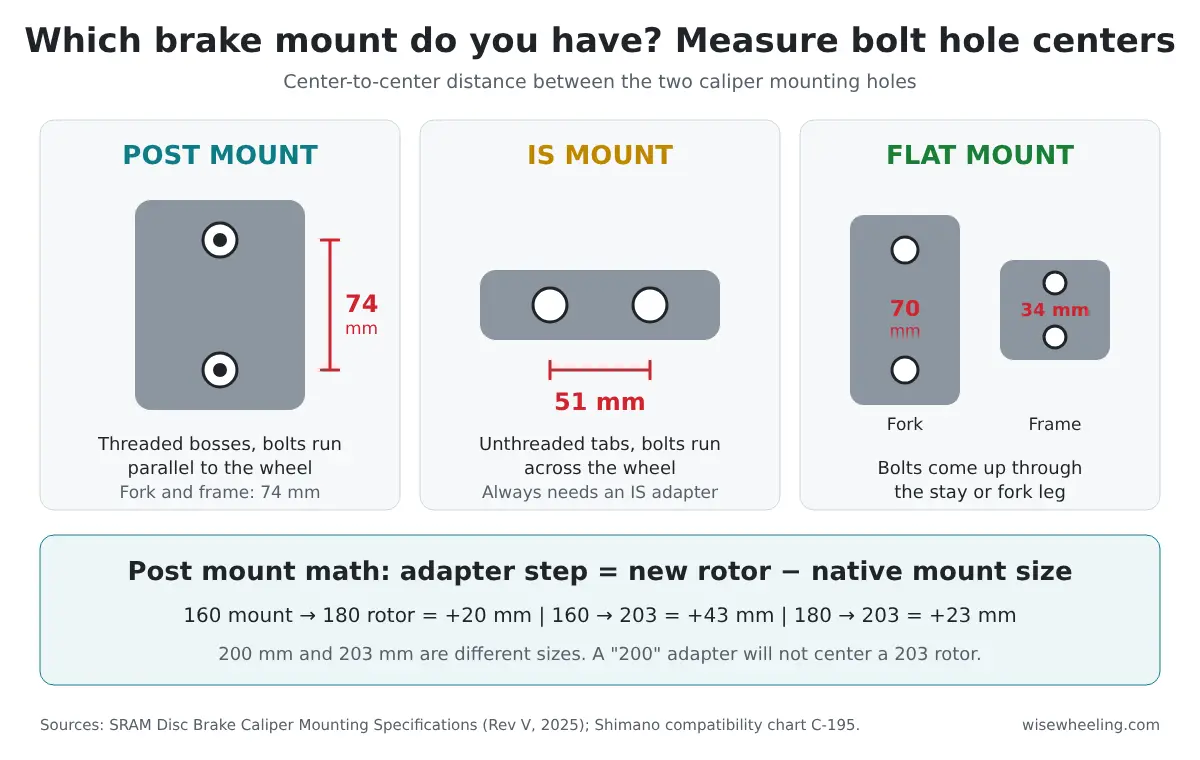
Take the caliper off and measure from the center of one mounting hole to the center of the other. SRAM’s mounting spec gives these numbers:
| Mount | Fork hole spacing | Frame hole spacing | How to spot it |
|---|---|---|---|
| Post mount | 74 mm | 74 mm | Two threaded bosses; bolts point along the wheel |
| IS (International Standard) | 51 mm | 51 mm | Unthreaded tabs; bolts point across the wheel. Always needs an adapter for a post-mount caliper. |
| Flat mount | 70 mm | 34 mm | Caliper sits flat on the stay or fork; bolts come up from underneath |
| Thru-bolt fork | 34 mm | n/a | Bolt holes go right through the fork leg |
Here’s what a lot of guides get wrong: flat mount isn’t “post mount with 74 mm spacing and countersunk bolts.” On a fork it’s 70 mm, and on a frame it’s 34 mm. A post-mount adapter won’t bolt to it.
Step 2: Find your native rotor size
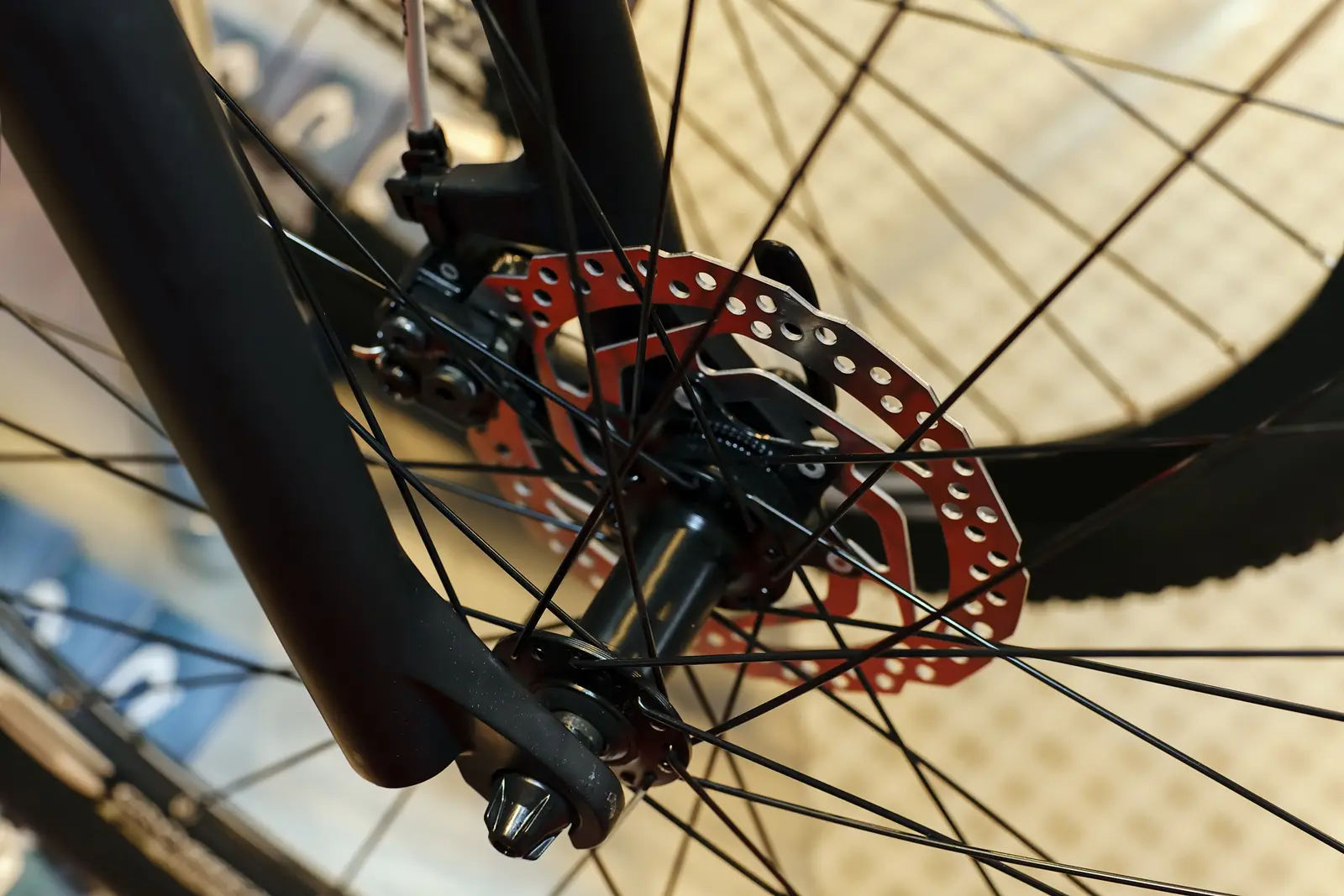
The native size is the rotor diameter the caliper fits with no adapter. Post mounts come in 140, 160, 180, 200 and 203 mm versions, and front and rear on the same bike are often different. Three ways to pin it down, quickest first:
- Read the spec sheet. Fork makers list it as “post mount 180 mm” or similar. Frame makers put it in the geometry/spec page or the frame manual, often next to a maximum rotor size.
- No adapter on the bike now? The caliper bolts straight to the posts, so the rotor you’re running is the native size. Measure the rotor across its outer edge to confirm: a 180 measures 180 mm, a 203 measures 203 mm.
- Adapter already fitted? Read the part number on it and find it in the chart above. That row’s “native” column is your mount size. With SRAM, subtract the step: a 20 P-1 under a 180 rotor means a 160 mount.
Keep 200 and 203 mm straight. They’re separate sizes with separate adapters in both brands’ charts. A 200 mm adapter won’t put a 203 rotor in the right spot, and the reverse doesn’t work either.
IS mount adapters
IS tabs can’t take a post-mount caliper directly. Shimano’s dealer manual says IS mounts need a dedicated adapter. You’ll find these on older forks and frames, and on some budget bikes.
| Rotor | Shimano front (IS fork) | Shimano rear (IS frame) | SRAM on 140 IS | SRAM on 160 IS |
|---|---|---|---|---|
| 140 mm | Not listed | SM-MA90-R140P/S | 0 IS | Not listed |
| 160 mm | SM-MA-F160P/S, SM-MA90-F160P/S | SM-MA-R160P/S, SM-MA90-R160P/S | 20 IS | 0 IS |
| 180 mm | SM-MA-F180P/S | SM-MA-R180P/S, SM-MA90-R180P/S | 40 IS | 20 IS |
| 200 mm | Not listed | Not listed | 60 IS | 40 IS |
| 203 mm | SM-MA-F203P/S | SM-MA-R203P/S | Not listed | Not listed |
Flat mount: going from 140 to 160 mm (road and gravel)
Flat mount bikes usually move between 140 and 160 mm, and sometimes 180 mm. Shimano flat-mount calipers ship with a flip-flop front bracket (Shimano part Y8N230000) that covers two rotor sizes. Rear jumps use SM-MA-R160D/D. SRAM uses an F0/F20 front bracket and an FD20 bracket, and you pick by measuring from the mount slot to the axle:
| SRAM measurement | 140 mm rotor | 160 mm rotor | 180 mm rotor |
|---|---|---|---|
| Fork, dimension A = 23.5 mm | F0 bracket position | F20 bracket position | Not listed |
| Fork, dimension A = 32 mm | Not listed | F0 bracket position | F20 bracket position |
| Rear, dimension B = 36.5 mm | Direct to frame | FD20 bracket | Not listed |
| Rear, dimension B = 45 mm | Not listed | Direct to frame | FD20 bracket |
SRAM’s rotor chart has a footnote for road, gravel and cyclocross: check the fork or frame maker’s spec before you fit a 140 or 180 mm rotor, because those sizes have compatibility limits on many forks and frames.
What rotor size should you run?
Bigger rotors add braking power and heat capacity, and that matters more as rider-plus-bike weight goes up. SRAM publishes this recommendation chart. Values are rear/front, and the system weight includes the bike:
| Rider + bike | Road / gravel / CX | Cross-country | Trail | Downhill |
|---|---|---|---|---|
| Under 140 lb | 140 | 160 | 160 | 180 |
| 140–170 lb | 140/160 | 160/180 | 160/180 | 180 |
| 170–200 lb | 140/160 | 160/180 | 180/200 | 180/200 |
| 200–230 lb | 160 | 180 | 180/200 | 180/200 |
| 230–260 lb | 160 | 180 | 180/200 | 200 |
| 260–290 lb | 160/180 | 180 | 200 | 200 |
| 290–320 lb | 160/180 | 200 | 200 | 200 |
| Over 320 lb | 180 | 200 | 220 | 220 |
Example: a 210 lb rider on a 35 lb trail bike is at 245 lb, so SRAM points to 180 rear / 200 front. If that bike came with 180/180 on 180 mm post mounts, only the front needs a +20 mm adapter.
How to install the adapter and new rotor
- Check the limit first. Find the maximum rotor size your fork and frame maker allows. Don’t go over it.
- Match the rotor to the hub. Six-bolt hubs take six-bolt rotors and Center Lock hubs take Center Lock rotors. Changing diameter doesn’t change that. (A six-bolt rotor can go on a Center Lock hub with an adapter, but not the other way round; see our Center Lock vs 6-bolt guide for the limits and torque.)
- Swap the rotor and torque its bolts or lockring to the rotor maker’s spec.
- Mount the adapter to the fork or frame, then hang the caliper on the adapter loosely. On Shimano adapters, Shimano’s manual says the mark faces up.
- Check bolt length. Adapters often need longer caliper bolts. SRAM wants 9–13 mm of thread engagement on post mounts and 5–7 mm on flat mounts.
- Center the caliper. Squeeze the lever so the pads clamp the rotor, then tighten the bolts in steps to the torque spec below. If it still rubs, see how to fix a rubbing disc brake.
- Bed in the new rotor following your brake maker’s procedure before any real descent. If the brake gets noisy afterward, work through our disc brake squeal checks.
| Bolt | Shimano | SRAM |
|---|---|---|
| Post mount caliper bolts (MTB) | 6–8 N·m (53–71 in-lb) | 9.5 N·m (84 in-lb) |
| Adapter-to-frame/fork bolts (IS adapter) | 6–8 N·m (53–71 in-lb) | Use SRAM’s spec for your brake |
| Flat mount caliper bolts | Use Shimano’s spec for your caliper | 5 N·m (44 in-lb) |
| Minimum thread engagement | n/a | Post mount 9–13 mm; flat mount 5–7 mm |
Those values are small enough that guessing by feel is risky. A 2–20 N·m bike torque wrench covers them, along with most other bolts you’ll touch, such as the ones in our stem bolt torque guide.
Mistakes that cost riders a second order
- Buying by the number on the adapter. A Shimano “F180” on a 140 mm mount gives a 160 mm rotor, not 180.
- Assuming front and rear match. The fork and frame mounts are often different native sizes, so check each end separately.
- Mixing 200 and 203. Shimano’s and SRAM’s charts both treat them as separate sizes with separate adapters.
- Reusing the old SRAM 20P on Maven. SRAM says it isn’t compatible. Use the 20 P-1 or 20 P-2.
- Skipping the bolt check. A spacer stack or adapter with the original short bolts can leave too little thread engaged. SRAM warns that can let the brake come off the bike.
- Forgetting the pads. A rotor swap is a good time to check pad wear. See when to replace disc brake pads.
DIY or shop?
If you have hex keys, a torque wrench and the right part number, this is a bolt-on job. It doesn’t need a bleed, because the hydraulic system stays closed. Take it to a shop if the mount threads are damaged, if you can’t confirm your fork’s maximum rotor size, or if the caliper won’t center without bending something. Mount faces that need facing are shop work too.
FAQ
Can I put a 180 mm rotor on a 160 mm fork?
Yes, as long as the fork maker allows 180 mm (check its spec sheet). On a 160 mm post mount use a +20 mm adapter: Shimano SM-MA-F180P/P2 or SRAM 20 P-1.
Do I need new brake pads or a bleed for a bigger rotor?
No. The caliper, pads and hose stay the same. The adapter just moves the caliper outward to meet the bigger rotor. Swap pads only if they’re worn or contaminated.
Can I mix a Shimano adapter with a SRAM caliper?
Both brands use the 74 mm post mount standard. But SRAM specifies its own brackets, and it requires 20 P-1/20 P-2 for Maven, so stick with the caliper maker’s adapter where possible.
Is a 203 mm rotor the same as a 200 mm rotor?
No. They’re different diameters with different adapters. Check which one your rotor brand makes before you buy the adapter.
Still unsure of your setup? Check the wider basics in our guide to adjusting bike brakes, then come back to the finder with your mount type and native size.

Suryashankar Dasgupta founded Wise Wheeling. He has been cycling for more than 20 years, on geared and single-speed bikes, across many kinds of terrain. His guides cover bike repair, fit and gear, and each one is checked against manufacturer manuals, Park Tool and other primary sources before it’s published. Read how guides are made: https://wisewheeling.com/editorial-policy/