Bike Chain Slipping? 3 Causes and the Fix for Each
This post contains Amazon affiliate links. As an Amazon Associate I earn from qualifying purchases, at no extra cost to you.
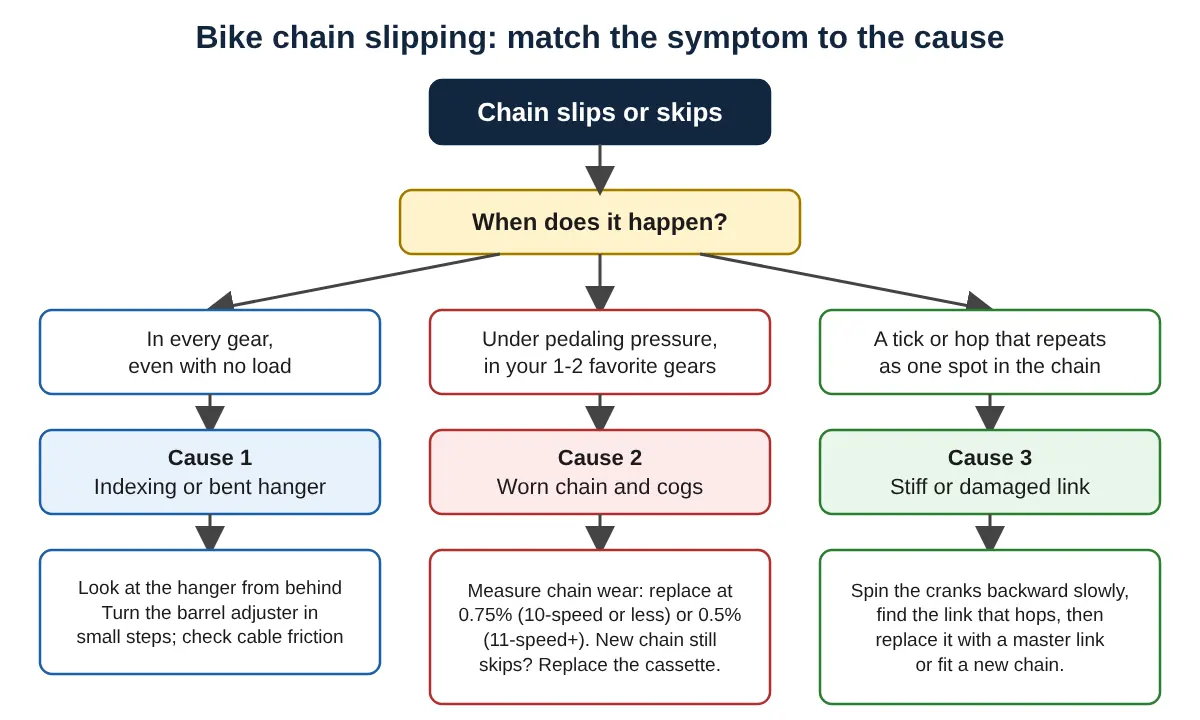
A bike chain that slips is almost always one of three things: indexing that is out of adjustment, a chain and cassette that are worn, or a stiff or damaged link. When it happens tells you which. If it skips in every gear, suspect indexing. If it only slips when you push hard in one or two favorite gears, suspect wear. If you feel a regular tick, look for a bad link. Measuring the chain takes a minute and rules the most common cause in or out. If the chain comes off the chainrings or cassette entirely instead of skipping, that is a different fault; see our guide to a chain that keeps falling off.
| What you feel | Likely cause | First check |
|---|---|---|
| Skips in every gear | Indexing is off | Hanger straight? Cable moving freely? Adjust the barrel adjuster |
| Slips under pressure in your 1-2 favorite gears | Chain and sprockets worn | Measure the chain (calculator below) |
| Slips right after a new chain went on | Cassette worn from the old chain | Inspect and replace the cogs |
| A tick or hop that repeats | Stiff or damaged link | Pedal backward slowly and watch each link pass the derailleur |
Park Tool’s derailleur troubleshooting table matches the first two rows: skipping in all gear combinations points to a poor index setting, while skipping under pressure in one or two favorite gears means the sprockets and chain may be worn out (Park Tool, rear derailleur advanced troubleshooting).
Measure chain wear first
A worn chain meshes poorly with the cogs and chainrings, and running it past its limit wears the cogs out early. Park Tool notes that replacing a cassette costs far more than replacing a chain, which is why the chain gets replaced on a schedule of wear, not when it fails (Park Tool, when to replace a worn chain).
| Drivetrain | Replace chain at | What that looks like over 12 inches |
|---|---|---|
| Single-speed | 1.0% wear | 12 1/8 in (about 307.8 mm) |
| 10-speed or fewer | 0.75% wear | about 12 3/32 in (about 307.1 mm) |
| 11-speed or more | 0.5% wear | about 12 1/16 in (about 306.3 mm) |
The limits come from Park Tool, which says to replace the chain by the time it reaches the value for your drivetrain and to check with the chain maker for specifics (Park Tool CC-3.2 chain checker). The last column is plain arithmetic on 12 inches, so it is a guide, not a replacement for the checker.
The ruler check
- Line up one rivet with the 0 mark on a 12-inch ruler.
- Count 24 more rivets. On a new chain the last one lands on 12 inches.
- If it lands more than 1/16 inch past 12, Park Tool calls the chain stretched to the point of replacement.
Park describes this ruler method as a ballpark check, less accurate than a chain checker. For 11-speed and wider chains, 1/16 inch is already past the 0.5% limit, so use the calculator, or a checker, to see the exact figure.
Chain wear calculator
Hang the chain straight or lay it flat. Line up one rivet (pin) with the 0 mark of a ruler, count 24 more rivets, and read where the last one lands.
A chain checker is faster and more precise. The Park Tool CC-3.2 reads both the 0.5% and 0.75% points: Park Tool CC-3.2 chain checker. SRAM Flattop and T-Type 12-speed chains need the CC-4.2 instead, per Park Tool.
New chain, still skipping? The cassette is next
Park Tool’s chain replacement guide says that if a new chain skips, it can be a symptom of a worn cassette or freewheel cogs, and that cogs may need replacing if an excessively worn chain was used for too long (Park Tool, chain replacement for derailleur bikes). The usual pattern is a new chain that runs fine in some gears and jumps under load in the ones you ride most. In that case, replace the cassette, and look at the chainrings if the skip happens in only one ring.
Also confirm the chain was sized correctly. Park says a properly sized chain shows a slight bend at each derailleur pulley, no slack, and no contact with itself in the largest and smallest cogs. Our bike chain length guide walks through the link count.
Skips in every gear: fix the indexing
- Sight down the bike from behind. Park Tool warns that if the derailleur hanger is clearly bent, adjustments will not work, and it points to an alignment tool such as the DAG-2.2 or DAG-3.
- Shift to the smallest cog, then work up. If the chain will not climb to the next larger cog, Park says to return the shifter to its outermost click and turn the barrel adjuster one full turn counter-clockwise, then retry.
- If a shift overshoots by two cogs, go back to the first cog and turn the barrel adjuster one turn clockwise.
- If shifts to smaller cogs are slow, turn the barrel adjuster a quarter turn clockwise.
- If shifting is slow in both directions, suspect friction in the cable system: lubricate or replace the cable and housing.
These steps come from Park Tool (rear derailleur adjustment). For the full process, including the limit screws, see our how to index a rear derailleur guide. If the bike shifts well on a stand but skips when you ride, this load-test guide covers that case.
A repeating tick: look for a stiff or damaged link
A link that does not flex freely hops through the derailleur pulleys and shows up as a tick, or an occasional skip, every time that one link comes around. Shift to a middle gear, pedal backward slowly or spin the cranks by hand with the rear wheel off the ground, and watch the chain through the derailleur. When you find the link, the clean fix is to replace it: Park Tool describes using a master link, checking its direction arrows, and confirming it is fully engaged (Park Tool, chain replacement). If several links are tight, replace the chain.
Slipping that is not a chain problem
- Chain that jams against the chainring is chain suck, a different fault.
- A chain that skips only under hard pedaling has a full diagnosis of load-related wear.
- How often a chain needs replacing is in this chain replacement guide.

Suryashankar Dasgupta founded Wise Wheeling. He has been cycling for more than 20 years, on geared and single-speed bikes, across many kinds of terrain. His guides cover bike repair, fit and gear, and each one is checked against manufacturer manuals, Park Tool and other primary sources before it’s published. Read how guides are made: https://wisewheeling.com/editorial-policy/