How Much Tubeless Sealant Per Tire? Chart + Calculator
This post contains Amazon affiliate links. As an Amazon Associate I earn from qualifying purchases, at no extra cost to you.
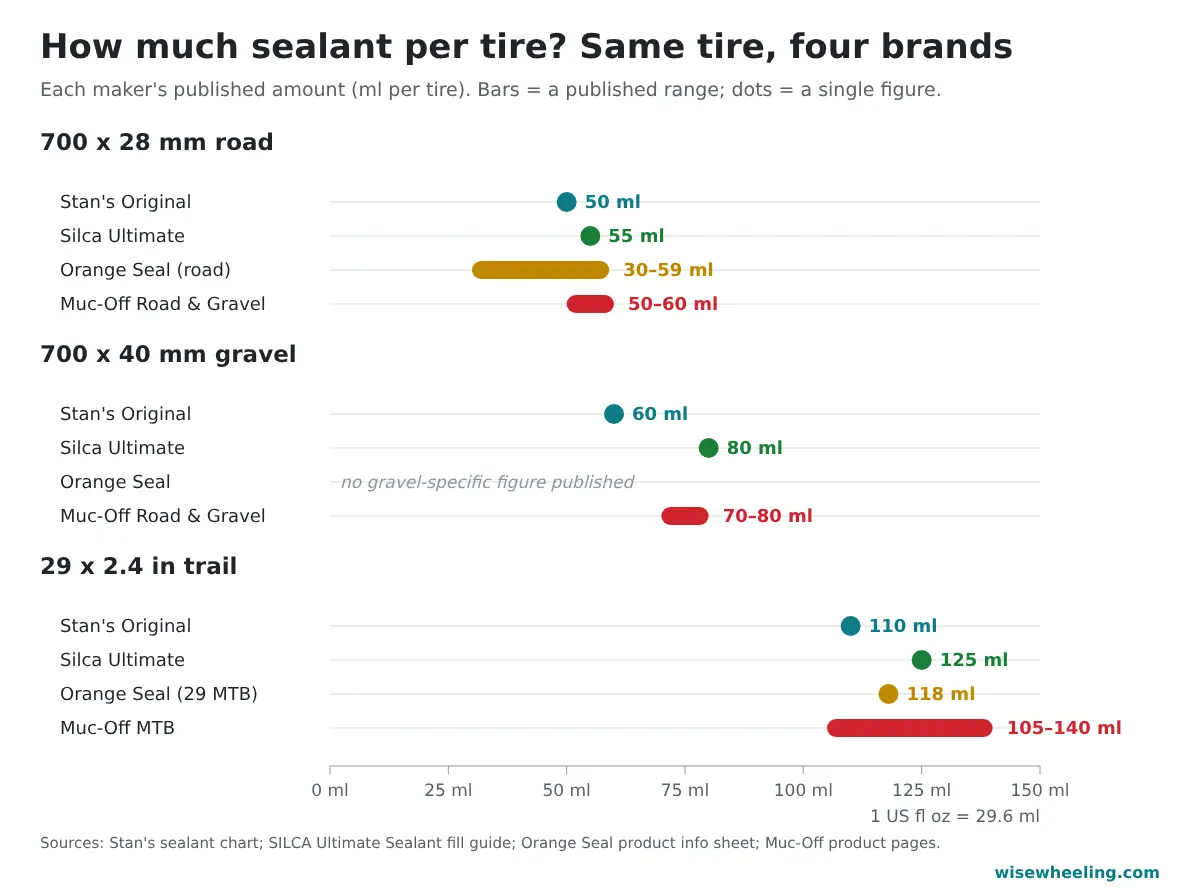
Most road and gravel tubeless tires take 1.5–2.5 oz (about 50–80 ml) of sealant, and a 29-inch trail tire takes about 3.5–4 oz (100–125 ml). The exact number depends on which sealant you pour in, because every maker publishes its own chart and they don’t agree. Stan’s says 60 ml for a 700 x 40 mm gravel tire, SILCA says 80 ml for the same size. Use the chart for the sealant in your hand, not a number you read somewhere else.
Below are the official per-tire amounts from four sealant makers side by side, a calculator that reads your brand’s chart for your tire size and tells you how many tires your bottle covers, and how often each brand says to top up.
How much sealant per tire, by brand and tire size
Every number here comes from the maker’s own chart, product page or product info sheet. A dash means that brand doesn’t publish a figure for that size. Find your size on the sidewall (for example 700x40c or 29×2.4; our bike tire size chart decodes the markings).
| Tire size | Stan’s Original / Race Day | Stan’s Rolled Gold | SILCA Ultimate | Orange Seal | Muc-Off |
|---|---|---|---|---|---|
| 700 x 28 mm (road) | 50 ml (1.7 oz) | 35 ml (1.2 oz) | 55 ml (1.85 oz) | 1–2 oz (road) | 50–60 ml |
| 700 x 32 mm | 55 ml (1.8 oz) | 40 ml (1.3 oz) | 65 ml (2.1 oz) | – | 70–80 ml (30–45c gravel) |
| 700 x 40 mm (gravel) | 60 ml (2 oz) | 50 ml (1.7 oz) | 80 ml (2.7 oz) | – | 70–80 ml |
| 700 x 45 mm | 80 ml (2.7 oz) | 60 ml (2 oz) | 90 ml (3.0 oz) | – | 70–80 ml |
| 700 x 50 mm | 95 ml (3.2 oz) | 70 ml (2.4 oz) | 100 ml (3.4 oz) | – | – |
| 650b x 47 mm (road plus / gravel) | 80 ml (2.7 oz) | 60 ml (2 oz) | 90 ml (3.0 oz) | – | – |
| 29 x 2.2″ | 100 ml (3.4 oz) | 75 ml (2.5 oz) | – | 4 oz (29″ MTB) | 105–140 ml (29″ MTB) |
| 29 x 2.3″ | 105 ml (3.5 oz) | 80 ml (2.7 oz) | – | 4 oz | 105–140 ml |
| 29 x 2.4″ | 110 ml (3.7 oz) | 80 ml (2.7 oz) | 125 ml (4.2 oz) | 4 oz | 105–140 ml |
| 29 x 2.5″ | 125 ml (4.2 oz) | 85 ml (2.9 oz) | – | 4 oz | 105–140 ml |
| 29 x 2.6″ | – | – | 135 ml (4.55 oz) | 4 oz | 105–140 ml |
| 27.5 x 2.3″ | 100 ml (3.4 oz) | – | – | 3 oz (27.5″ MTB) | 60–75 ml (26″/27.5″ MTB) |
| 27.5 x 2.4″ | 105 ml (3.5 oz) | – | – | 3 oz | 60–75 ml |
| 27.5 x 2.5″ | 110 ml (3.7 oz) | – | – | 3 oz | 60–75 ml |
| 26 x 1.95–2.0″ | 80 ml (2.7 oz) at 1.95″ | – | 95 ml (3.15 oz) at 2.0″ | 3 oz (26″ MTB) | 60–75 ml |
| 26 x 4.0″ (fat) | 175 ml (5.9 oz) | – | – | 6–8 oz (fat) | – |
Tubeless sealant calculator
Pick your sealant, wheel size and the width printed on the tire. The tool returns that brand’s published amount, the total for however many tires you’re filling, and whether your bottle is big enough.
How it works: at a size the brand lists, you get its exact number. Between two listed sizes less than 15 mm apart (Stan’s and SILCA charts only), the tool draws a straight line between them and rounds to 5 ml. That’s our estimate, not the brand’s. Orange Seal and Muc-Off publish categories, not per-width charts, so the tool returns their category amount or tells you the size isn’t covered. Bottle math uses the top of any range.
Why the brands give different amounts
Look at a 700 x 40 mm gravel tire: Stan’s Original says 60 ml, Muc-Off says 70–80 ml and SILCA says 80 ml. That’s a third more for the same tire. On a 29 x 2.4″ trail tire the spread is smaller (110 ml from Stan’s, 118 ml for Orange Seal’s 4 oz, 125 ml from SILCA), but Muc-Off’s range runs all the way from 105 to 140 ml.
Nobody’s wrong. Each company has tested how much of its own fluid it takes to coat a casing and keep enough liquid in reserve to seal holes. The formulas really do differ, and you can see it inside one brand: Stan’s Rolled Gold is listed at 80 ml for a 29 x 2.4″, while Stan’s Original is 110 ml for the same tire. Italian maker Effetto Mariposa goes lower still. Its Caffélatex page gives 60 ml for a 29 x 2.10 and 30 ml for a 700 x 25c, though its Végétalex page puts the Caffélatex minimum for that 29 x 2.10 at 70 ml.
So here’s the mistake to avoid: don’t use one brand’s number with another brand’s fluid. Put Rolled Gold amounts into a tire running Stan’s Original and you’ve shorted it by about a quarter. Read the chart for the bottle you’re pouring.
When to use more than the chart says
- Your casing is thin or porous. Stan’s says that because casings vary widely between manufacturers, some tires need more than its chart. It also notes that more porous tires may need a sealant refresh shortly after the first setup. They soak up fluid as they seal the casing.
- It’s a brand-new tire. SILCA’s FAQ suggests adding an extra ounce (about 30 ml) on the first install of a new tire.
- You want more puncture protection. Muc-Off says you can add up to 20 ml more on road and gravel tires and up to 30 ml more on MTB tires.
- Your tire is between two chart sizes. Round up to the next listed size rather than down. Too little sealant does nothing for you. As Effetto Mariposa puts it, too little “is utterly pointless as punctures will still occur.”
More isn’t always better, though. Extra sealant is extra rotating weight, and it doesn’t fix a leak that sealant can’t fix. If a tire keeps going soft with plenty of liquid inside, the problem is usually the rim tape, valve or bead. Our guide to a tubeless tire losing air overnight walks through those checks in order.
How often to add sealant (each brand’s own interval)
Sealant dries out inside the tire, so the amount you put in on day one won’t stay there. Here’s what each maker says about how long it lasts.
| Sealant | How long it lasts / when to check | Notes from the maker |
|---|---|---|
| Stan’s Original | Average 2–6 months; check or refresh every three months | Depends on heat, humidity, how often you ride, storage (cooler is better) and casing thickness |
| Stan’s Race | Inspect about every 2–3 weeks | Can’t be injected through the valve; break the bead and pour it in |
| SILCA Ultimate | Reinstall every 6 months for best results | Add about 1 oz extra on a new tire’s first install |
| Orange Seal Regular | 30–45 days average life | Same fill amounts across all three formulas |
| Orange Seal Endurance | 60–120 days average life | Rated for longer life between top-offs |
| Orange Seal Subzero | 60–180 days average life | Made for very cold riding |
For US riders that range matters. Stan’s lists temperature, humidity and storage as factors (cooler is better), so a bike that lives in a hot Arizona or Texas garage should be checked toward the short end of these windows. When in doubt, check. Pull the valve core and dip the tire (Orange Seal has been including a dipstick with its 4 oz and 8 oz injector bottles), or take a peek with the bead popped off at the valve.
How to measure and add sealant through the valve
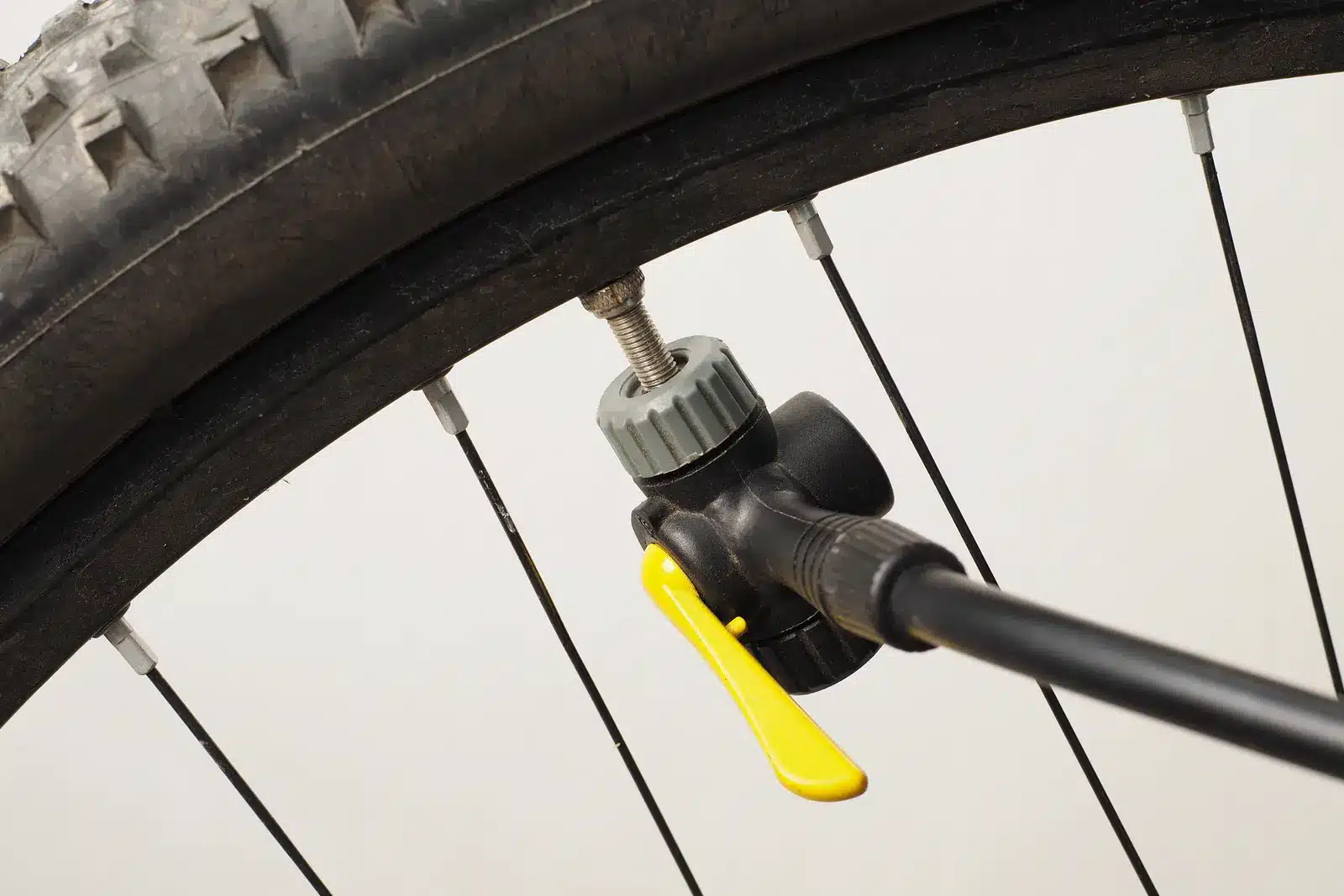
- Look up your number first. Use the table or calculator above for the exact sealant you’re using. Shake the bottle hard; Stan’s notes its sealing crystals settle.
- Let all the air out before you touch the core.
- Remove the valve core with a core tool. Your valve needs a removable core; see our tubeless valve size guide if you’re replacing one.
- Measure with a graduated injector, not by guessing from a bottle. A 4 oz bottle is about 118 ml, so “half a bottle” is close enough for a 700 x 40 with Stan’s (60 ml) but well short for SILCA (80 ml).
- Inject, reinstall the core and inflate. Then spin and tilt the wheel so the sealant coats the whole casing and the bead.
- Ride it soon. Riding spreads the sealant into the casing and seals tiny leaks. Recheck pressure the next morning.
One exception: Stan’s Race sealant can’t be injected through the valve. Stan’s says to break the bead and pour it in.
What you need
- A graduated injector: Stan’s Tubeless Tire Sealant Injector (check the current price on Amazon).
- A valve core tool: Park Tool Valve Core Remover.
- Sealant in a bottle big enough for both tires (the calculator tells you): Stan’s NoTubes Original, Orange Seal Endurance, SILCA Ultimate Tubeless Sealant, Muc-Off Road & Gravel or Muc-Off MTB.
Not sure which formula fits your riding? Our best tubeless sealant for mountain bikes guide compares them by climate and trail type.
Tubeless sealant FAQ
Is 2 oz of sealant enough?
For road and most gravel tires, yes, or close to it. 2 oz is about 59 ml, which covers Stan’s figures up to a 700 x 40 mm tire (60 ml). It’s short for a 700 x 45 mm (80 ml on Stan’s chart) and for any 27.5″ or 29″ mountain tire, where every brand lists more.
How much sealant for a 29er?
Roughly 100–125 ml (3.4–4.2 oz) per tire for typical 2.2–2.5″ trail tires. Orange Seal lists 4 oz for any 29″ mountain tire, Stan’s Original lists 100 ml for a 29 x 2.2″ up to 125 ml for a 29 x 2.5″, and SILCA lists 125 ml for a 29 x 2.4″.
How many tires does one bottle fill?
Stan’s lists a minimum bottle size for two tires: 125 ml for 700 x 28–40 mm, 250 ml for most 29″ and 27.5″ trail sizes, and 500 ml for 2.8″ and wider. The calculator above does the math for your bottle and tire.
Can I put sealant in a tube?
Stan’s says yes, if the tube has a removable valve core, and recommends 1–2 oz (30–60 ml) for tubes or tubulars.
Does sealant freeze in winter?
Stan’s says anti-freeze agents let its sealant work down to -20°F (-28.8°C). For colder riding, Orange Seal makes Subzero specifically for frigid temperatures.
Suryashankar Dasgupta founded Wise Wheeling. He has been cycling for more than 20 years, on geared and single-speed bikes, across many kinds of terrain. His guides cover bike repair, fit and gear, and each one is checked against manufacturer manuals, Park Tool and other primary sources before it’s published. Read how guides are made: https://wisewheeling.com/editorial-policy/