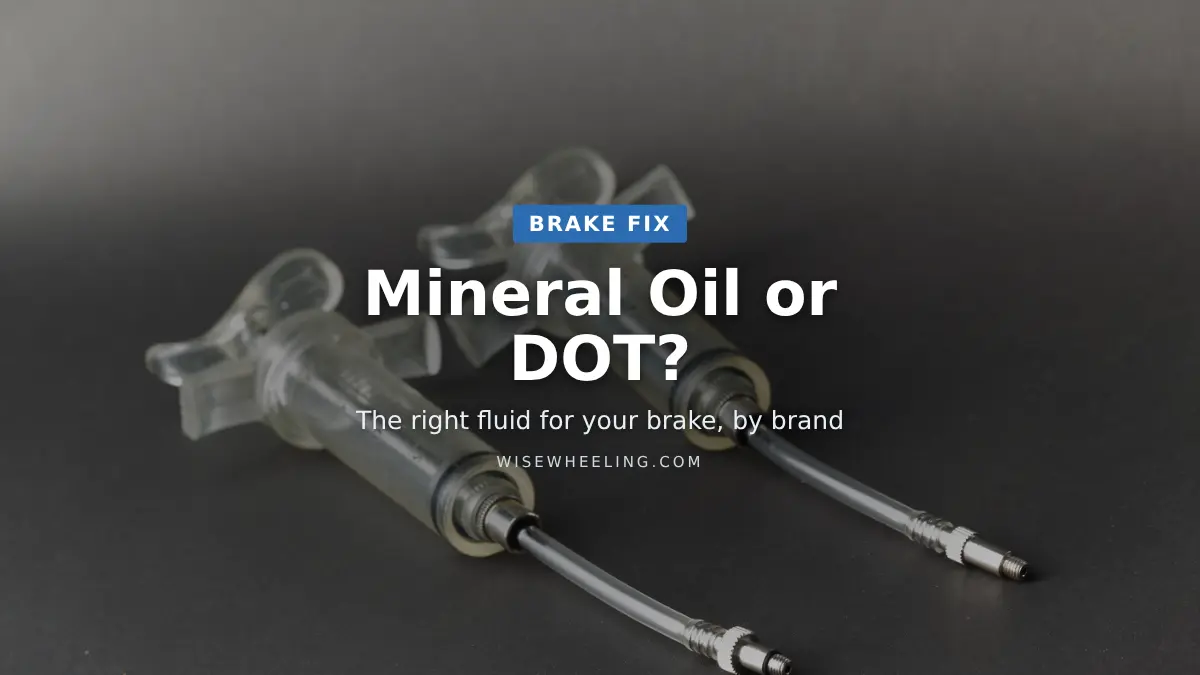
Mineral Oil vs DOT Brake Fluid: Which One Does Your Bike Use?
This post contains Amazon affiliate links. As an Amazon Associate I earn from qualifying purchases, at no extra cost to you.
Your bike takes whichever fluid the brake maker designed it for, and the two families never mix. Shimano, Magura, TRP/Tektro and SRAM’s newer Maven, Motive and DB mountain brakes run on mineral oil. SRAM Level, Guide, G2, Code and its road hydraulic brakes, plus Hope and Hayes, use DOT 5.1 (SRAM and Hope also accept DOT 4). Find your brake in the table below. If it isn’t there, read the marking on the lever or caliper before you open anything, because the wrong fluid ruins the seals.
Which brake do you have? Fluid by brand and model
Start with the brand and model name on your lever or caliper (or your bike’s spec sheet), then read across. The “How to spot it” column covers what you can see on the bike.
| Brake | How to spot it | Fluid it takes | Never put in |
|---|---|---|---|
| Shimano XTR M9200 / M9220, XT M8200 / M8220, BR-MT805 | Model number on the lever (BL-M9200, BL-M9220, BL-M8200) or caliper (BR-M9200, BR-M9220, BR-M8200, BR-M8220, BR-MT805) | Shimano Low Viscosity mineral oil | Standard Shimano mineral oil, DOT fluid |
| Every other Shimano hydraulic disc brake | Shimano BL-/BR- model number not in the row above | Shimano (standard) hydraulic mineral oil | Shimano Low Viscosity oil, DOT fluid |
| SRAM Maven, Motive, DB8, DB6, DB4 | Model name on the lever or caliper | Maxima Mineral Brake Oil (SRAM’s mineral oil) | DOT fluid, other brands’ mineral oil |
| SRAM Level, Guide, G2, Code | Model name on the lever or caliper | DOT 5.1 or DOT 4 | Mineral oil, DOT 5 (silicone) |
| SRAM road and gravel hydraulic (Red, Force, Rival, Apex AXS; eTap AXS; HydroR; S-300; S-900 Aero) | SRAM shifter/brake lever on drop bars | DOT 5.1 or DOT 4 | Mineral oil, DOT 5 (silicone) |
| Magura MT series | “MT” model name on the lever | Magura Royal Blood mineral oil | DOT fluid |
| TRP and Tektro hydraulic disc (e.g. EVO family, Trail EVO) | TRP or Tektro logo on lever or caliper | TRP/Tektro-branded mineral oil | DOT fluid |
| Hope (e.g. Tech 4) | Hope logo; RX4+ calipers are etched D (DOT) or M (mineral oil) | DOT 5.1 (or DOT 4); “M” RX4+ calipers take mineral oil | Mineral oil in a DOT Hope brake; DOT in an “M” caliper |
| Hayes Dominion | “Dominion” on the lever or caliper | DOT 5.1 | Mineral oil |
Brake fluid finder
Pick your brand and brake family. The finder tells you the fluid, what to keep out of the brake, and how often the maker says to bleed it.
The finder uses the same data as the table above (SRAM, Shimano, Magura, Hope, TRP and Hayes documents). Model lists change; if your brake is newer than the docs cited here, confirm on the maker’s site.
How to tell which brake fluid your bike uses
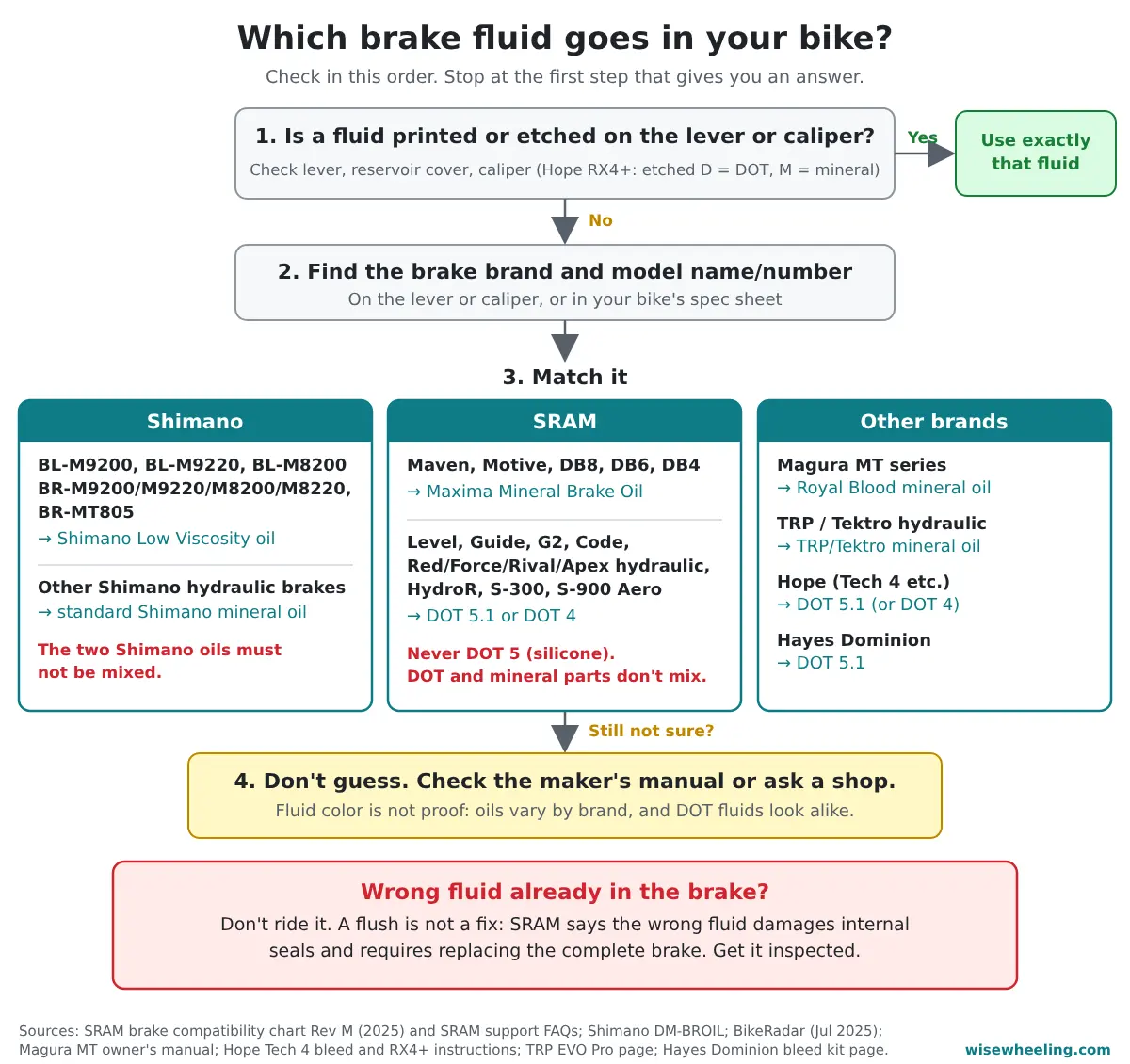
- Read the brake itself. The fluid type is usually printed somewhere on the lever or caliper (BikeRadar). Look at the reservoir cover, the lever body and the caliper. Hope’s RX4+ calipers, sold to pair with other brands’ levers, are etched with a D for DOT 4/5.1 or an M for mineral oil (Hope). If you find a marking, that’s your answer.
- Find the model. No marking? Get the brand and model name or number from the lever or caliper. Shimano uses BL- (lever) and BR- (caliper) codes, and that code matters more than the group name now that Shimano has two oils.
- Match it against the table or the finder above.
- Still unsure? Stop. Check the maker’s manual or ask a shop. Don’t go by color: each brand’s mineral oil is its own formula, and DOT 4 and 5.1 look alike.

One case trips people up: a bike that came with mismatched parts, like a Hope caliper on a Shimano lever. The whole system has to run one fluid, and both parts must be rated for it. SRAM’s own chart puts it bluntly: “DOT and Mineral Oil components are not compatible.”
Mineral oil vs DOT brake fluid: what’s actually different
Neither fluid is “better” in a way that lets you pick. The brake’s seals are made for one of them. The differences matter for upkeep, though, and they explain why the bleed schedules differ so much.
| Mineral oil | DOT 4 / DOT 5.1 | |
|---|---|---|
| Base | Mineral oil; each brand makes its own (Shimano, Magura Royal Blood, SRAM/Maxima, TRP/Tektro) | Glycol-based fluid made to the federal FMVSS 116 standard, so any maker’s DOT 4 or 5.1 meets the same minimums |
| Water | Doesn’t absorb moisture (SRAM) | Hygroscopic: absorbs moisture once opened, which is why SRAM says to buy small bottles |
| Boiling point | Varies by brand; no common standard | Minimum dry/wet: DOT 4 446°F / 311°F (230/155°C); DOT 5.1 500°F / 356°F (260/180°C) |
| Paint | Generally harmless to paint (bike-components), but wipe spills anyway | Can damage painted surfaces if left on them (Hope) |
| Bleed interval | SRAM: at least every 2 years (DB8). Magura: only when needed | SRAM: at least once a year. Hope: shouldn’t need more than once a year |
| Can you swap brands? | No. Use the brake maker’s own oil | Yes, between DOT 4/5.1 makers in brakes rated for both (SRAM) |
The moisture point is the big practical one. DOT fluid pulls in water over time, and the wet boiling point is the number that tells you what’s left after that happens. That’s why DOT brakes get the shorter interval. Mineral oil doesn’t absorb water, so SRAM gives its mineral brakes a longer interval, and Magura says Royal Blood doesn’t age at all.
Shimano now has two mineral oils, and they don’t mix
Most guides still say “Shimano uses mineral oil” and stop there. Shimano’s newest XTR and XT brakes changed that. The BL-M9200, BL-M9220 and BL-M8200 levers and the BR-M9200, BR-M9220, BR-M8200, BR-M8220 and BR-MT805 calipers use Shimano Low Viscosity mineral oil. Shimano says the two oils are not interchangeable. Its oil manual warns that mixing them may stop the brakes from working and could cause serious injury (Shimano DM-BROIL; BikeRadar).
The hose, connector insert, flare nut, olive and Shimano’s TL-BR001 and TL-BR003 bleed tools work with either oil, BikeRadar reports. Levers and calipers don’t, because their seals are specified for one oil or the other. So you can’t mix generations on one brake, like a new M8200 lever on an older M8100 caliper. And if you bought “Shimano mineral oil” for a brand-new XT brake, check the bottle before you bleed.
Can I use car brake fluid on my bicycle?
Only in a DOT brake, and only DOT 4 or DOT 5.1. SRAM says any maker’s DOT 4 or 5.1 is fine in its DOT brakes because all of it is made to the federal FMVSS standard. Hope’s older manuals even point riders to auto-parts stores for DOT 5.1. Three rules apply:
- Never in a mineral oil brake. Shimano, Magura, TRP/Tektro and SRAM Maven/Motive/DB brakes are ruined by DOT fluid.
- Never DOT 5. Despite the name, it’s silicone-based, not a stronger DOT 5.1. SRAM says DOT 5 damages the internals of its brakes. Federal rules require DOT 5 silicone fluid to be dyed purple, so a purple fluid is a red flag.
- Open a fresh, small bottle. DOT fluid absorbs moisture once the seal is broken. A half-used quart that’s been in the garage since last summer isn’t a fluid you want in your brakes.
What happens if you put the wrong fluid in your brakes?
The brake makers agree: it’s a parts problem, not a flushing problem. SRAM says using anything other than DOT 4 or 5.1 in its DOT brakes “will contaminate your brake system, causing damage to the internal seals and requiring the replacement of the complete brake” (SRAM). Hope says its RX4+ DOT calipers work only with DOT 4 or 5.1 and any other fluid “will result in brake failure.” Shimano’s user manuals warn that other oils can make the system unusable. Magura’s manual says to never use DOT fluid.
If you’ve already done it, don’t ride the bike. Take the brake to a shop and tell them exactly what went in. If fluid got on the pads or rotor, the pads are done too. Hope’s troubleshooting lists brake fluid contamination as a cause of poor pad performance (more on that in why disc brakes squeal and when to replace disc brake pads).
What you need before you bleed
Buy the exact fluid your brake takes and keep a separate bleed kit for each fluid type. SRAM, for example, says its DB8 is designed for use with the SRAM Mineral Oil Bleed Kit only.
- Standard Shimano brakes: Shimano SM-DB-OIL mineral oil
- Shimano XTR M9200/M9220, XT M8200/M8220: Shimano SM-LVOIL Low Viscosity mineral oil
- SRAM Maven, Motive, DB: SRAM Maxima Mineral Brake Oil
- SRAM Level, Guide, G2, Code and road: SRAM DOT 5.1 brake fluid (4 oz is plenty)
- Magura: Magura Royal Blood
- Hayes Dominion: Hayes DOT 5.1 brake fluid
- For any bleed: nitrile gloves and safety glasses (Hope’s bleed instructions recommend gloves and protective glasses), plus clean rags
Check the current price on Amazon before you order. Not sure a bleed will even fix your problem? A lever that comes back to the bar has other causes too. Work through brake lever pulls to the handlebar first, and if the brake drags instead, see how to fix a rubbing disc brake.
Brake fluid FAQ
Can you use DOT fluid in Shimano brakes?
No. Shimano hydraulic brakes take only Shimano mineral oil, and the newest XTR/XT models take only Shimano Low Viscosity oil. Shimano’s manuals warn that other oils can make the brake system unusable.
Can I use Shimano mineral oil in SRAM, Magura or Tektro brakes?
Not according to those makers. SRAM says its mineral brakes need Maxima Mineral Brake Oil. It hasn’t tested other mineral oils, and damage from them isn’t covered under warranty. Magura says to use Royal Blood exclusively. TRP/Tektro says to use only TRP/Tektro-branded mineral oil. In SRAM’s DOT brakes, mineral oil isn’t an option at all.
Is DOT 5.1 the same as DOT 5?
No. DOT 5.1 is glycol-based like DOT 4, with a higher boiling point. SRAM lists 500°F (260°C) for DOT 5.1 vs 446°F (230°C) for DOT 4. DOT 5 is silicone-based, and SRAM says it isn’t compatible with its brakes.
Can you mix DOT 4 and DOT 5.1?
SRAM rates its DOT brakes for either DOT 4 or DOT 5.1, and Hope’s Tech 4 instructions say DOT 5.1 or DOT 4. If you’re switching from one to the other, do a full bleed rather than a top-up. Hope’s older manuals say to flush out all the old DOT 5.1 before switching to DOT 4.
Does mineral oil go bad?
Magura says Royal Blood doesn’t age, so it only needs a bleed when the lever feels wrong. SRAM still recommends a full bleed with fresh oil at least every two years on its DB8 mineral brakes, sooner with heavy braking or sub-freezing riding. Follow your brake maker’s figure.
Sources
- SRAM, MTB and Road Hydraulic Disc Brake Lever and Caliper Compatibility (Rev M, 2025); support FAQs: DOT brake fluid type, other mineral oils, DOT 5, DOT 4 vs 5.1; DB8 and Motive product pages
- Shimano, DM-BROIL dealer’s manual (brake oil); BikeRadar, Shimano LV mineral oil (July 2, 2025)
- Magura, MT owner’s manual (multilingual, includes English)
- Hope, Tech 4 bleed instructions, RX4+ caliper instructions, disc brake service manual (older models)
- TRP, EVO Pro; Hayes, Dominion Pro Bleed Kit
- 49 CFR 571.116, FMVSS No. 116, motor vehicle brake fluids

Suryashankar Dasgupta founded Wise Wheeling. He has been cycling for more than 20 years, on geared and single-speed bikes, across many kinds of terrain. His guides cover bike repair, fit and gear, and each one is checked against manufacturer manuals, Park Tool and other primary sources before it’s published. Read how guides are made: https://wisewheeling.com/editorial-policy/