Bike Gear Ratio Calculator: Is Your Low Gear Low Enough?
This post contains Amazon affiliate links. As an Amazon Associate I earn from qualifying purchases, at no extra cost to you.
Your bike’s gear ratio is simply chainring teeth divided by rear cog teeth, so a 34×34 is 1.00 and a 50×11 is 4.55. Multiply that by your wheel’s diameter and you get gear inches, the number that lets you compare any two bikes, and gear inches × cadence ÷ 336 gives your speed in mph. If you’re grinding up your steepest climb in your lowest gear, the fix is a gear that’s lower by the ratio of the cadence you have to the cadence you want: 55 rpm when you want 70 means a gear about 21% lower. The calculator below does all of that, plus works out which cog or chainring gets you there.
Bike gear ratio calculator: compare two gears and find the cog you need
Set your rim size and tire width once, then enter your current low gear as Gear A and a setup you’re considering as Gear B. Put the cadence you actually see on your hardest climb in “Your cadence” and the cadence you’d like to hold in “Target cadence”.
| Result | Gear A | Gear B |
|---|
How it works: wheel diameter = 0.99 × (rim bead seat diameter + 1.98 × tire width), the same rollout-corrected method used in Sheldon Brown’s gear calculator. Gear inches = chainring ÷ cog × diameter in inches; development = gear inches × π in meters; gain ratio = gear ratio × wheel radius ÷ crank length (from Sheldon Brown’s gain-ratio article); speed (mph) = gear inches × rpm ÷ 336.1. The “you need” line uses new gear = current gear × current rpm ÷ target rpm, because at the same road speed cadence and gear size trade off one for one. Real tires vary by a percent or two with pressure and tread.
How low is your lowest gear? Road, gravel and MTB compared
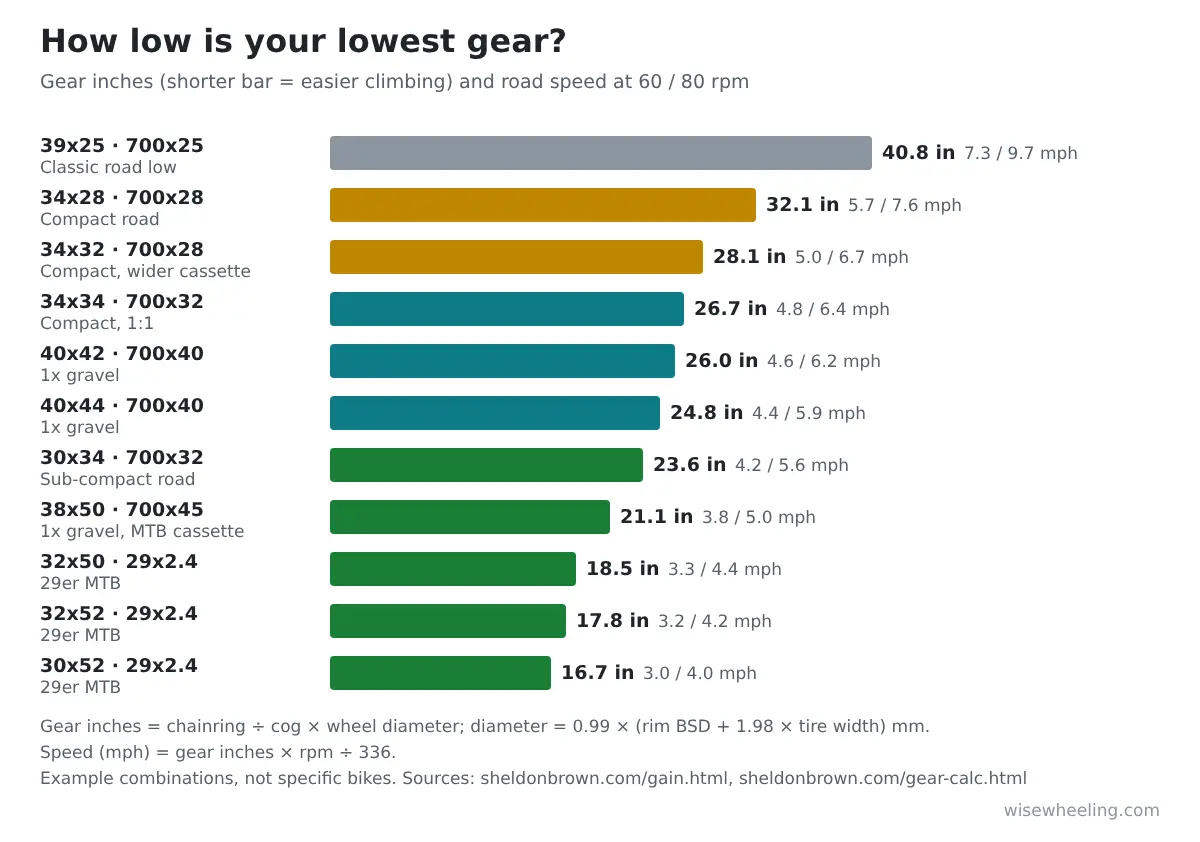
Tooth counts alone hide a lot, because gravel and mountain bikes run bigger tires. Here are common low-gear combinations worked out with the tire each one usually wears. A lower gear-inch number is an easier gear.
| Low gear | Tire | Typical use | Ratio | Gear inches | Development (m) | mph @ 60 rpm | mph @ 80 rpm |
|---|---|---|---|---|---|---|---|
| 39×25 | 700×25 | Classic road low | 1.56 | 40.8 | 3.26 | 7.3 | 9.7 |
| 34×28 | 700×28 | Compact road | 1.21 | 32.1 | 2.56 | 5.7 | 7.6 |
| 34×32 | 700×28 | Compact, wider cassette | 1.06 | 28.1 | 2.24 | 5.0 | 6.7 |
| 34×34 | 700×32 | Compact, 1:1 | 1.00 | 26.7 | 2.13 | 4.8 | 6.4 |
| 40×42 | 700×40 | 1x gravel | 0.95 | 26.0 | 2.08 | 4.6 | 6.2 |
| 40×44 | 700×40 | 1x gravel | 0.91 | 24.8 | 1.98 | 4.4 | 5.9 |
| 30×34 | 700×32 | Sub-compact road | 0.88 | 23.6 | 1.88 | 4.2 | 5.6 |
| 38×50 | 700×45 | 1x gravel, MTB-range cassette | 0.76 | 21.1 | 1.68 | 3.8 | 5.0 |
| 32×50 | 29×2.4 | 29er MTB | 0.64 | 18.5 | 1.48 | 3.3 | 4.4 |
| 32×52 | 29×2.4 | 29er MTB | 0.62 | 17.8 | 1.42 | 3.2 | 4.2 |
| 30×52 | 29×2.4 | 29er MTB | 0.58 | 16.7 | 1.33 | 3.0 | 4.0 |
A few things jump out. A 1x gravel bike with a 40×44 is only about 7% lower than a road compact’s 34×34 once you account for its 40 mm tires, so a switch from 2x to 1x can add less climbing range than the cog sizes suggest. The real step change comes from MTB-range cassettes: a 38×50 on 700×45 sits around 21 gear inches, and a 29er with 32×52 is near 18. Sheldon Brown wrote that the lowest gear on most mountain bikes was around 22–26 inches; today’s 50–52T cassettes go well below that.
How much easier does one bigger cog or smaller chainring make it?
Each change lowers your easiest gear by 1 − (new ratio ÷ old ratio). This is the number to look at before you spend money, because a single tooth matters much less on a big cog than on a small one.
| Change | Held constant | How much lower |
|---|---|---|
| Cog 28 → 32T | 34 ring | 12.5% |
| Cog 32 → 34T | 34 ring | 5.9% |
| Cog 34 → 36T | 34 ring | 5.6% |
| Cog 42 → 44T | 40 ring | 4.5% |
| Cog 50 → 52T | 32 ring | 3.8% |
| Ring 34 → 31T | 34T cog | 8.8% |
| Ring 40 → 38T | 44T cog | 5.0% |
| Ring 32 → 30T | 52T cog | 6.3% |
Two steps up the back is usually only 5–6% each at the big end of a cassette. If your calculator result says you need 20% lower, no single cog swap gets you there; you’re looking at a new cassette range, smaller chainrings, or both.
Is it time for an easier climbing gear?
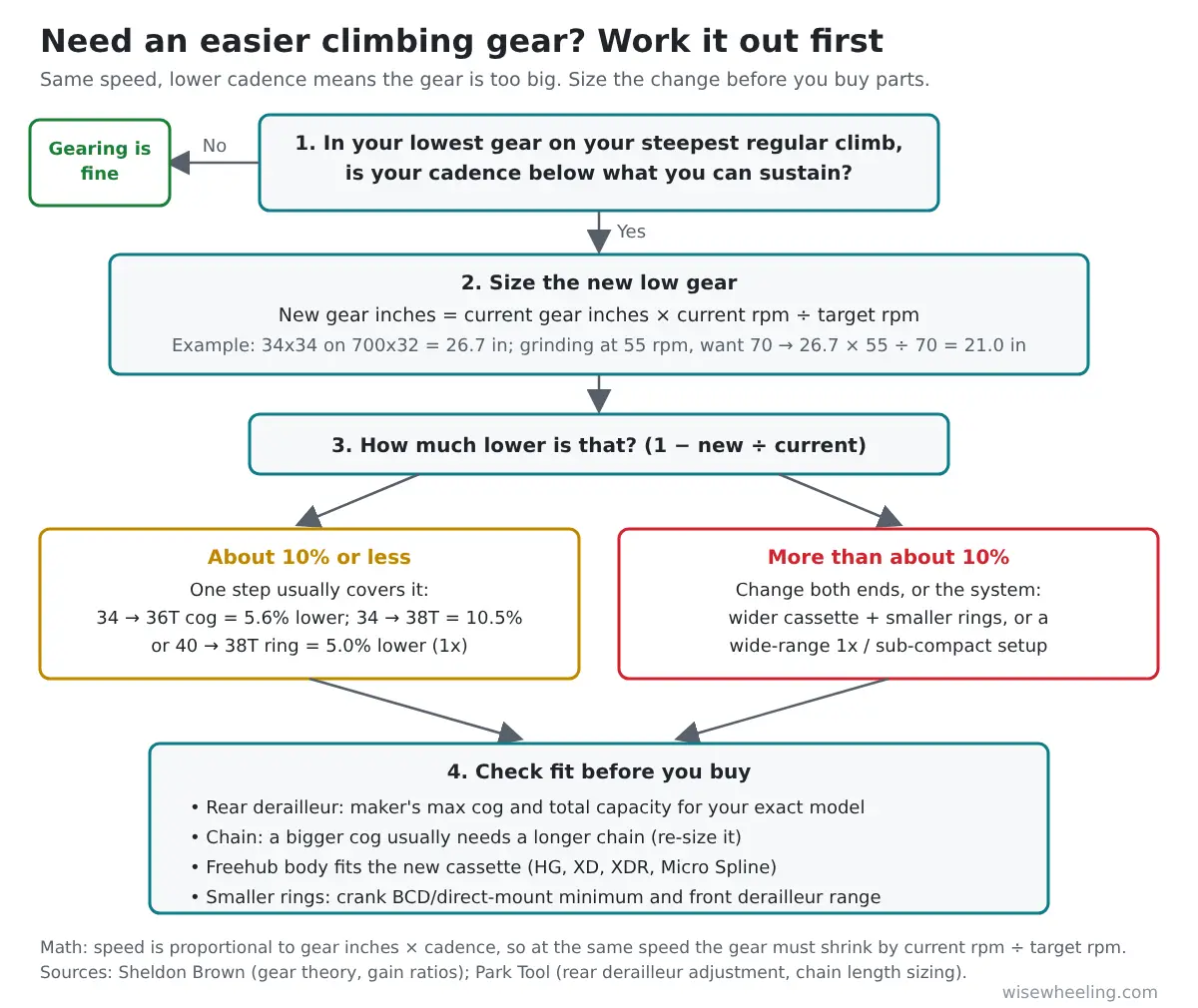
The honest test is your cadence in your lowest gear on the steepest climb you ride regularly. There’s no single right number for everyone; Sheldon Brown’s point in his gear theory article is that your low gear should be low enough that you don’t have to drop your cadence even when the bike slows to a crawl. As a practical reference, Roadman Cycling suggests 70–85 rpm on sustained climbs and treats a climbing cadence that’s consistently below 60 rpm as a sign the gearing is too big.
- Measure, don’t guess. Ride your benchmark climb in your lowest gear and note your cadence. A head unit with a cadence sensor makes this easy; the Wahoo RPM cadence sensor and Garmin Bike Cadence Sensor 2 are common choices (check the current price on Amazon). Without one, count right-foot pedal strokes for 15 seconds and multiply by 4.
- Size the new gear. New gear inches = current gear inches × current rpm ÷ target rpm. Example: 34×34 on 700×32 is 26.7 in; at 55 rpm with a 70 rpm target you need 26.7 × 55 ÷ 70 = 21.0 in, roughly what the 38×50 gravel setup in the table gives.
- Pick the cheapest change that gets there. Use the step table above. Up to about 10% is often one cassette or one chainring swap; more than that usually means changing the cassette range and the rings.
- Check fit before ordering. See the next section; this is where most “bigger cassette” upgrades go wrong.
Before you fit a bigger cassette or smaller chainring
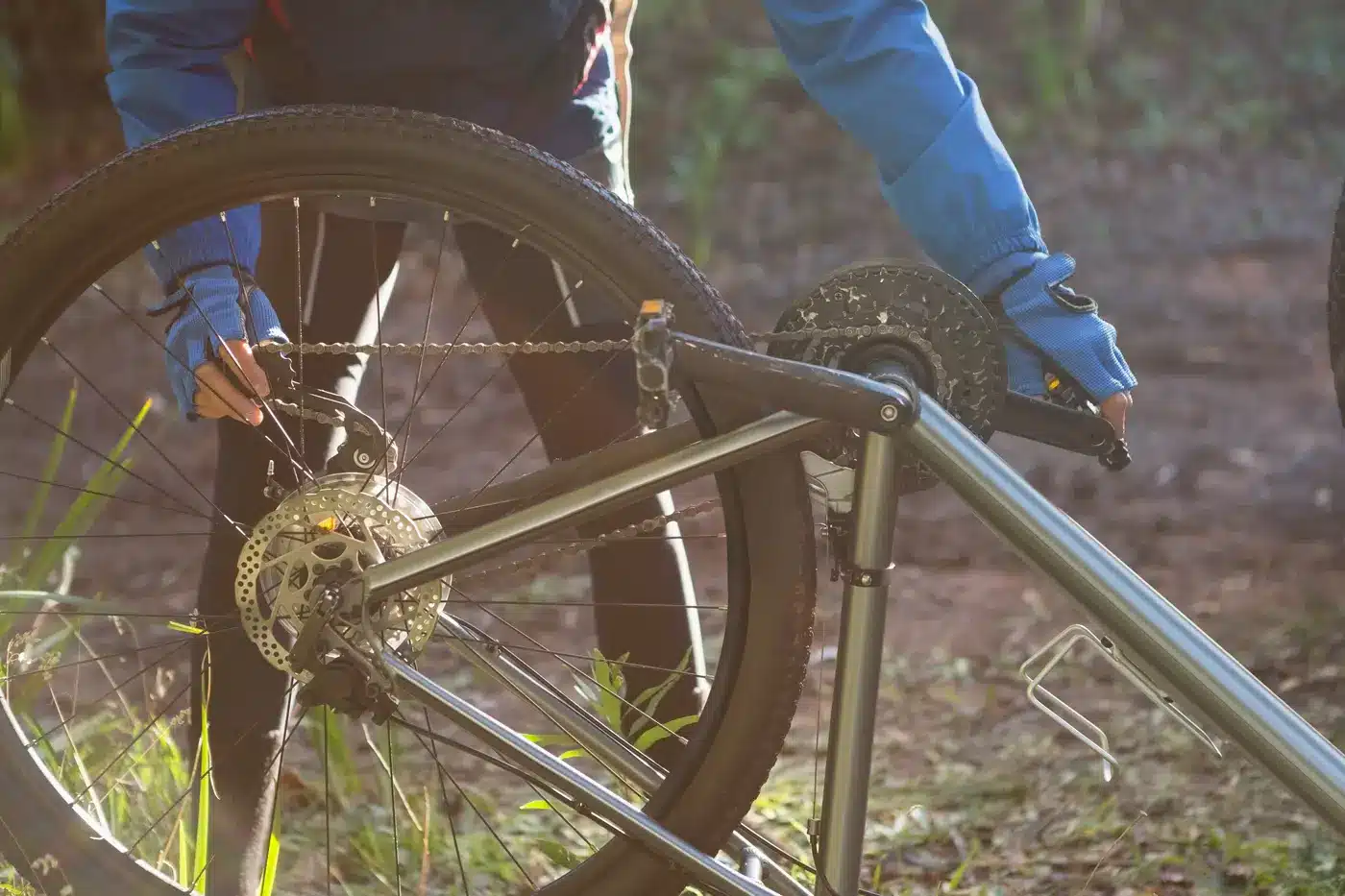
- Rear derailleur limits. Every derailleur has a maximum largest cog and a total capacity set by its maker. Look up the spec for your exact model number (it’s printed on the derailleur body) before buying a wider cassette; don’t go by what a friend’s bike runs.
- Chain length. A bigger largest cog needs more chain. Park Tool’s chain sizing guide uses largest ring + largest cog + two rivets for cassettes up to 36T, and largest cog with a shortest joining point plus four rivets for 1x systems with 42T and bigger cogs. Our chain length calculator walks through each method.
- Freehub body. Cassettes with 10T cogs need an XD, XDR or Micro Spline driver rather than a standard HG body. Check yours with our freehub body guide.
- B-tension and indexing. After a cassette change, reset the guide pulley gap on the largest cog; Park Tool says most road and mountain derailleurs want 5–6 mm. Then re-index using our rear derailleur indexing steps.
- Smaller chainrings. Your crank’s bolt circle or direct-mount standard sets the smallest ring it can take, and on a 2x the front derailleur has its own capacity and minimum ring size. Again, the maker’s spec for your model is the only reliable source.
Does tire size change your gearing?
Gear ratio, no. Gear inches and speed, yes. A taller tire makes every gear slightly harder, which matters when you switch wheel sizes or go much wider. Here’s the same 34×34 on different tires (see our bike tire size chart if you’re not sure of your rim’s bead seat diameter).
| Tire | BSD / width | Diameter (in) | Circumference (mm) | 34×34 gear inches | vs 700×28 |
|---|---|---|---|---|---|
| 700×25 | 622 / 25 mm | 26.2 | 2088 | 26.2 | -0.9% |
| 700×28 | 622 / 28 mm | 26.4 | 2107 | 26.4 | baseline |
| 700×32 | 622 / 32 mm | 26.7 | 2132 | 26.7 | +1.2% |
| 700×40 | 622 / 40 mm | 27.3 | 2181 | 27.3 | +3.5% |
| 700×45 | 622 / 45 mm | 27.7 | 2212 | 27.7 | +5.0% |
| 650b x 47 | 584 / 47 mm | 26.4 | 2106 | 26.4 | -0.1% |
| 27.5 x 2.4 | 584 / 61 mm | 27.5 | 2192 | 27.5 | +4.0% |
| 29 x 2.4 | 622 / 61 mm | 29.0 | 2310 | 29.0 | +9.6% |
The useful takeaway: a 650b x 47 mm gravel tire has almost exactly the same outside diameter as a 700×28 road tire, so swapping a gravel bike to 650b “road plus” wheels makes every gear about 5% lower than the same bike on 700×45. Going from 700×28 to a 29×2.4 mountain tire raises every gear by nearly 10%.
Top gear: will you spin out?
At the other end, what matters is speed at a high cadence. This is also where 10T cogs earn their keep: a 46×10 is within about 1% of a 50×11, so a smaller chainring paired with a 10T cog doesn’t cost top-end speed.
| Top gear | Ratio | Gear inches (700×28) | mph @ 90 rpm | mph @ 110 rpm |
|---|---|---|---|---|
| 50×11 | 4.55 | 120.0 | 32.1 | 39.3 |
| 52×11 | 4.73 | 124.8 | 33.4 | 40.8 |
| 46×10 | 4.60 | 121.5 | 32.5 | 39.7 |
| 48×10 | 4.80 | 126.7 | 33.9 | 41.5 |
| 40×10 | 4.00 | 105.6 | 28.3 | 34.6 |
| 42×10 | 4.20 | 110.9 | 29.7 | 36.3 |
| 44×10 | 4.40 | 116.2 | 31.1 | 38.0 |
On a 1x gravel bike, a 40×10 tops out around 35 mph at 110 rpm. Compare that with the speeds you actually pedal at on descents before deciding a 1x top gear is too low.
Gear inches vs gain ratio vs development: which number to use
- Gear ratio (chainring ÷ cog): fine for comparing gears on the same bike, useless across different wheel sizes.
- Gear inches: ratio × wheel diameter. The standard US number, and the one most forum advice uses. Includes tire size.
- Development (meters): how far the bike rolls per crank turn. Same information as gear inches in metric (gear inches × 0.0798).
- Gain ratio: also includes crank length. As Sheldon Brown’s gain-ratio article notes, a bike with 175 mm cranks has about a 3% lower effective gear than the same gearing with 170 mm cranks. Use it when comparing bikes with different crank lengths.
If you’re curious how gravel bikes handle climbing beyond the gearing, our post on whether a gravel bike is good uphill covers weight, tires and position.
FAQ
What is a good gear ratio for climbing?
There isn’t one number for everyone; it depends on your weight, fitness, load and the grades you ride. Look at it from the cadence side: if you’re below the cadence you can sustain in your lowest gear, it’s too high. As a rough reference, Roadman Cycling suggests a lowest ratio above about 1.2 is likely too hard if you regularly ride 8%+ grades at under about 4 W/kg. A 34×34 is 1:1, and gravel or MTB-range setups go well below 1.0.
Is 34×34 low enough for gravel?
For a lot of riders, yes; it works out to about 26.7 gear inches on a 700×32 tire, or 27.7 on a 700×45. For long, steep or loaded climbs, the math shows why riders go to MTB-range cassettes: a 38×50 on 700×45 is about 21 gear inches, roughly 24% lower.
Is a higher gear ratio faster?
Only if you can turn it. Speed is gear inches × cadence, so a higher gear at a cadence you can’t hold is slower than a lower gear you can spin. Top-gear ratio only limits your top pedaling speed.
How do I calculate gear inches?
Divide chainring teeth by cog teeth and multiply by wheel diameter in inches. For a 700×28 tire, use about 26.4 in; for 700×32 about 26.7 in; for 29×2.4 about 29.0 in. Example: 50×11 on 700×28 = 4.55 × 26.4 = 120 gear inches.
Does a 10-tooth cog give a higher gear than an 11?
On the same chainring, yes, by 10%. That’s why 1x and some 2x systems pair smaller chainrings with a 10T cog: 46×10 (4.60) is almost the same as 50×11 (4.55).
Suryashankar Dasgupta founded Wise Wheeling. He has been cycling for more than 20 years, on geared and single-speed bikes, across many kinds of terrain. His guides cover bike repair, fit and gear, and each one is checked against manufacturer manuals, Park Tool and other primary sources before it’s published. Read how guides are made: https://wisewheeling.com/editorial-policy/